


The Ministry of National Defense yesterday released its quadrennial defense review (QDR) in which the ministry warned of a rising Chinese military threat, but omitted provocative wording that might anger Beijing.
The long-awaited report was the second published by the ministry, which is required by law to submit a QDR to the legislature within 10 months of every presidential inauguration.
While tensions across the Taiwan Strait have been at their lowest in six decades, China’s military threat remains strong because its strategy is to “rapidly end an island conflict and reduce the possibility of foreign interference.”
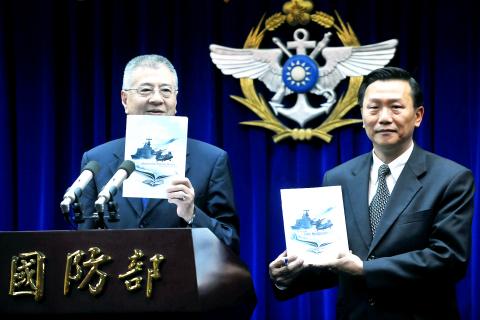
Photo: Mandy Cheng, AFP
China now possesses the ability to impose a partial blockade of Taiwan and to conduct “anti-access/area denial” operations in certain areas, the review said.
Minister of National Defense Kao Hua-chu (高華柱) held a briefing on the 70-page report — which was similar to the 2009 edition in its content, despite being dozens of pages shorter — to legislators yesterday morning.
Lawmakers questioned a number of points, including the ministry’s change of stance on proposed military confidence-building measures between Taiwan and China.
Kao said there is a lack of a public consensus on signing a cross-strait peace agreement and confidence-building measures, so a hasty move toward the initiatives would be risky.
The ministry’s position was different in 2009, when it appeared to be more positive about confidence-building measures.
Department of Strategic Planning Director-General Cheng Yun-peng (成雲鵬) said at a press conference yesterday afternoon that military mutual trust would be meaningless without mutual trust on political affairs, while Deputy Minister of National Defense Andrew Yang (楊念祖) said that the confidence-building measures should be seen as building blocks.
The ministry did not explain why the report does not mention asymmetrical warfare capability, a topic which occupied an entire chapter in the 2009 review, in which it was stated that Taiwan would “make decisive attacks” to counter China if necessary.
The report contained four chapters on the security environment and national defense challenges; national defense policy and strategic guidance; joint warfare capabilities and preparedness; as well as defense organization and transformation.
Lawmakers and observers were also concerned about the all-voluntary military service system, which the ministry had pledged to achieve by next year, but which it has now postponed until 2016 due to a lack of resources and a poor recruitment record.
The ministry said the military personnel target would be about 215,000 to avoid personnel shortages, despite recruitment having been hit hard by financial difficulties.
In response to a media report which, quoting Chinese Nationalist Party (KMT) Legislator Lin Yu-fang (林郁方), said the military is considering relaunching a domestic project to manufacture third-generation domestic fighter jets, Kao said Taiwan has been purchasing arms from the US because they cannot be manufactured domestically.
However, he said that Taiwan is trying to make domestic production of unmanned combat air vehicles possible, adding that Washington has yet to respond to requests for assistance in the domestic production of various weapons systems.
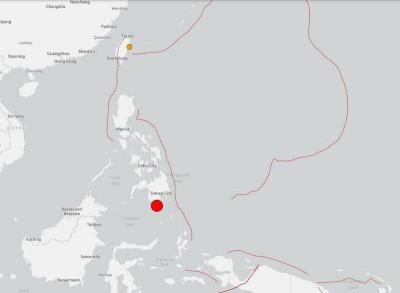
A magnitude 7.8 earthquake struck off the southern coast of Mindanao in the Philippines at 7:38am today, prompting the US Tsunami Warning System to issue an alert for neighboring countries, including Taiwan. The system issued a purple alert indicating a "tsunami threat." The potential threat zone includes Taiwan, the Philippines, Papua New Guinea, Yap and Palau. Philippine authorities were assessing the damage from the quake, with the office of civil defense seeking to verifying initial reports that 15 people had been killed and 129 injured in the region, mostly from falling debris. Arlene Hollero, disaster chief of Maasim town in the Philippines' Sarangani Province,
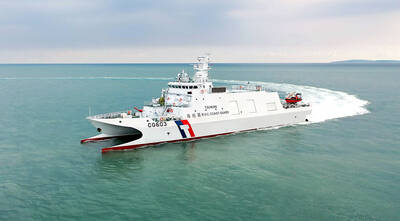
‘GRAY ZONE’ PRESSURE: Beijing’s activities are intended to create the deceitful impression that China has jurisdiction over the area around Taiwan, the CGA said Taiwan’s rights over its territorial waters and exclusive economic zone must not be violated by any country, the Mainland Affairs Council said yesterday, adding that it will not accept any unprovoked actions. The council issued the remarks in response to the China Coast Guard conducting maritime enforcement drills near eastern Taiwan and claiming to fully exercise China’s maritime administrative law enforcement authority. The Coast Guard Administration (CGA) has been closely monitoring the situation and is taking concrete steps to defend the nation’s sovereignty and secure its waters, the council said. China has no sovereign rights over the waters off eastern
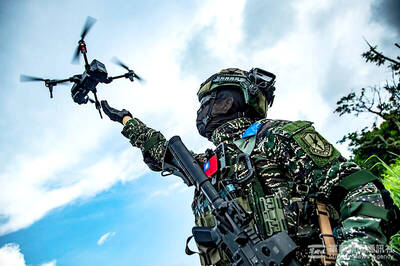
RESILIENCE: Taiwan plays a key role in semiconductors, energy, information infrastructure and advanced manufacturing, AIT Director Raymond Greene said Taiwan’s continued investment in deterrence and resilience remains vital, especially in uncrewed systems and other emerging technologies, American Institute in Taiwan (AIT) Director Raymond Greene said yesterday. Greene made the remarks at the annual National Strategic Summit on Supply Chain Resilience held by the Research Institute for Democracy, Society and Emerging Technology (DSET), a government-backed think tank. As Taiwan last year became the US’ fourth-largest trading partner and supply chain security is becoming more important, cooperation in emerging technologies continues to deepen between the two countries, he said. The US is committed to accelerating innovation, building key infrastructure, strengthening cooperation

The National Chungshan Institute of Science and Technology yesterday showcased its locally developed variants of the Vision 60 robotic patrol dog, which it plans to deploy on the nation’s outlying territories in the South China Sea. The variants were produced under the Joint Lab project — created by the institute and domestic companies — and assembled with domestically produced motors, lenses and artificial intelligence (AI) systems alongside licensed tech from the US, Missile and Rocket Systems Research Division deputy director Jen Kuo-kang (任國光) told the media event at a military base in Taipei’s Dazhi (大直) area. Taiwan has built up its strengths


 RSS
RSS