


Light beams, fireworks and water jets exploded from the banks of the Pearl River as China marked the opening of the 16th Asian Games in the southern city of Guangzhou, two years after dazzling the world with a gala opener to the Beijing Olympics.
Unlike the land-bound festivities at the Bird’s Nest stadium that featured thousands of performers moving in coordination in 2008, Asian Games organizers planned to pay tribute to coastal southern Guangdong province’s seafaring heritage.
Athletes set sail in 45 brightly lit vessels along the Pearl River to tiny Haixinsha island, where organizers built a ship-like stadium for the opening night celebrations.
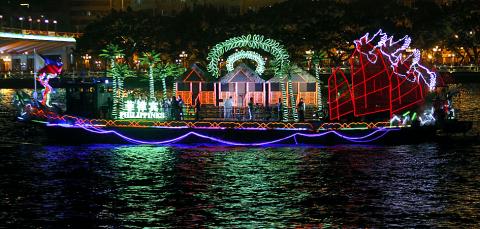
Photo: REUTERS
The ceremony began with a small boy floating down from the sky on a leaf-like carriage lit in green. He poured water from a bottle, setting off giant fountains which sprayed in arcs across a stage. Four dozen water goddesses seemed to walk across the water, followed by a dozen fairies rising out of pools in the stage floor.
Performers flapping large pieces of red cloth scrambled across the stage to create the image of petals dropping on water. Other actors entered in a large sampan-like vessel, recreating a journey in rough seas, with the would-be sailors swaying on ropes and ladders amid waters represented by large flags waved by hundreds of dancers.
Classical pianist Lang Lang (郎朗) performed on a white grand and Crouching Tiger, Hidden Dragon actress Zhang Ziyi (章子怡) sang as synchronized swimmers danced and water sprouted before them.
Chinese Premier Wen Jiabao (溫家寶) was to declare the games open toward the end of the four-hour ceremony designed by Chen Weiya (陳維亞), deputy to famed Chinese director Zhang Yimou (張藝謀) when he crafted the Beijing ceremony.
However, the huge scale of the event posed a logistical dilemma for the Chinese organizers.
Officials locked down areas near the stadium, ordering residents within a 1km radius to leave their homes for the night — apparently to eliminate the threat of sniper fire. They were, however, asked to leave their lights on to help maintain a glittering skyline backdrop.
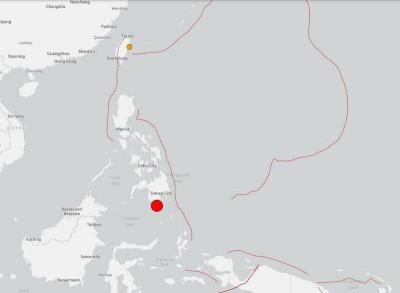
A magnitude 7.8 earthquake struck off the southern coast of Mindanao in the Philippines at 7:38am today, prompting the US Tsunami Warning System to issue an alert for neighboring countries, including Taiwan. The system issued a purple alert indicating a "tsunami threat." The potential threat zone includes Taiwan, the Philippines, Papua New Guinea, Yap and Palau. Philippine authorities were assessing the damage from the quake, with the office of civil defense seeking to verifying initial reports that 15 people had been killed and 129 injured in the region, mostly from falling debris. Arlene Hollero, disaster chief of Maasim town in the Philippines' Sarangani Province,
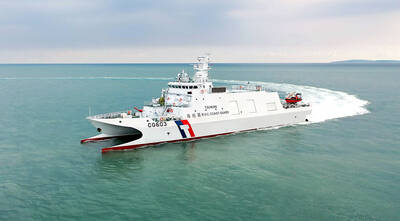
‘GRAY ZONE’ PRESSURE: Beijing’s activities are intended to create the deceitful impression that China has jurisdiction over the area around Taiwan, the CGA said Taiwan’s rights over its territorial waters and exclusive economic zone must not be violated by any country, the Mainland Affairs Council said yesterday, adding that it will not accept any unprovoked actions. The council issued the remarks in response to the China Coast Guard conducting maritime enforcement drills near eastern Taiwan and claiming to fully exercise China’s maritime administrative law enforcement authority. The Coast Guard Administration (CGA) has been closely monitoring the situation and is taking concrete steps to defend the nation’s sovereignty and secure its waters, the council said. China has no sovereign rights over the waters off eastern

RESILIENCE: Taiwan plays a key role in semiconductors, energy, information infrastructure and advanced manufacturing, AIT Director Raymond Greene said Taiwan’s continued investment in deterrence and resilience remains vital, especially in uncrewed systems and other emerging technologies, American Institute in Taiwan (AIT) Director Raymond Greene said yesterday. Greene made the remarks at the annual National Strategic Summit on Supply Chain Resilience held by the Research Institute for Democracy, Society and Emerging Technology (DSET), a government-backed think tank. As Taiwan last year became the US’ fourth-largest trading partner and supply chain security is becoming more important, cooperation in emerging technologies continues to deepen between the two countries, he said. The US is committed to accelerating innovation, building key infrastructure, strengthening cooperation

The National Chungshan Institute of Science and Technology yesterday showcased its locally developed variants of the Vision 60 robotic patrol dog, which it plans to deploy on the nation’s outlying territories in the South China Sea. The variants were produced under the Joint Lab project — created by the institute and domestic companies — and assembled with domestically produced motors, lenses and artificial intelligence (AI) systems alongside licensed tech from the US, Missile and Rocket Systems Research Division deputy director Jen Kuo-kang (任國光) told the media event at a military base in Taipei’s Dazhi (大直) area. Taiwan has built up its strengths


 RSS
RSS