


Chinese authorities said yesterday that tests had found traces in nearly 12 percent of milk powder products of an industrial chemical that has so far sickened 53,000 children, killing four.
As China marked its national day, Chinese President Hu Jintao (胡錦濤) said lessons must be learned from the scandal over tainted milk that has soiled China’s reputation and led to a series of bans or curbs on its dairy exports worldwide.
The Anglo-Dutch company Unilever became the latest big-name brand to recall some Chinese products, taking Lipton milk tea powder off shelves in Hong Kong and Macau after tests showed they contained traces of melamine.
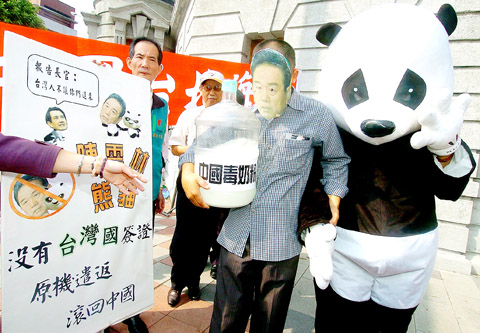
PHOTO: LIU HSIN-DE, TAIPEI TIMES
“Food safety is directly linked to the well-being of the broad masses and the competence of a company,” Hu said during a tour on Tuesday of dairy companies in Anhui Province, Xinhua news agency reported.
“Chinese companies should learn from the lessons of the Sanlu tainted milk powder incident,” he said, referring to Sanlu Group whose toxic baby formula was at the origin of the crisis.
A sweeping nationwide check has found melamine in 31 milk powder products, representing 11.7 percent of a total of 265 products put to the test, said the General Administration of Quality Supervision, Inspection and Quarantine. They came from 20 different companies, including Sanlu Group and several of its partner enterprises.
All had been produced before Sept. 14, it said, insisting products made after that date were safe.
The agency said it had checked 154 companies altogether, representing more than 70 percent of the entire market for milk powder.
In Shijiazhuang, where Sanlu is headquartered, authorities issued an unusual apology for their tardy response to the scandal, the China Daily reported.
Wang Jianguo, a spokesman for the Shijiazhuang leadership, said the city felt “a deep sense of guilt and regret” over the sick children.
He said the government received reports from Sanlu Group on Aug. 2 that some milk powder caused kidney stones, but waited until Sept. 9 to pass on the report to the Hebei provincial government.
Instead of alerting their superiors, Shijiazhuang officials offered medical treatment to patients, urged Sanlu to import inspection machines and recalled the company’s milk powder, the paper said.
Sanlu also asked for government help in “managing” the media response to the scandal, the People’s Daily reported, citing Wang.
He said Sanlu asked the local government to monitor milk quality and take legal action against people adding melamine.
It also asked the government “to strengthen management, control and coordination of the media ... to create a favorable environment for the company’s recall of problem products and prevent a negative impact on society by stirring up the issue,” the newspaper said.
Wang said officials had not considered the consequences of their actions.
“We mistakenly thought that taking necessary measures and raising product quality could mitigate the effect and reduce losses,” he said.
“The bungling of the best opportunity to report up the handling of the issue caused much harm to people’s safety, and seriously affected the image of the party and the government,” Wang said.
Meanwhile, the parents of an infant thought sickened by the tainted baby formula have launched what could be the first lawsuit of the scandal against Sanlu, said Ji Cheng, an attorney in Beijing.

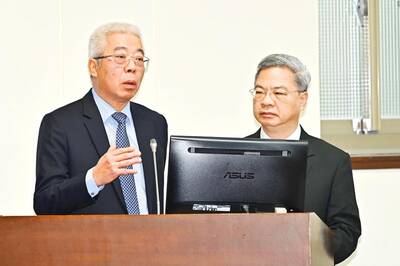
Taiwan has arranged for about 8 million barrels of crude oil, or about one-third of its monthly needs, to be shipped from the Red Sea this month to bypass the Strait of Hormuz and ease domestic supply pressures, CPC Corp, Taiwan (CPC, 台灣中油) said yesterday. The state-run oil company has worked with Middle Eastern suppliers to secure routes other than the Strait of Hormuz, through which about 20 percent of the world’s oil and liquefied natural gas typically passes, CPC chairman Fang Jeng-zen (方振仁) said at a meeting of the legislature’s Economics Committee in Taipei. Suppliers in Saudi Arabia have indicated they
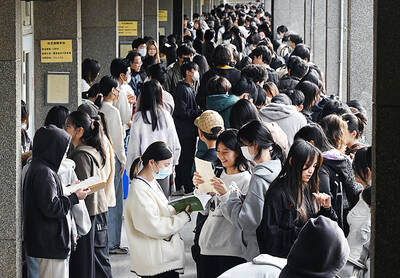
A global survey showed that 60 percent of Taiwanese had attained higher education, second only to Canada, the Ministry of the Interior said. Taiwan easily surpassed the global average of 43 percent and ranked ahead of major economies, including Japan, South Korea and the US, data from the Organisation for Economic Co-operation and Development (OECD) for 2024 showed. Taiwan has a high literacy rate, data released by the ministry showed. As of the end of last year, Taiwan had 20.617 million people aged 15 or older, accounting for 88.5 percent of the total population, with a literacy rate of 99.4 percent, the data
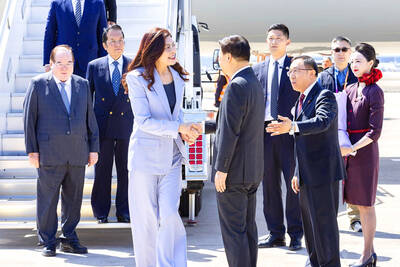
CCP ‘PAWN’? Beijing could use the KMT chairwoman’s visit to signal to the world that many people in Taiwan support the ‘one China’ principle, an academic said Chinese Nationalist Party (KMT) Chairwoman Cheng Li-wun (鄭麗文) yesterday arrived in China for a “peace” mission and potential meeting with Chinese President Xi Jinping (習近平), while a Taiwanese minister detailed the number of Chinese warships currently deployed around the nation. Cheng is visiting at a time of increased Chinese military pressure on Taiwan, as the opposition-dominated Legislative Yuan stalls a government plan for US$40 billion in extra defense spending. Speaking to reporters before going to the airport, Cheng said she was going on a “historic journey for peace,” but added that some people felt uneasy about her trip. “If you truly love Taiwan,

NEW LOW: The council in 2024 based predictions on a pessimistic estimate for the nation’s total fertility rate of 0.84, but last year that rate was 0.69, 17 percent lower An expected National Development Council (NDC) report expects the nation’s population to drop below 12 million by 2065, with the old-age dependency ratio to top 100 percent sooner than 2070, sources said yesterday. The council is slated to release its latest population projections in August, using an ultra-low fertility model, the sources said. The previous report projected that Taiwan’s population would fall to 14.37 million by 2070, but based on a new estimate of the total fertility rate (TFR) — the average number of children born to a woman over her lifetime — the population is expected to reach 12 million by


 RSS
RSS