


Frightened Indonesians on Sumatra huddled in tents outside their damaged homes yesterday, traumatized by the latest of more than 40 aftershocks since a huge earthquake struck two days ago.
Indonesia's meteorology agency issued the latest in a series of tsunami warnings yesterday after another strong quake in Sumatra, although it was lifted about an hour later.
There have been a series of tremors ranging in intensity from 4.9 to 7.8 since Wednesday's 8.4 quake, repeatedly setting off tsunami warnings in Indian Ocean countries.
Seismologist Mike Turnbull of Australia's Central Queensland University warned against complacency over the frequent tsunami warnings: "The problem is, these were very large earthquakes. They had every capability to generate large tsunami."
At least two areas in Bengkulu province were hit by tsunamis after Wednesday's quake, residents said. About 100 houses were damaged by a 3m wave in Serangai, 70km north of Bengkulu, but there were no casualties.
Some houses had been shifted about 10m by the water and tree trunks and large logs littered the main road.
Padang Bakung, a village two hours drive south of Bengkulu, also suffered a tsunami that inundated houses with water as high as half a meter. The houses were 60m from the coast.
Rustam Pakaya, head of the Indonesian health ministry's crisis center in Jakarta, said 14 people had been killed and 56 injured across the region since Wednesday's quake.
The latest quakes triggered new panic among thousands camping out in makeshift shelters or tents, using torches and kerosene lights, and setting fires overnight to keep warm.
Patients had to be moved into tents in front of the hospital in Bengkulu, the nearest major town to the epicenter of Wednesday's 8.4 quake.
Rescue workers rushed aid across Sumatra yesterday.
The Indonesian military and local officials began distributing food and medical aid to survivors relatively unhampered, an official from the national disaster mitigation agency said.
"The local infrastructure has not been seriously damaged and we can still deliver aid by land," the official, Soetrisno, said.
The military provided two Bell helicopters, one each to be based in the worst-hit cities of Bengkulu and Padang, he said.
A local aid worker said the main problem was a shortage of manpower to move supplies.

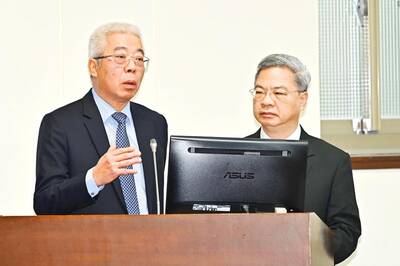
Taiwan has arranged for about 8 million barrels of crude oil, or about one-third of its monthly needs, to be shipped from the Red Sea this month to bypass the Strait of Hormuz and ease domestic supply pressures, CPC Corp, Taiwan (CPC, 台灣中油) said yesterday. The state-run oil company has worked with Middle Eastern suppliers to secure routes other than the Strait of Hormuz, through which about 20 percent of the world’s oil and liquefied natural gas typically passes, CPC chairman Fang Jeng-zen (方振仁) said at a meeting of the legislature’s Economics Committee in Taipei. Suppliers in Saudi Arabia have indicated they
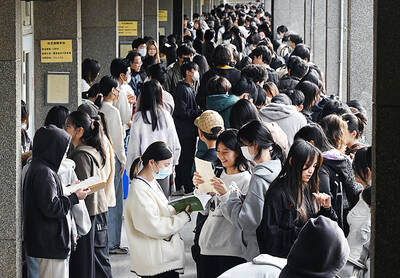
A global survey showed that 60 percent of Taiwanese had attained higher education, second only to Canada, the Ministry of the Interior said. Taiwan easily surpassed the global average of 43 percent and ranked ahead of major economies, including Japan, South Korea and the US, data from the Organisation for Economic Co-operation and Development (OECD) for 2024 showed. Taiwan has a high literacy rate, data released by the ministry showed. As of the end of last year, Taiwan had 20.617 million people aged 15 or older, accounting for 88.5 percent of the total population, with a literacy rate of 99.4 percent, the data

CCP ‘PAWN’? Beijing could use the KMT chairwoman’s visit to signal to the world that many people in Taiwan support the ‘one China’ principle, an academic said Chinese Nationalist Party (KMT) Chairwoman Cheng Li-wun (鄭麗文) yesterday arrived in China for a “peace” mission and potential meeting with Chinese President Xi Jinping (習近平), while a Taiwanese minister detailed the number of Chinese warships currently deployed around the nation. Cheng is visiting at a time of increased Chinese military pressure on Taiwan, as the opposition-dominated Legislative Yuan stalls a government plan for US$40 billion in extra defense spending. Speaking to reporters before going to the airport, Cheng said she was going on a “historic journey for peace,” but added that some people felt uneasy about her trip. “If you truly love Taiwan,

NEW LOW: The council in 2024 based predictions on a pessimistic estimate for the nation’s total fertility rate of 0.84, but last year that rate was 0.69, 17 percent lower An expected National Development Council (NDC) report expects the nation’s population to drop below 12 million by 2065, with the old-age dependency ratio to top 100 percent sooner than 2070, sources said yesterday. The council is slated to release its latest population projections in August, using an ultra-low fertility model, the sources said. The previous report projected that Taiwan’s population would fall to 14.37 million by 2070, but based on a new estimate of the total fertility rate (TFR) — the average number of children born to a woman over her lifetime — the population is expected to reach 12 million by


 RSS
RSS