


President Chen Shui-bian (
Speaking at a meeting of his economic advisory panel, Chen said that the value-added tax should be raised by one to two percentage points from the current 5 percent in the near future.
This tax increase is expected to inject at most NT$68 billion (US$2 billion) per year into state coffers, which have suffered a shortfall of more than NT$300 billion annually over the past few years, said Lin Hsin-yi (
According to government forecasts, the budget deficit will worsen to a record NT$337.3 billion this year from an estimated NT$304 billion last year.
Chen also said the tax base should be widened and tax items simplified to boost efficiency.
Major directions laid out in his speech included establishing a minimum corporate tax scheme and considering imposing capital-gains tax on transactions of unlisted companies' stocks, he said.
Some companies, particularly high technology firms, are exempt from income taxes because of tax breaks the government offers to encourage investment.
Rock Hsu (許勝雄), chairman of the Taiwan Electrical and Electronic Manufacturers Association (電電公會), last week suggested that Taiwan's minimum corporate tax rate should be set at between 3.75 percent and 7.5 percent to maintain competitiveness as China imposes an average 7.5 percent tax on companies.
In response, the Ministry of Finance said Hsu's proposed range can neither meet the public's expectations nor increase tax revenues.
The ministry said that with a minimum corporate tax of 10 percent, as Finance Minister Lin Chuan (林全) has planned, the government can boost tax income by around NT$20 billion a year and promote equitable taxation.
As the government has not reached a consensus on this issue, Lin Hsin-yi said the advisory panel has not set any timetable to push for this policy change.
Chen set out instructions that inheritance and gift taxes be trimmed from 50 percent to 40 percent, as part of the effort to boost investment.
This tax cut will translate into a loss of NT$8.97 billion.
However, when asked how much this new investment scheme will create that its only a 10 percentage point difference, Lin Hsin-yi did not explain.
In general, Chen hopes to increase the national taxation rate, a gauge that divides taxes by GDP, from the current 13.6 percent to 15 percent within three years, and set a longer-term goal of 18 percent.
He said the ratio at the Organization for Economic Cooperation and Development is about 27 percent.
Chen's instructions are in line with conclusions reached by the Economic Development Advisory Conference in 2001, which set a goal of balancing the budget in five to 10 years.
Finance ministry still pushing for corporate tax revamp
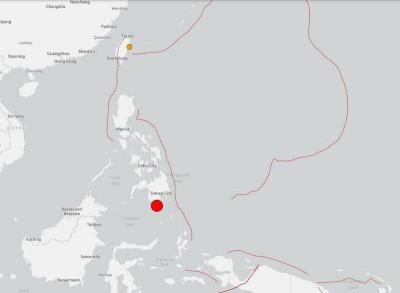
A magnitude 7.8 earthquake struck off the southern coast of Mindanao in the Philippines at 7:38am today, prompting the US Tsunami Warning System to issue an alert for neighboring countries, including Taiwan. The system issued a purple alert indicating a "tsunami threat." The potential threat zone includes Taiwan, the Philippines, Papua New Guinea, Yap and Palau. Philippine authorities were assessing the damage from the quake, with the office of civil defense seeking to verifying initial reports that 15 people had been killed and 129 injured in the region, mostly from falling debris. Arlene Hollero, disaster chief of Maasim town in the Philippines' Sarangani Province,
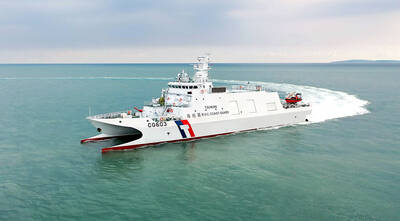
‘GRAY ZONE’ PRESSURE: Beijing’s activities are intended to create the deceitful impression that China has jurisdiction over the area around Taiwan, the CGA said Taiwan’s rights over its territorial waters and exclusive economic zone must not be violated by any country, the Mainland Affairs Council said yesterday, adding that it will not accept any unprovoked actions. The council issued the remarks in response to the China Coast Guard conducting maritime enforcement drills near eastern Taiwan and claiming to fully exercise China’s maritime administrative law enforcement authority. The Coast Guard Administration (CGA) has been closely monitoring the situation and is taking concrete steps to defend the nation’s sovereignty and secure its waters, the council said. China has no sovereign rights over the waters off eastern
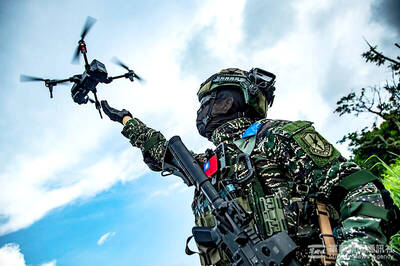
RESILIENCE: Taiwan plays a key role in semiconductors, energy, information infrastructure and advanced manufacturing, AIT Director Raymond Greene said Taiwan’s continued investment in deterrence and resilience remains vital, especially in uncrewed systems and other emerging technologies, American Institute in Taiwan (AIT) Director Raymond Greene said yesterday. Greene made the remarks at the annual National Strategic Summit on Supply Chain Resilience held by the Research Institute for Democracy, Society and Emerging Technology (DSET), a government-backed think tank. As Taiwan last year became the US’ fourth-largest trading partner and supply chain security is becoming more important, cooperation in emerging technologies continues to deepen between the two countries, he said. The US is committed to accelerating innovation, building key infrastructure, strengthening cooperation

The National Chungshan Institute of Science and Technology yesterday showcased its locally developed variants of the Vision 60 robotic patrol dog, which it plans to deploy on the nation’s outlying territories in the South China Sea. The variants were produced under the Joint Lab project — created by the institute and domestic companies — and assembled with domestically produced motors, lenses and artificial intelligence (AI) systems alongside licensed tech from the US, Missile and Rocket Systems Research Division deputy director Jen Kuo-kang (任國光) told the media event at a military base in Taipei’s Dazhi (大直) area. Taiwan has built up its strengths


 RSS
RSS