


The Presidential Office yesterday announced its list of advisors for next year, which included new additions Liu Chia (
Shihlin Paper Co owner Chen Chao-chuan (
The posts of more than 100 advisors remained unchanged, including former DPP chairmen Yao Chia-wen (姚嘉文), Hsu Hsin-liang (許信良) and Peng Min-min (彭明敏) -- a long-standing advocate of Taiwan independence.
The tough-talking advisor King, who is noted for her pro-independence stance, has triggered uproar during recent trips back to Taiwan during which she refused to count herself as a citizen of the Republic of China.
Shi, on the other hand, has caused controversy by telling a Japanese cartoonist that some Taiwan women volunteered to serve as prostitutes for the Japanese army during World War II.
Sources in the Presidential Office said primary consideration for the selection was given to those upholding the rights of the disadvantaged and women.
Liu Chia, a renowned writer with the pen name Ching Lin Tzu (
Lee Yuan-chen, the founder of the Awakening Foundation (
In an effort to douse criticism of individuals who hold dual citizenship and serve as presidential advisors, the Presidential Office changed the posts of prominent industrialists Nita Ing (
Originally listed as national policy advisors or senior advisor to the president, their posts were shifted to become advisors, who perform their services voluntarily because they hold dual citizenship.
Wang Yung-ching (王永慶), chairman of the Formosa Plastics Group (台塑集團), was expected to be on the list, but turned out not to be. Sources said that Wang had been offered the post, but turned it down.
The positions of both senior advisors to the president and national policy advisors, created in 1948, have traditionally been filled by senior retired officials.
Although seldom consulted, a senior advisor receives NT$201,960 in monthly salary, as much as the vice premier. A national policy advisor receives NT$179,520, the same as a Cabinet minister. Only 45 advisors are on the government payroll, while the rest perform their services voluntarily.
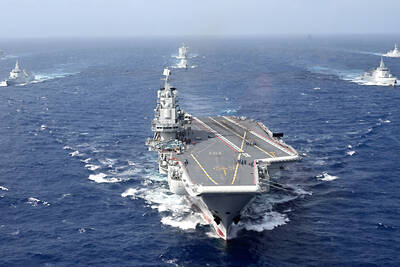
PROVOCATIVE: Chinese Deputy Ambassador to the UN Sun Lei accused Japan of sending military vessels to deliberately provoke tensions in the Taiwan Strait China denounced remarks by Japan and the EU about the South China Sea at a UN Security Council meeting on Monday, and accused Tokyo of provocative behavior in the Taiwan Strait and planning military expansion. Ayano Kunimitsu, a Japanese vice foreign minister, told the Council meeting on maritime security that Tokyo was seriously concerned about the situation in the East China and South China seas, and reiterated Japan’s opposition to any attempt to change the “status quo” by force, and obstruction of freedom of navigation and overflight. Stavros Lambrinidis, head of the EU delegation to the UN, also highlighted South China Sea
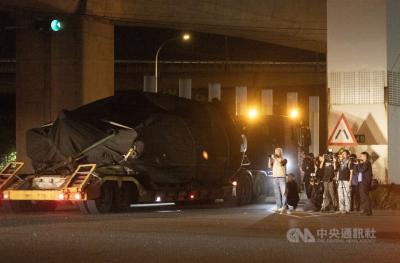
The final batch of 28 M1A2T Abrams tanks purchased from the US arrived at Taipei Port last night and were transported to the Armor Training Command in Hsinchu County’s Hukou Township (湖口), completing the military’s multi-year procurement of 108 of the tanks. Starting at 12:10am today, reporters observed more than a dozen civilian flatbed trailers departing from Taipei Port, each carrying an M1A2T tank covered with black waterproof tarps. Escorted by military vehicles, the convoy traveled via the West Coast Expressway to the Armor Training Command, with police implementing traffic control. The army operates about 1,000 tanks, including CM-11 Brave Tiger
Taiwan Semiconductor Manufacturing Co (TSMC, 台積電), the world’s largest contract chipmaker, said it expects its 2-nanometer (2nm) chip capacity to grow at a compound annual rate of 70 percent from this year to 2028. The projection comes as five fabs begin volume production of 2-nanometer chips this year — two in Hsinchu and three in Kaohsiung — TSMC senior vice president and deputy cochief operating officer Cliff Hou (侯永清) said at the company’s annual technology symposium in Silicon Valley, California, last week. Output in the first year of 2-nanometer production, which began in the fourth quarter of last year, is expected to
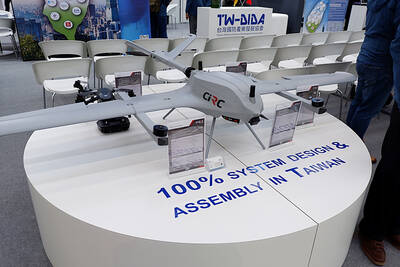
Taiwan’s drone exports surged past US$100 million in the first quarter, exceeding last year’s full-year total, with the Czech Republic emerging as the largest buyer, the Ministry of Economic Affairs said. Exports of complete drones reached US$115.85 million in the period, about 1.2 times the total recorded for all of last year, the ministry said in a report. Exports to the Czech Republic accounted for about US$100 million, far outpacing other markets. Poland, last year’s top destination, recorded about US$11.75 million in the first quarter. Taiwan’s drone exports have expanded rapidly in the past few years, with last year’s total


 RSS
RSS