


Japan’s thousand-year-old samurai horse festival has survived wars, earthquakes and a nuclear disaster. Now it’s battling a new challenge — climate change.
The Soma Nomaoi began as a way to train mounted warriors and it still looks the same a millennium later, with riders dressed in samurai armor competing in horseback events.
Until 2024, the festival took place at the height of Japan’s grueling summers, which had become so hot that riders and spectators were collapsing and horses dying of heatstroke.
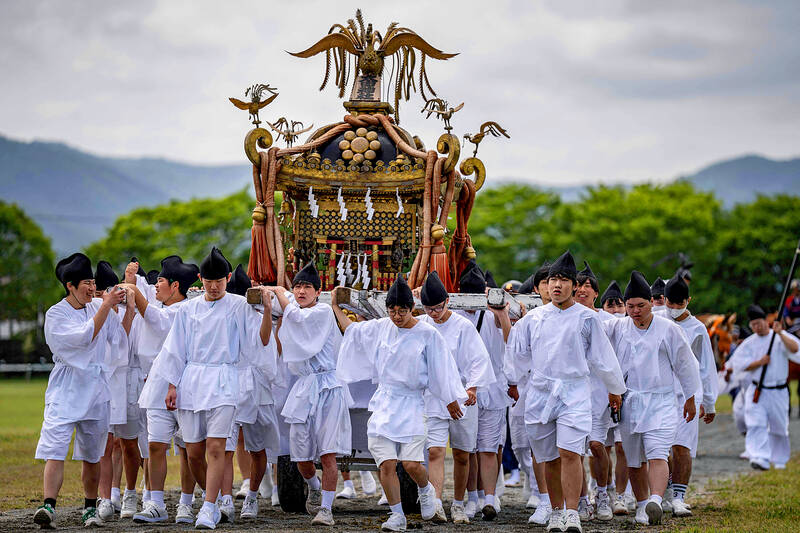
Photo: AFP
That prompted organizers to switch the festival to the cooler temperatures of late May.
Mitsukiyo Monma, who has been taking part in the event for 54 years, said that the change had given the festival a new lease of life.
“You have to wear a kimono under the armor, which is not like going out in just a T-shirt in the summer,” said the 69-year-old, adding that he needed medical attention on a day when the mercury was close to 40 degrees Celsius.
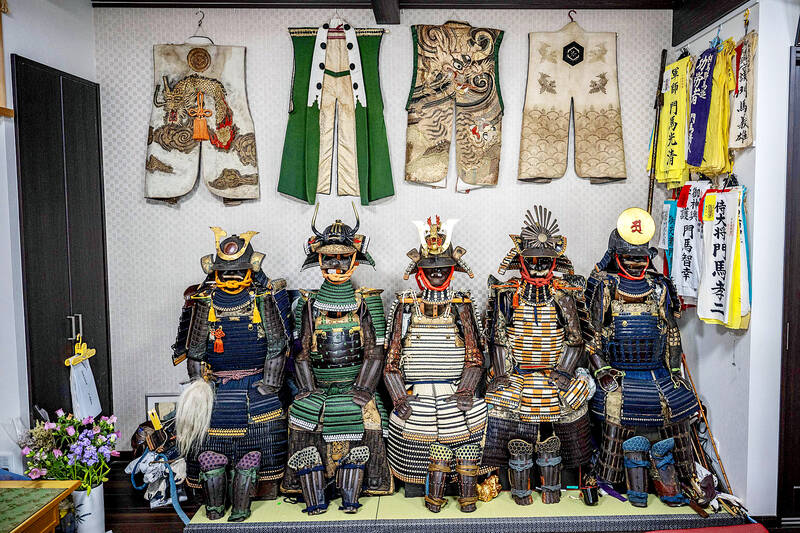
Photo: AFP
“Your clothes would be so soaked that you could wring out the sweat,” he said. “When the festival moved to May, it was the first time I could drink hot coffee before going out.”
Scientists say climate change is making extreme weather events more frequent and severe, and temperatures around the world have soared in recent years.
Japan is no exception. Last year, the country had its hottest summer since records began in 1898.
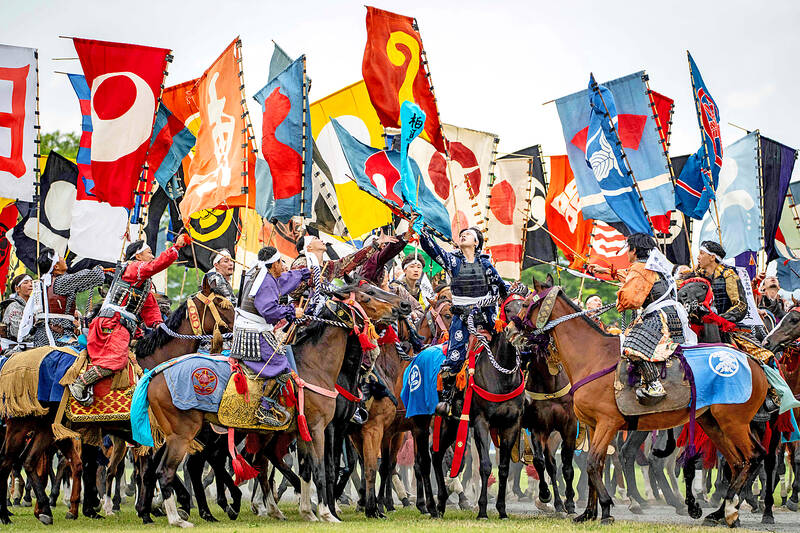
Photo: AFP
Temperatures rising to 40 degrees Celsius and above have become so common that Japan’s weather agency recently created an official designation for them, labeling them “cruelly hot” days.
TRULY A SAMURAI
Such conditions are hardly ideal for the Soma Nomaoi, where participants compete on horseback in samurai armor weighing around 25kg.
The main event starts with races around a flat, oval track, with riders carrying giant flags on their backs.
Hundreds of riders then gather in a large grass field and compete to grab colored flags that drift to the ground after being fired high into the air.
On the last of the festival’s three days, participants try to grab wild horses with their bare hands and offer them to the gods.
The action is fast and furious, and Monma says it is serious business for the riders taking part.
“I feel like I’ve truly become a samurai,” he said.
“I feel more courageous, and on the day itself, my whole body and mind tighten.”
The Soma Nomaoi takes place around Minamisoma, almost 300km north of Tokyo.
It started around 1,000 years ago and records suggest it has been held uninterrupted for at least the last 400 years.
The festivities kept going even in the aftermath of a 2011 earthquake and tsunami that left over 18,000 people dead or missing and caused a devastating meltdown at the Fukushima nuclear plant.
Fumihiko Futakami, director of the Minamisoma City Museum, says the Soma Nomaoi was a source of comfort when he was evacuated to Tokyo after the disaster.
“Even for people who have left here and now live elsewhere, when they think of their hometown, they think of mounted warriors,” he said.
“It’s the identity of our town.”
UNCERTAIN FUTURE
The festival’s warrior roots meant only samurai could take part until the feudal system was abolished in the late 19th century.
Women were admitted after World War II, and festival veteran Monma fulfilled a lifelong dream when his two granddaughters joined him for this year’s event.
It took place under cloudy skies, with the temperature hovering around a pleasant 18 degrees Celsius.
There was little chance of a repeat of the 2023 Soma Nomaoi, when more than 100 horses and dozens of people needed treatment for heatstroke, and two animals died.
“There isn’t much shade anywhere, so I think this is the most comfortable temperature for everyone,” said 25-year-old Haruto Inoue, who was visiting from nearby Tochigi to watch the festival for the first time.
“They look so cool in their samurai gear, racing through the mud and giving it everything they’ve got.”
Anyone can participate in the Soma Nomaoi, but owning or hiring a horse is not cheap.
The number of participants is steadily declining, and Japan’s aging population is a major factor.
Monma worries that the festival might not survive another 100 years unless organizers can come up with solutions.
Museum director Futakami believes moving it away from the punishing summer heat has been a good start.
“The horses are livelier and the participants aren’t so exhausted that they can barely move the next day,” he said.
“I think most people would say it’s been a good thing.”

Taiwan’s English education system is being pulled apart by three opposing forces. Bilingual Nation 2030 pulls students toward English and global communication. Artificial Intelligence (AI) readiness pulls them toward digital judgment, verification and AI-mediated work. But Taiwan’s old exam culture pulls them back toward memorization, grammar drills, timed reading and correct answers. If the education system keeps using old exams to define success, it risks producing graduates who are neither genuinely bilingual nor genuinely AI-ready, but trained for tasks machines can already perform. The first force is Bilingual Nation 2030. Launched in 2018, the policy aimed to “help Taiwan’s workforce connect
It seems every few days one bumps into one of those “real man” comments in which Taiwan is urged to “face reality” or similar, and “make a deal,” with the speaker implying that soon it will be too late. “Deal” advocates always present themselves as having a superior grip on reality, and the manly ability to make the “hard choice.” Their testosterone-laden language often echoes that of Taiwan sellout advocates. Note that such commentary always specifies a process (“make a deal, work with, make progress”), never the end state of what occupation by a violent authoritarian colonialist state will entail. In
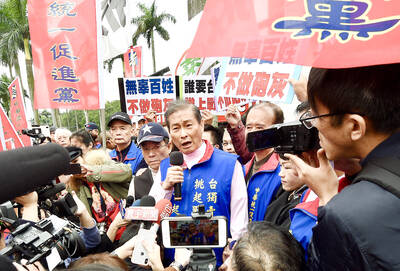
There are shadowy cabals plotting to sell out Taiwan to be annexed by China, by invasion if necessary. Fortunately, they are buffoons. In 2019, former Bamboo Union gangster and founder of the China Unification Promotion Party (CUPP), Chang An-le (張安樂, colorfully known as “White Wolf”), led a protest at the Legislative Yuan against comments made by then-premier Su Tseng-chang (蘇貞昌) that in the event of an attack by China, he would never surrender, but would protect the nation by fighting to the end, even if he only had a broom. Chang had party members bring a wooden casket that they
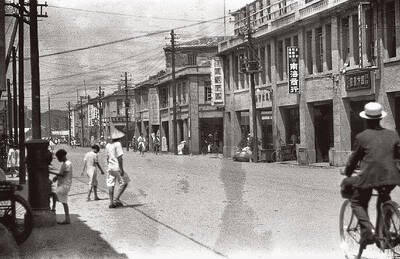
June 1 to June 7 "If all Taiwanese were as afraid of dying as you, then what would happen?” Physician Shih Chiang-nan (施江南) reportedly said this to his wife Chen Chiao-tung (陳焦桐) after she urged him to stop intervening on behalf of Taiwanese soldiers stranded overseas after serving in the Japanese Army during World War II. Shih had clashed with high-ranking officials over the issue, engaged in several heated arguments with Taiwan governor-general Chen Yi (陳儀) and allegedly shouted at general Ko Yuan-fen (柯遠芬), chief of staff of the Taiwan Garrison Command, over


 RSS
RSS