


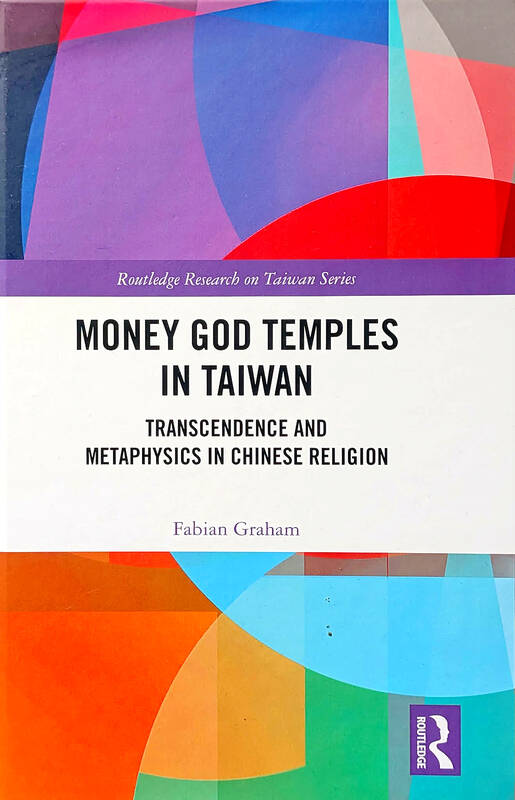
As someone who normally steers clear of books with “transcendence” or “metaphysics” in their subtitles, this reviewer — a casual observer of local belief systems since the 1990s — found Fabian Graham’s Money God Temples in Taiwan a challenging read. Those who’ve only dipped their toes into temple culture will likely need to parse several sections with special care if they’re to keep up with the author, a British ethnographic researcher whose previous books have investigated religious practices among ethnic Chinese in Southeast Asia.
This scholarly volume examines a facet of Taiwan’s religious landscape that didn’t exist a century ago, and which only appears in a small minority of the country’s 15,000-plus officially registered shrines.
Money god temples are places of worship where worshippers may borrow small amounts of cash (facai jin, 發財金) in the hope the temple’s deity will make a favorable intervention on their behalf. These loans are unsecured, but most are repaid with interest within a year.
The underlying logic resembles American prosperity theology, which tells Christians that, if they donate generously to their churches, God will ensure they eventually enjoy financial rewards. Graham doesn’t compare what he’s seen here with practices elsewhere, however, except to say money god temples appear to be an only-in-Taiwan phenomenon.
He’s more interested in using the “true gift” paradox written about by Jacques Derrida as a lens through which to ponder the nature of deity-backed loans issued by money god shrines. (For a certain kind of scholar, this reviewer wonders, is finding a real-world example of Derrida’s “true gift” akin to the quest for Fermat’s Last Theorem?)
Even if that angle doesn’t appeal to you, what Graham has to say about the rapid growth of cash-lending rituals after 1990 (that year’s stock market crash was a factor), the diverse and fluid character of Taiwan’s vernacular religion (“unrestricted by a distinct orthodox directive, and ununified by a single sacred text”), and how technologies like social media may be accelerating the rate at which the spiritual topography shifts, should engross anyone interested in this society.
Money god temples represent “a blatant commodification of religious cosmology,” but this shouldn’t be seen as evidence of secularization, Graham argues. Pointing out that religion in Chinese societies “has always been a marketplace and a marketable commodity,” he asserts that recent decades show Taiwan does not “fit in with the underlying assumptions of the secularization thesis — that modernization results in decreasing religiosity, or desecularization discourse — that religiosity increases in reaction to secularization.”
An “extreme example” of commodification provides one of the book’s several memorable anecdotes. At a temple in Taichung, having cast divination blocks (筊, bue in Hoklo) and received divine permission to leave with NT$168 of money blessed by wealth god Zhao Gongming (趙公明), Graham is dismayed to discover he first has to hand over NT$360. This he does “somewhat begrudgingly.”
Zhao Gongming, Graham explains, “evolved in progressive stages over approximately 700 years from a sexually deviant demonic force, into the munificent Money Gods of the Five Directions [aka Wulu Caishen, 五路財神].” Taiwan’s original wealth god, however, was the humble land god, Tudi Gong (土地公). Graham explores Tudi Gong’s long history, his various responsibilities and how he emerged as a money god in the early 1930s at Zihnan Gong (紫南宮), a then-obscure but now super-popular shrine in Nantou County’s Jhushan Township (竹山).
Over more than a decade, Graham interviewed temple owners, Taoist priests and other religious specialists. He gathered data and opinions from more than 500 recipients of fortune money, including some who were returning to repay a loan.
It’s impossible to know what percentage of borrowers default, but Graham visited a number of shrines that had stopped lending money. Some temple managers attributed this to “diminishing numbers of recipients returning to repay their debts.” The fact that the most famous money god shrines now use computers to record borrowers’ ID details “may suggest that honesty has become an issue, or simply that the temples have evolved with modernity and developed a more businesslike approach.”
At one temple, having been initially approved — and informed that, to obtain the greatest efficacy, one banknote should be “stored in my wallet, one in a revered position in my home and the third spent on something related to my wish” — Graham ran into a problem that other foreign residents of Taiwan have encountered. It turned out that, without a Taiwan ID number, the loan couldn’t be issued.
“I suggested that such a high-ranking deity couldn’t possibly be prejudiced by someone’s birthplace, and she agreed, informing me that it wasn’t the deity but the computer system that needed reconfiguring to accept different length ID numbers,” the author recalls.
According to Graham, temple owners concede that rising prices and stagnating salaries drive the enduring popularity of money god temples. The influx of visitors stems not from a sudden surge in religious fervor or superstition, but from a search for alternative paths to financial success. This mirrors a well-documented trend in the US, where a spike in the unemployment rate typically triggers an even steeper rise in lottery ticket sales.
In Graham’s account of the 2024 opening of the new, expanded Jinshan Caishen Miao (金山財神廟) in New Taipei City, he comes close to addressing a question that had been on my mind from the first chapter. I’d wondered if, by lending real money, religious entities ever incurred the disapproval of financial regulators. The presence of one bank’s representatives at the event suggests the answer is negative: “Having entered into an agreement with the temple, [the bank] was opening new bank accounts for those wishing to deposit their fortune money, with a credit card featuring a talisman obtained from the temple’s Zhao Gongming.”
The deity consented to this cobranding, the reader has to assume, via divination blocks.

Taiwan’s English education system is being pulled apart by three opposing forces. Bilingual Nation 2030 pulls students toward English and global communication. Artificial Intelligence (AI) readiness pulls them toward digital judgment, verification and AI-mediated work. But Taiwan’s old exam culture pulls them back toward memorization, grammar drills, timed reading and correct answers. If the education system keeps using old exams to define success, it risks producing graduates who are neither genuinely bilingual nor genuinely AI-ready, but trained for tasks machines can already perform. The first force is Bilingual Nation 2030. Launched in 2018, the policy aimed to “help Taiwan’s workforce connect
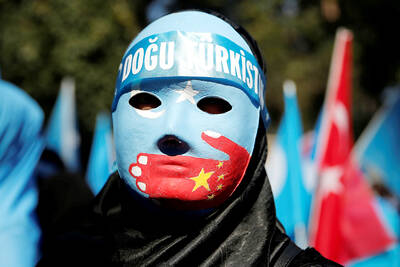
It seems every few days one bumps into one of those “real man” comments in which Taiwan is urged to “face reality” or similar, and “make a deal,” with the speaker implying that soon it will be too late. “Deal” advocates always present themselves as having a superior grip on reality, and the manly ability to make the “hard choice.” Their testosterone-laden language often echoes that of Taiwan sellout advocates. Note that such commentary always specifies a process (“make a deal, work with, make progress”), never the end state of what occupation by a violent authoritarian colonialist state will entail. In
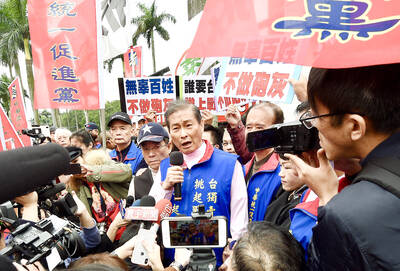
There are shadowy cabals plotting to sell out Taiwan to be annexed by China, by invasion if necessary. Fortunately, they are buffoons. In 2019, former Bamboo Union gangster and founder of the China Unification Promotion Party (CUPP), Chang An-le (張安樂, colorfully known as “White Wolf”), led a protest at the Legislative Yuan against comments made by then-premier Su Tseng-chang (蘇貞昌) that in the event of an attack by China, he would never surrender, but would protect the nation by fighting to the end, even if he only had a broom. Chang had party members bring a wooden casket that they
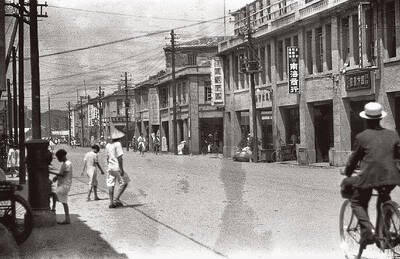
June 1 to June 7 "If all Taiwanese were as afraid of dying as you, then what would happen?” Physician Shih Chiang-nan (施江南) reportedly said this to his wife Chen Chiao-tung (陳焦桐) after she urged him to stop intervening on behalf of Taiwanese soldiers stranded overseas after serving in the Japanese Army during World War II. Shih had clashed with high-ranking officials over the issue, engaged in several heated arguments with Taiwan governor-general Chen Yi (陳儀) and allegedly shouted at general Ko Yuan-fen (柯遠芬), chief of staff of the Taiwan Garrison Command, over


 RSS
RSS