


Lost in the news last week: Chinese Nationalist Party (KMT) and Taiwanese People’s Party (TPP) legislators fast-tracked bills intended to expand local government authority over industrial air pollution. The government, Taiwan Power Co (Taipower) and local business organizations all registered objections to the new bills.
The bills attack industrial pollution permits in two ways. First, they slash the validity of industrial pollution permits from their current three to five years, to two to five years, or two years only in highly polluted areas. Second, under the proposed changes, permits would be invalidated if not approved by the local or central government within two months.
The bills affect not only industrial manufacturing concerns, but also hotels, restaurants and hospitals that operate large boilers. The fallout from the second move is clear: businesses will be at the mercy of local governments to fast track their permits so they can continue operating. That in turn implies endless opportunities for bribery and graft.
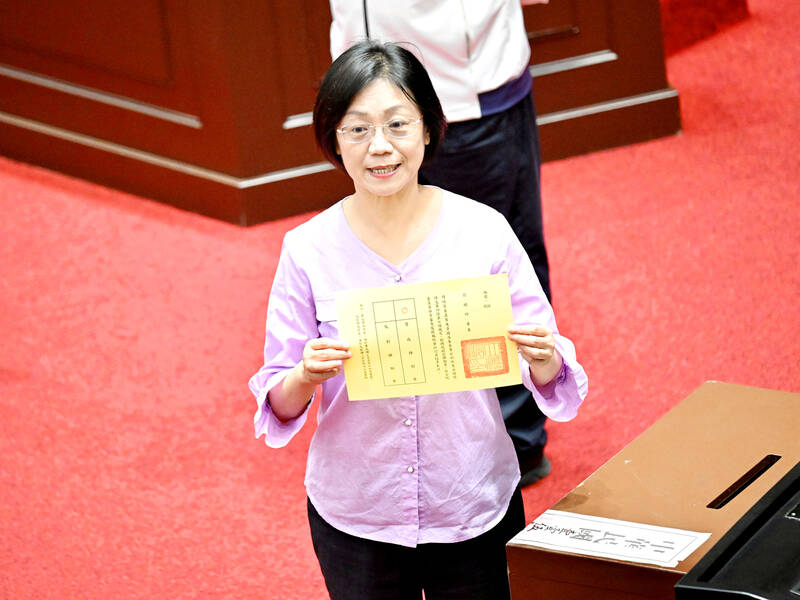
Photo: Peter Lo, Taipei Times
Or, if local governments are honest, endless waiting for permits since many local governments lack the governance capabilities to carry out pollution surveys and then issue permits. The Ministry of Economic Affairs (MOEA) complained that a stable and predictable regulatory environment is necessary for the functioning of business. The proposed bills will create the opposite environment.
The proposed laws encompass three important themes of recent KMT-TPP legislation: increasing graft (typified by the apparent legalization of the former and common crime of legislators dipping into stipends intended for aides), increasing problems for Taiwan’s energy supply and energy transition and increasing local government powers at the expense of central government authority. The KMT has thrown up roadblocks in the form of more difficult regulatory environments for solar power on bodies of water. Local governments run by the KMT make it more difficult to get approvals for renewables. The KMT has also quietly forced the closure of the nuclear plants in the north by opposing site surveys for spent fuel disposal.
The bills, warned government officials, effectively allow local governments to deny permits to energy fuels they do not like, massively complicating energy planning for local businesses and central government authorities. Moreover, officials observed local governments could create conflicts between national policies and local demands. Business organizations objected to the increased administrative burden and uncertainty — what happens to the business when permits don’t arrive in time? Again, the impetus to bribery is obvious.
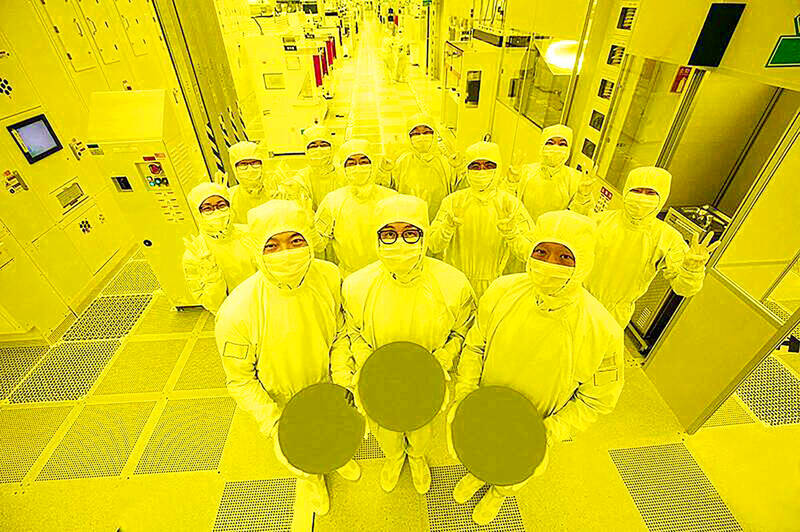
Photo: AFP
Moreover, this implies that local governments will have authority over the energy choices of the nation’s semiconductor and AI-related tech firms. If the goal of the KMT is to curb this development because it is good for Taiwan, the implications of this bill are obvious.
The assault on central government authority was also signaled last week by KMT legislative proposals to rein in the authority of acting heads of agencies. Because the party has been systematically blocking appointments of heads of central government agencies, the government has been forced to appoint or accept acting heads.
KMT Legislator Wen Hsiao-ling (翁曉玲) introduced a bill to place a 6 month limit and other restrictions on acting agency leadership appointees. Wen’s excuse was that she was seeking to restore the legislative branch’s power of review of appointments. The KMT created this problem by blocking Democratic Progressive Party (DPP) appointments to government agencies in order to hamper their functioning. As former Central Election Commission chairman Chen Yin-chin (陳英鈐) observed last week, the proposed laws expand legislative powers at the expense of central government powers. They are thus a component of the KMT’s general campaign of reducing or thwarting central government power.
Wen is a party list legislator and thus does not face the voters. She is an ardent Chinese nationalist who argues that Taiwan needs to peacefully annex itself to the People’s Republic of China (PRC). She was an important proponent of the gutting of the nation’s Constitutional Court.
DISTRACTIONS
Another key component of the KMT anti-governance drive is the constant provision of distractions. The Central Election Commission (CEC) this month rejected a legislative proposal to hold a referendum on capital punishment. The KMT has long used the issue as an irritant in Taiwan’s relations with EU states, who remain opposed to capital punishment. Since capital punishment remains widely supported in Taiwan, there is little need of a referendum. It is simply a distraction designed to focus attention away from the KMT’s attack on governance and the KMT-controlled legislature’s failure to produce meaningful legislation on a range of urgent public issues.
In a similar vein, all 52 KMT legislators supported a referendum on allowing caning as a form of judicial punishment. There is no evidence caning is effective either as a form of rehabilitation or crime prevention, but the bright sadism of the proposal is clearly intended to catch the public eye, again acting as a distraction.
The caning proposal was led by KMT legislator Hung Meng-kai (洪孟楷), who wrote on Facebook of Singapore proposing expanding caning to include scammers, and lamented the lack of progress on drunk driving and fraud. Singapore has long been held up as a model by KMT and TPP party officials.
Finally, this week KMT Chair Cheng Li-wun (鄭麗文) is off to the US to meet with supporters in the Taiwanese diaspora and perhaps a prominent politician or two. As Ross Feingold pointed out earlier this week, the trip will quickly be forgotten because next year the presidential race begins, and the KMT candidate, whoever she is, will make a trip to the US in search of American approval, a far more important journey.
Cheng is unpopular with voters in general. This means that her trip is simply another two-part distraction: one part aimed at giving voters in Taiwan the appearance that she is a weighty person out doing big things, the other at continuing the KMT’s dawdling and delays in fully funding the domestic proportion of the defense budget. Her only purpose in meeting US government officials is to sow doubt, discord and delay.
Former KMT legislator Jason Hsu (許毓仁) said in the Wall Street Journal that her message will be that Taiwan operates under a constitution that supports the principle that Taiwan and the PRC are part of a single China, straight out of the PRC playbook.
Gunter Schubert, in an incisive review of Cheng’s policies at Taiwan Insight, concluded that “the KMT’s China policy, as articulated by Chairwoman Cheng, appears largely devoid of concrete policy content.”
This hollowness will quickly become apparent to US officials who interact with her. Its essential meaninglessness is itself a form of distraction and delay: asking her for concrete policy statements will simply produce more meaningless verbiage, as many observers have noted.
Meanwhile, it is June. Has the 2026 government budget emerged from committee review yet?
Notes from Central Taiwan is a column written by long-term resident Michael Turton, who provides incisive commentary informed by three decades of living in and writing about his adoptive country. The views expressed here are his own.

Taiwan’s English education system is being pulled apart by three opposing forces. Bilingual Nation 2030 pulls students toward English and global communication. Artificial Intelligence (AI) readiness pulls them toward digital judgment, verification and AI-mediated work. But Taiwan’s old exam culture pulls them back toward memorization, grammar drills, timed reading and correct answers. If the education system keeps using old exams to define success, it risks producing graduates who are neither genuinely bilingual nor genuinely AI-ready, but trained for tasks machines can already perform. The first force is Bilingual Nation 2030. Launched in 2018, the policy aimed to “help Taiwan’s workforce connect
It seems every few days one bumps into one of those “real man” comments in which Taiwan is urged to “face reality” or similar, and “make a deal,” with the speaker implying that soon it will be too late. “Deal” advocates always present themselves as having a superior grip on reality, and the manly ability to make the “hard choice.” Their testosterone-laden language often echoes that of Taiwan sellout advocates. Note that such commentary always specifies a process (“make a deal, work with, make progress”), never the end state of what occupation by a violent authoritarian colonialist state will entail. In
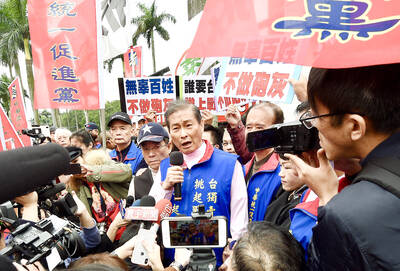
There are shadowy cabals plotting to sell out Taiwan to be annexed by China, by invasion if necessary. Fortunately, they are buffoons. In 2019, former Bamboo Union gangster and founder of the China Unification Promotion Party (CUPP), Chang An-le (張安樂, colorfully known as “White Wolf”), led a protest at the Legislative Yuan against comments made by then-premier Su Tseng-chang (蘇貞昌) that in the event of an attack by China, he would never surrender, but would protect the nation by fighting to the end, even if he only had a broom. Chang had party members bring a wooden casket that they
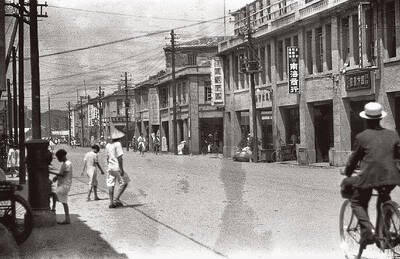
June 1 to June 7 "If all Taiwanese were as afraid of dying as you, then what would happen?” Physician Shih Chiang-nan (施江南) reportedly said this to his wife Chen Chiao-tung (陳焦桐) after she urged him to stop intervening on behalf of Taiwanese soldiers stranded overseas after serving in the Japanese Army during World War II. Shih had clashed with high-ranking officials over the issue, engaged in several heated arguments with Taiwan governor-general Chen Yi (陳儀) and allegedly shouted at general Ko Yuan-fen (柯遠芬), chief of staff of the Taiwan Garrison Command, over


 RSS
RSS