


The pavements of Hanoi’s wide boulevards and narrow lanes have long been clogged with bustling food stalls, weaving scooters and crowds of coffee and beer drinkers sitting on low plastic stools.
But the spontaneity that charmed tourists and supported street vendors in Vietnam’s capital has subsided in recent months as authorities clamp down on illegal use of footpaths.
Unauthorized peddling, parking and blocking foot traffic were long tolerated informally, but fines are now being enforced — and city authorities are considering doubling them.
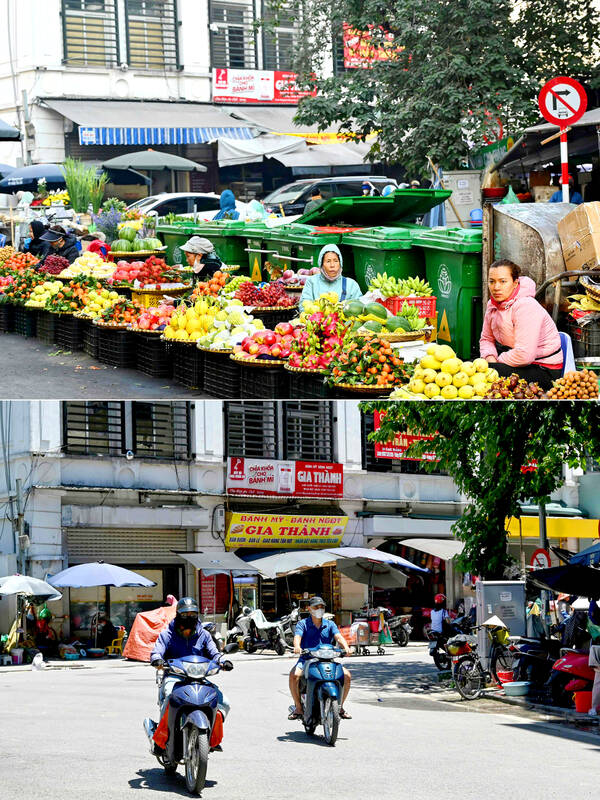
Photo: AFP
“Without vendors, I don’t think Hanoi is Hanoi anymore,” said Nguyen Thi Hoan, 58, who used to sell flowers on the pavement outside a large downtown apartment complex.
“Of course, I support the efforts to make the pavements clearer,” she added.
Hoan worked from the same slab of concrete for a decade, eking out a modest living hawking colorful bouquets. Now she has been banished along with fruit and vegetable sellers to a vacant lot with lower foot traffic, her turnover roughly halving as a result.
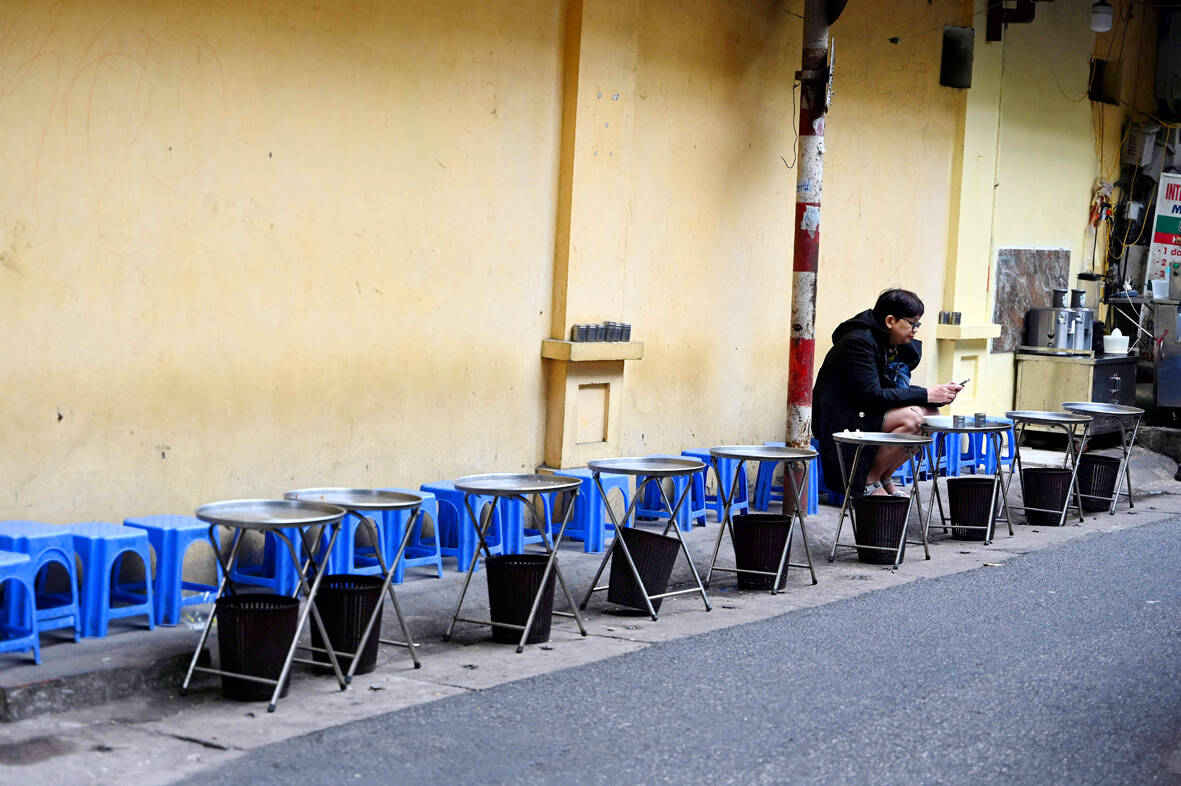
Photo: AFP
“I don’t know what to do instead to make ends meet,” she said. Street vending is “the tradition of people in Hanoi.”
CURB CULTURE
Whether you need a meal or a mechanic, balloons or even a barber, Hanoi’s busy pavements could always oblige. The capital has attracted record numbers of tourists in recent years, many eager to sit outside drinking beer and eating street food as the city surges past.
“Low plastic stool, cheap but delicious noodles, cold Hanoi beer,” former US president Barack Obama reminisced about a meal he shared there with late chef Anthony Bourdain in 2016.
They ate their US$6 bun cha inside, but the Hanoi episode of Bourdain’s CNN travelogue is a love letter to the city’s pavements, chronicling everything from pavement Zumba classes to outdoor noodle vendors to local draft beer bia hoi.
Hanoi’s vibrant curb culture has always had downsides — traffic jams and noise complaints, safety and sanitary concerns.
Now the capital is changing fast, as is Vietnam, whose communist leaders have spurred rapid development but brook little dissent.
Authorities say their crackdown will bring cleanliness and order to the city of eight million people.
ICED TEA
Hanoi has launched previous campaigns to clear footpaths, but they were often short-lived. This time authorities have intensified their efforts over several months, installing nearly 2,000 surveillance cameras to catch offenders.
Businesses that obstruct foot traffic face fines of up to 6 million Vietnamese dong (US$230), while illegal vendors can be penalized 250,000 dong. Police have issued more than 3,000 fines since December, according to state media.
Some welcome the new order. Le Trung Chien, who works at a marketing firm in a busy downtown area, used to fume at the street vendors and scooters parked in his path, forcing him to walk in traffic to get to his bus stop.
“I completely support the city’s efforts to make the sidewalks clear and tidy,” he said. “I don’t like my city to be a mess as it has always been.”
Under a new plan floated this month, the fines would double as the city mulls allowing vendors to rent back authorized curb space.
For Tran Trung Van, who manages a three-story coffee shop, that means packing more patrons around inside tables and turning away those who want to smoke.
“About one third of my clients want to sit on the pavements, especially during cooler days, mornings and evenings,” he said.
He has lost some business, he said, noting that “culture and habits” mean people want to be outside.
Office worker Dinh Tung is among them, and says he misses lingering with colleagues at tables that spilled into the street.
“I hope things will return to normal soon,” he said. “Hanoi is only Hanoi if we can have sidewalk iced tea.”
It seems every few days one bumps into one of those “real man” comments in which Taiwan is urged to “face reality” or similar, and “make a deal,” with the speaker implying that soon it will be too late. “Deal” advocates always present themselves as having a superior grip on reality, and the manly ability to make the “hard choice.” Their testosterone-laden language often echoes that of Taiwan sellout advocates. Note that such commentary always specifies a process (“make a deal, work with, make progress”), never the end state of what occupation by a violent authoritarian colonialist state will entail. In
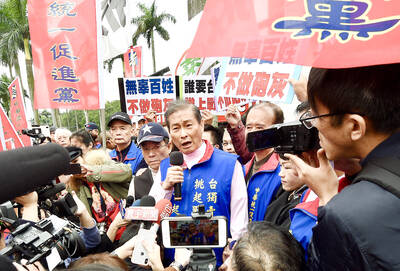
There are shadowy cabals plotting to sell out Taiwan to be annexed by China, by invasion if necessary. Fortunately, they are buffoons. In 2019, former Bamboo Union gangster and founder of the China Unification Promotion Party (CUPP), Chang An-le (張安樂, colorfully known as “White Wolf”), led a protest at the Legislative Yuan against comments made by then-premier Su Tseng-chang (蘇貞昌) that in the event of an attack by China, he would never surrender, but would protect the nation by fighting to the end, even if he only had a broom. Chang had party members bring a wooden casket that they
June 1 to June 7 "If all Taiwanese were as afraid of dying as you, then what would happen?” Physician Shih Chiang-nan (施江南) reportedly said this to his wife Chen Chiao-tung (陳焦桐) after she urged him to stop intervening on behalf of Taiwanese soldiers stranded overseas after serving in the Japanese Army during World War II. Shih had clashed with high-ranking officials over the issue, engaged in several heated arguments with Taiwan governor-general Chen Yi (陳儀) and allegedly shouted at general Ko Yuan-fen (柯遠芬), chief of staff of the Taiwan Garrison Command, over

Food prices have often played a major role in Taiwan’s history. The first major wave of migration from China occurred in 1628. A moderate drought, the Ming Dynasty maritime ban that prohibited fishing and trading (intended to reduce piracy) and a temporary tax, conspired to exhaust local resources, leading to famine in Fujian Province. The famed pirate and trader Zheng Zhilong (鄭芝龍), scooped up starving people from Fujian and transported them across the Taiwan Strait, where they settled under the Dutch. Two factors enabled Zheng. First, by 1624 he had settlements around today’s Beigang (北港) in Yunlin County with a small


 RSS
RSS