


The sport of surfing is generally believed to have been invented in Hawaii and then, in the 1910s, spread to California, the US East Coast and Australia. Its first popularity boom came in the 1960s on the back of youth culture and counterculture, and globalization has progressed it ever since.
By the late 1980s, when surf photographer John Seaton Callahan came on the scene, surf-related adventure tourism was ready to explode. Born and raised in Hawaii and graduating from the University of California at Los Angeles (UCLA) in 1987, Callahan spent his late 20s and 30s in what he describes as the “Golden Era” of surf discovery, the 1990s, a decade when “magical new lineups were surfed for the first time in Asia, Europe, Africa and the Americas.”
Callahan recently published a record of three decades of travels in SurfExplore: Discovering Surfing Locations Worldwide. It’s a coffee table book of photos and almost 60,000 words of text describing his trips from 1992 to the 2010s to 28 rather atypical surf locations. They include Haiti, Algeria, Gabon, Sierra Leone and, in Asia, Myanmar, China, South Korea, Pacific-facing Indonesia and Taiwan.
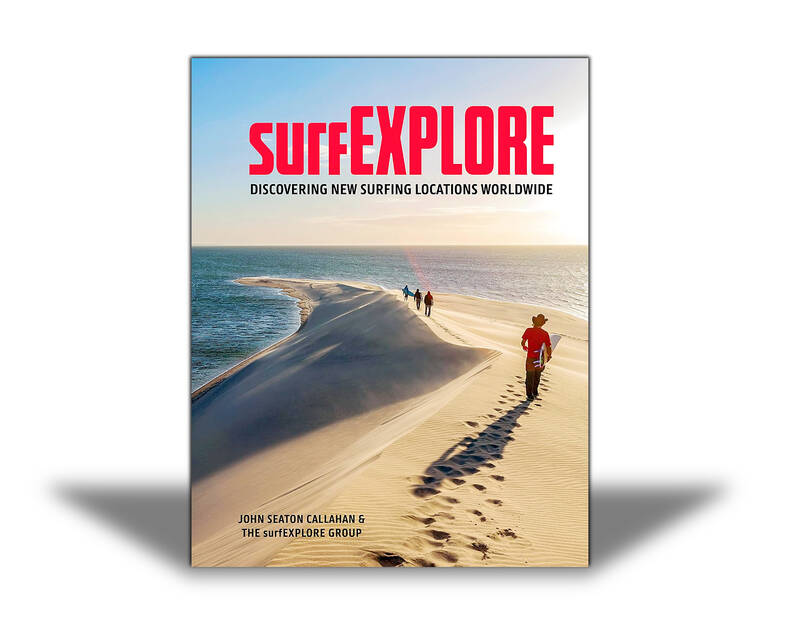
Callahan, who is credited with naming one of Asia’s most famous waves — Cloud 9 in the Philippines— and currently resides in Singapore, started out as a photographer for Surfing Magazine. The monthly set him on this career path in 1988 by lending him a high-powered 650mm zoom lens to shoot the famed breaks of Oahu’s North Shore.
As Hawaii’s big, photogenic swells only hit during the winter months, Callahan would spent the rest of the year mounting expeditions in search of every surfer’s dream — waves that were not only perfect, but also, as a rule, empty. Preferably, they were also tropical.
This search, which still continues today through SurfExplore Group, an operation Callahan founded in 2010, which has taken him to locales that were dangerous either for their extremely remote locations (West Papua), hostile inhabitants (the Andaman Islands) or because they were in or near war zones (Mauritania, Sierra Leone).
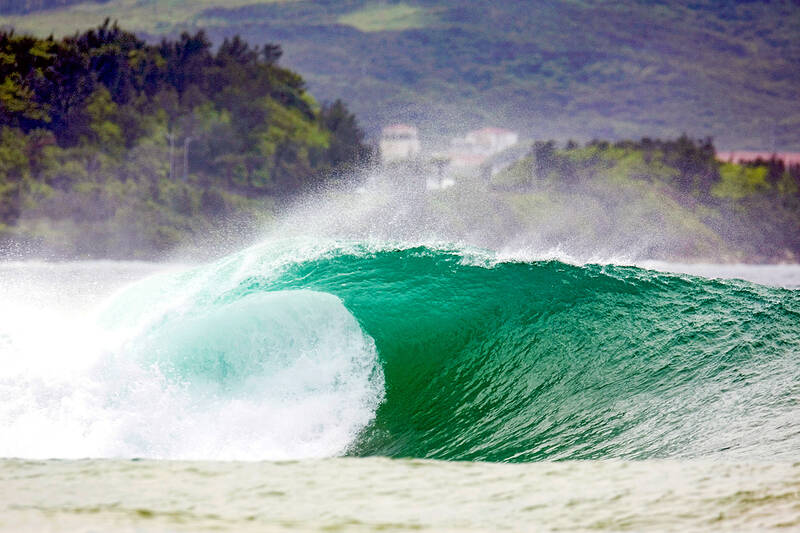
Photo: courtesy of John Seaton Callahan and SurfExplore
The Taiwan chapter is subtitled “Surfing the Rebel Country (That is Not a Country)” and, like other chapters, includes brief overviews of local politics and surfing history. His quick take on Taiwan-China politics is actually not bad, but his version of Taiwan’s surfing history is in need of correction.
Callahan writes that surfing was not possible during Taiwan’s martial law period, which lasted until 1987, save in one area that was open to water recreation, Yilan’s Honeymoon Bay. There, surfing was pioneered by “the Sun brothers, ethnic Chinese from Hawaii.”
This is mostly wrong.
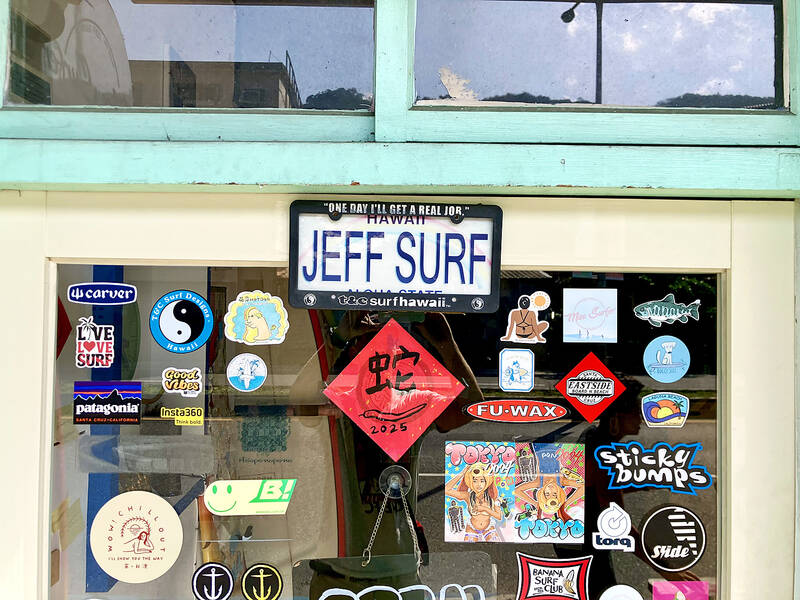
Photo: David Frazier
I began renting boards from Jeff Sun (孫耀聖) and his brother Tom (孫耀東) — “the Sun brothers” —when I first started surfing in Taiwan in 1996. In the years since, as a journalist I have interviewed Jeff, who is regarded as Taiwan’s godfather of surfing and still has his name on a surf shop in Yilan’s Wushi Harbor, multiple times.
Jeff was born in Taiwan, not Hawaii, in 1952, and began surfing during the mid-1960s with American GIs at Jinshan Beach on the north coast.
Though Taiwan’s beaches were generally off limits for watersports during the martial law period — the KMT government feared incursions by Chinese communist spies or even an invasion — special dispensations were given to the US military, which kept several thousand personnel based on the island from the early 1950s to 1979.
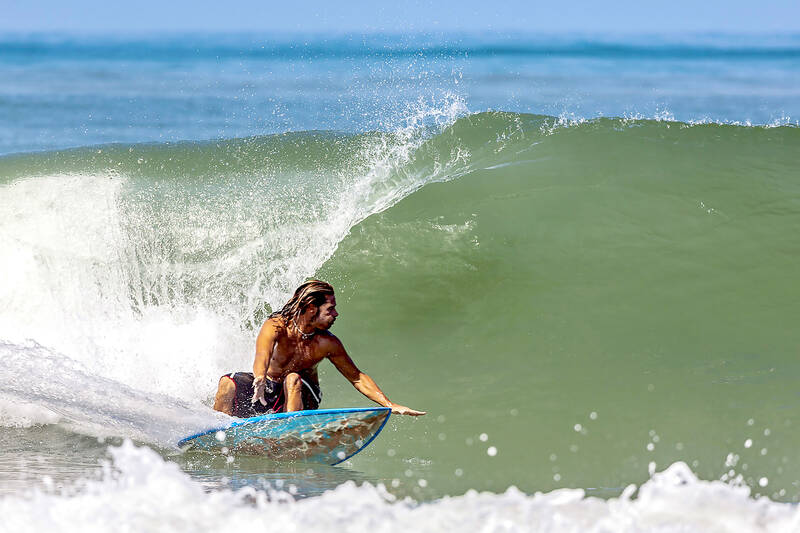
Photo: courtesy of John Seaton Callahan and SurfExplore
By the 1960s, the US military had established Camp McCauley, a weekend getaway that featured some beach huts and basic lodging, on the northeast coast near New Taipei City’s Wanli District (萬里). Though the camp no longer exists, the location was near what is now Guosheng Nuclear Power Plant and also quite close to the famed rock formations at Yehliu.
Nearby Dingliao Beach was then known as McCauley Beach and, according to photos posted in veterans groups, GIs surfed there with both fiberglass and wooden surfboards. It seems they may have also surfed at other northeast coast beaches like New Taipei City’s Jinshan District (金山), as reported by Jeff Sun.
In the 1960s, “On the beaches, it was only the foreigners surfing. Among the Chinese, there was nobody,” Sun told me in a 2008 interview.
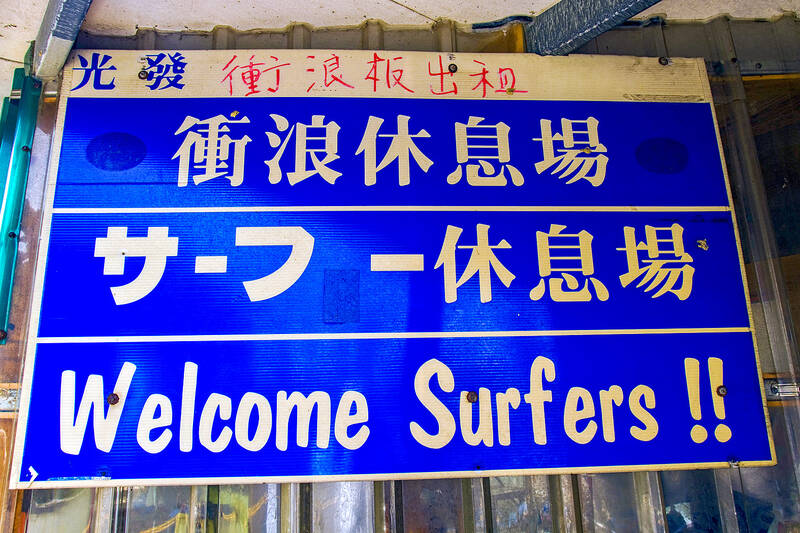
Photo: courtesy of John Seaton Callahan and SurfExplore
Sun got his first surfboard, a nine-foot woodie brought from California by his father, when he was 20 years old. Five years later, in 1977, he moved to Hawaii, where he progressed to surf some of the island’s most famous breaks, including Bonzai Pipeline and Waimea Bay. He also met and surfed with wave-riding legends including Gerry Lopez, Hans Hedemann and Dane Kealoha.
“I was surfing with these guys all the time. They were my good friends,” Sun said. “They taught me to surf big waves when we’d paddle out together.”
After a short stint in California, Sun returned to Taiwan in the early 1980s, where he worked as a lifeguard on Fulong Beach and began renting and shaping surfboards. After taking a job in Taipei, he frequently took the 4:30am train to Honeymoon Bay, a small beach near the Yilan County fishing port town of Dasi Township (大溪), for early morning surfs before work. He was joined by a couple of friends from Hawaii, including a radio DJ at ICRT and an exchange student.
In 1979, Sun moved to Honeymoon Bay and opened Jeff Surf Shop. For almost 20 years it was the only surf shop in all of Taiwan.
It’s not clear when Callahan visited Taiwan for the trip he documents in SurfExplore. Like many of the chapters in his book, documentation is vague and descriptions — a mix of travelogue and travel guide — can be frustratingly brief.
Photos show the High Speed Rail, so the visit was likely during the last decade or so. Surf spots visited included Jialeshuei (佳樂水) near Kenting and several “secret spots” along Taiwan’s southwestern coast between Kenting and Kaohsiung. And as luck had it, Callahan scored. A typhoon passing through the South China Sea produced four-meter waves — ridable swell at that scale is a rarity in Taiwan.
Though the writeups in SurfExplore are more about lore than fact checking, the book is still marvelous for imbuing readers (presumably surfers) with the stoke of discovering magnificent and uncharted waves. The locations Callahan visits will have you checking GoogleMaps constantly. (Where the heck is Morotai Island?) As with much surf writing, the key information is about seasonal weather variation and wave access.
Callahan’s photography, meanwhile, is stunning. Represented by Getty, he’s published more than 3,000 images over four decades in magazines the world over. The stories his pictures tell are of surfers on their endless quest — trekking over sand dunes, or along empty palm-lined beaches, or skirting the rusting hulks of shipwrecks. For better or worse, they are the modern day board-riding equivalents of Richard Burton looking for the source of the Nile.
Taiwan’s renewable shortfall is a problem of execution, not resources. Japan’s long-cycle, joined-up energy planning is the model worth studying — but what Taiwan can borrow is the institutional machinery, not the politics. When Nvidia CEO Jensen Huang (黃仁勳) used his visit to Taipei last month to warn that the country needs far more electricity, he was naming a constraint its own planners already know well: Taiwan Power Co (Taipower, 台電) expects demand from the semiconductor and artificial intelligence (AI) sector alone to exceed 5 gigawatts (GW) by 2030. The harder question is not whether to build more capacity but which
In a projection room, visitors at the Re: Battle City exhibition at Kaohsiung’s Neiwei Arts Center are invited to sit and watch a 20-minute animated movie. Artist Chang Li-ren (張立人) created the movie with dolls he made by molding paper into crude, painted figurines. The dolls interact in a detailed and realistic Taiwanese cityscape. Outside the projection room, visitors can wander around a massive model of the city. A sizeable crowd happily takes pictures of what looks like the best dollhouse in Taiwan: the same props that were used to tell the story of the country’s descent into techno-dictatorship in the movie. The

The last time Taiwan’s foreign correspondents were invited to a special briefing with a sitting president was in 2015. That was two presidents ago under Ma Ying-jeou (馬英九). But Thursday morning, President William Lai (賴清德) welcomed the nation’s international press corps warmly, speaking specifically to the theme of press freedom. Lai addressed Taiwan’s foreign press corps saying, “You live, work and report in Taiwan.” “Thank you for your professionalism and upholding the spirit of press freedom,” he continued. “As you engage in your work of journalism, you let the world see Taiwan.” The timing of this event, hosted by the Taiwan Foreign
Chinese Nationalist Party (KMT) Chairwoman Cheng Li-wun’s (鄭麗文) recent trip to the US highlighted her party’s anti-Taiwan defense policies. Disapproval of their policies was strong among those who met with her. Republican Senator Dan Sullivan, said that the KMT was “playing with fire.” Democratic Representative Tom Suozzi reportedly said that Cheng’s party was “weakening deterrence.” Foreign policy maven David Sacks observed in Asia Nikkei that “many Americans struggle to see the logic behind the KMT’s refusal to fund the portion of the special defense budget pertaining to indigenous defense production.” The logic of the KMT’s decision to purchase only US


 RSS
RSS