


Chinese Nationalist Party (KMT) Chairwoman Cheng Li-wun (鄭麗文) has wrapped up her trip to China to meet with Chinese Communist Party (CCP) officials, including CCP Secretary-General Xi Jinping (習近平).
Yet, despite all the press, there may be more going on than meets the eye.
THE TIMING
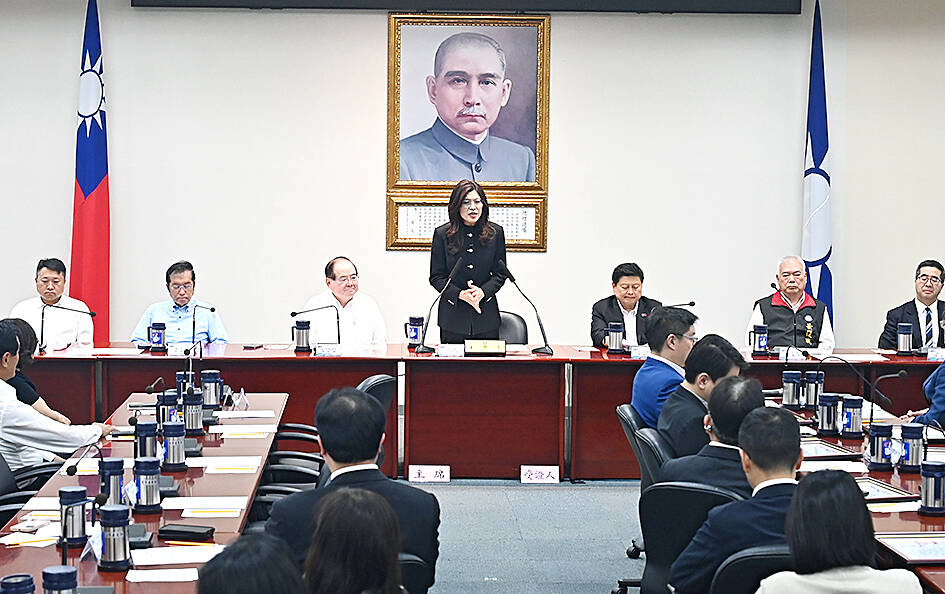
Photo: Wang Yi-sung, Taipei Times
The invitation from the CCP appears to have arrived on the morning of March 30. Cheng immediately accepted and hastily prepared a press conference to make the announcement.
There has been speculation that the CCP wanted to arrange this meeting prior to US President Donald Trump’s visit to Beijing on May 14 and 15 for propaganda purposes, which begs an obvious question.
Trump was originally scheduled to visit on March 31, but the dates were moved back due to the Iran war. Cheng repeatedly expressed her desire to meet Xi even before taking office in November. If this were the main reason, why was she not invited before the originally scheduled meeting?
Some have speculated that the CCP chose April 7 as the starting day of her trip to coincide with Taiwan’s Freedom of Speech Day. It is true the CCP often chooses dates for political messaging, but this seems unlikely: Why would it want to draw attention to freedom of speech, on a day chosen to commemorate the self-immolation by pro-Taiwan independence activist Deng Nan-jung (鄭南榕)?
The date chosen for the Cheng-Xi meeting is more likely meant to undermine the 47th anniversary of the signing of the Taiwan Relations Act in the US. The announcement of the meeting took place only after Cheng had arrived in China; the April 7 arrival was likely to give the CCP a couple of days to assess if Cheng was a loose cannon prone to saying things embarrassing to the CCP.
For her part, Cheng has been clear all along that she planned to visit Beijing first, and only then would she visit the US with a hoped-for outline of a plan for cross-Strait peace she could pitch to the Americans. She hoped to accomplish both trips by June, allowing her to shift focus to the November elections.
OWN GOAL
From the perspective of the ideological Chinese Nationalist wing of the KMT, she seemingly made a strategic blunder in hastily accepting the CCP’s invitation, with no negotiation over the details. She handed over control of the itinerary and press access to the CCP.
Her predecessors on similar trips were less hasty and more careful. They had more control over their trips and their entourage, including over the choice of journalists accompanying them.
Former president and party chair Ma Ying-jeou (馬英九) is an example. Like Cheng, his agenda called for closer integration with China culturally, politically and economically. After leaving office, he was more explicit that he was laying the groundwork for eventual “reunification with the mainland.”
He was mindful that he had to sell his agenda not only to KMT supporters, but to Taiwanese voters. To achieve his ultimate aim required keeping some leverage in negotiations.
That required demanding at least some respect for the dignity of the KMT and the Republic of China (ROC) to sustain trust among Taiwanese that his administration could set a path forward at a pace and on terms the public could accept and absorb. Despite his efforts, he grossly misjudged public sentiment in how fast he could proceed, leading to the Sunflower movement rising up and flooding the streets of Taipei with hundreds of thousands of protesters, effectively halting his plans.
Cheng gave away leverage right out of the gate, setting a precedent that makes it harder for her and her ideological successors to negotiate with even the slightest semblance of parity or reciprocity. This puts her own goals of closer cross-Strait integration and peace on terms she can successfully sell to the Taiwanese public — already highly improbable — even harder to accomplish.
But why? Was this a blunder, or is there something about her goals that does not require negotiating leverage?
DEFENSE BUDGET DEMANDS?
Cheng has sued the Liberty Times (Taipei Times’ sister newspaper) over reporting that the CCP demanded the KMT block defense spending increases in exchange for a Cheng-Xi meeting. She vehemently denies any such quid pro quo.
It is very possible that both Cheng and the journalist are telling the truth. The emissaries she sent prior to her visit are well-known to the Chinese side, and they are likely well versed in their — and Cheng’s — sincerity in their Chinese nationalism.
Knowing this, and the way negotiations are done in China, there would be no need to say such a thing so explicitly. Implicitly, both sides understand each other. At most, they would only need to refer to “goodwill” and “sincerity” in conversations to get the message across.
A similar line of speculation is whether Xi made similar demands of Cheng in their closed-door meeting. Their discussions were about far more consequential topics than the mere holding of a meeting.
In this case, it is far more likely that specifics were discussed. It is very possible Xi did bring up defense spending.
However, there is a flipside to these discussions that I have not seen discussed: What if it was the other way around?
It could be that it was not the CCP making demands, but rather that Cheng used the blocking of defense spending as a gesture of goodwill to achieve her goals.
Cheng appears to genuinely believe that she can work a deal with the CCP that will restore peace and stability in the Taiwan Strait, and by extension, the region and the world by removing this potential flashpoint. She has bent over backward to accommodate the CCP on everything else, so why not on this?
Short of the release of recordings of all the meetings, we cannot know for sure. Keeping in mind the timeline, her behavior and her stated aims, this should be considered a serious possibility.
SISTERLY BONDS
Though far less likely, there is another possibility.
Initially seemingly opposed to any special military budget, Cheng bowed to public pressure and countered President William Lai’s (賴清德) proposed NT$1.25 trillion (US$40 billion when proposed) with a KMT counterproposal of NT$380 billion “+N,” with the “N” representing potential future additional spending negotiated on a case-by-case basis.
Meanwhile, potential KMT presidential candidate Taichung Mayor Lu Shiow-yen (盧秀燕) called for a budget of between NT$800 billion and NT$1 trillion following her recent visit to the US. In an official readout from a recent bipartisan trip to Taiwan by US Senate Foreign Relations Committee senators, they stated: “The Senators also warmly welcomed Taichung Mayor Lu Shiow-yen’s recent statements of support for robust defense spending.”
This seemingly pits Cheng and Lu against each other as leaders of the “ideological” and “electability” factions in the KMT. But what if they are two sides of the same coin?
Former KMT chairman Eric Chu (朱立倫) played both sides, messaging very different things to American audiences than to his Chinese counterparts.
What if Cheng is the KMT’s “acceptable” face to the ideological base and China, while Lu plays the role of “acceptable” face of the KMT to moderate voters and the Americans?
Both refer to their mutual relationship as “sisterly,” and their body language suggests a genuine warmth. They are in regular communication and share similar backgrounds.
That being said, both Cheng and Lu have been fairly consistent in their respective stances going back years, so this does seem unlikely.
But it is just possible enough to be worth keeping an eye on.

Taiwan’s English education system is being pulled apart by three opposing forces. Bilingual Nation 2030 pulls students toward English and global communication. Artificial Intelligence (AI) readiness pulls them toward digital judgment, verification and AI-mediated work. But Taiwan’s old exam culture pulls them back toward memorization, grammar drills, timed reading and correct answers. If the education system keeps using old exams to define success, it risks producing graduates who are neither genuinely bilingual nor genuinely AI-ready, but trained for tasks machines can already perform. The first force is Bilingual Nation 2030. Launched in 2018, the policy aimed to “help Taiwan’s workforce connect

It seems every few days one bumps into one of those “real man” comments in which Taiwan is urged to “face reality” or similar, and “make a deal,” with the speaker implying that soon it will be too late. “Deal” advocates always present themselves as having a superior grip on reality, and the manly ability to make the “hard choice.” Their testosterone-laden language often echoes that of Taiwan sellout advocates. Note that such commentary always specifies a process (“make a deal, work with, make progress”), never the end state of what occupation by a violent authoritarian colonialist state will entail. In
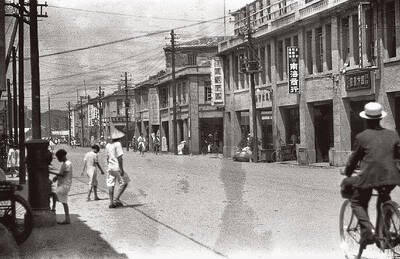
June 1 to June 7 "If all Taiwanese were as afraid of dying as you, then what would happen?” Physician Shih Chiang-nan (施江南) reportedly said this to his wife Chen Chiao-tung (陳焦桐) after she urged him to stop intervening on behalf of Taiwanese soldiers stranded overseas after serving in the Japanese Army during World War II. Shih had clashed with high-ranking officials over the issue, engaged in several heated arguments with Taiwan governor-general Chen Yi (陳儀) and allegedly shouted at general Ko Yuan-fen (柯遠芬), chief of staff of the Taiwan Garrison Command, over

“Taiwan’s Opposition Leader Comes to US With a Message Straight Out of Beijing” read a May 31 headline in the Wall Street Journal. Top US administration officials and members of Congress almost certainly read the WSJ, and if there was a bullet point takeaway that people in Washington should absorb ahead of Chinese Nationalist Party (KMT) Chair Cheng Li-wun’s (鄭麗文) arrival in DC on June 9, that headline is it. The last few columns have discussed this very topic, and the timing is not coincidental. While those top officials likely do not read the Taipei Times, judging by the number


 RSS
RSS