


For generations, human beings have wondered: What would alien life from another planet be like? But we rarely ask the opposite: What would they think of us?
It’s a question that can produce some, well, uncomfortable answers if you happen to be an earthling.
“If I were looking at Earth from a distance, I would be pretty disappointed,” theoretical physicist Avi Loeb says. “Most of our investing is dealing with conflicts to prevent other people from killing us or us killing others. Look at the Ukraine war over a little bit of territory. That is not a sign of intelligence.”
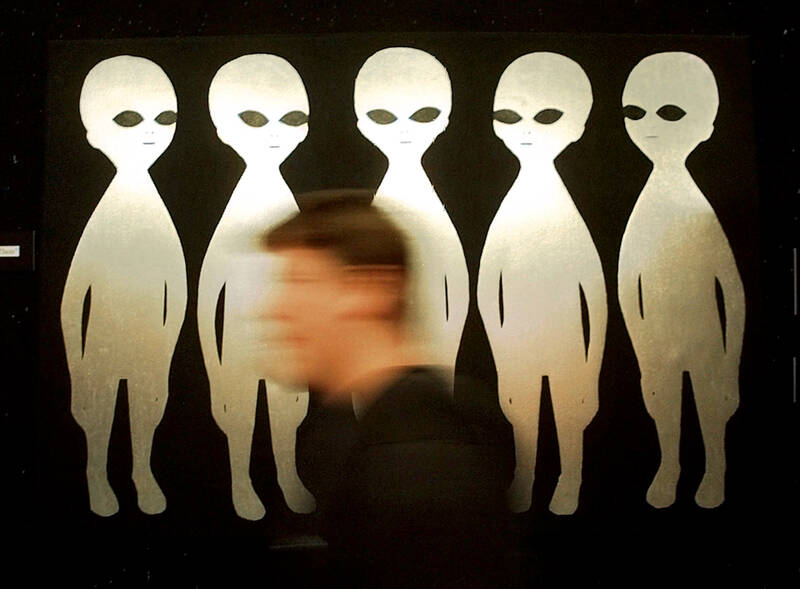
Photo: AP
The debate on whether little green men or UFOs are among us escalated in February when former president Barack Obama, responding to a podcaster’s question, said aliens are “real,” but he ”hasn’t seen them” and “they’re not being kept at Area 51.”
President Donald Trump later announced on social media that he was directing release of government files because of “tremendous interest.”
Stepped-up interest in UFOs also is swirling as the US heads back toward the moon with the April 1 launch of NASA’s Artemis II mission. The four astronauts aboard will do a fly-around of the moon before returning to Earth.
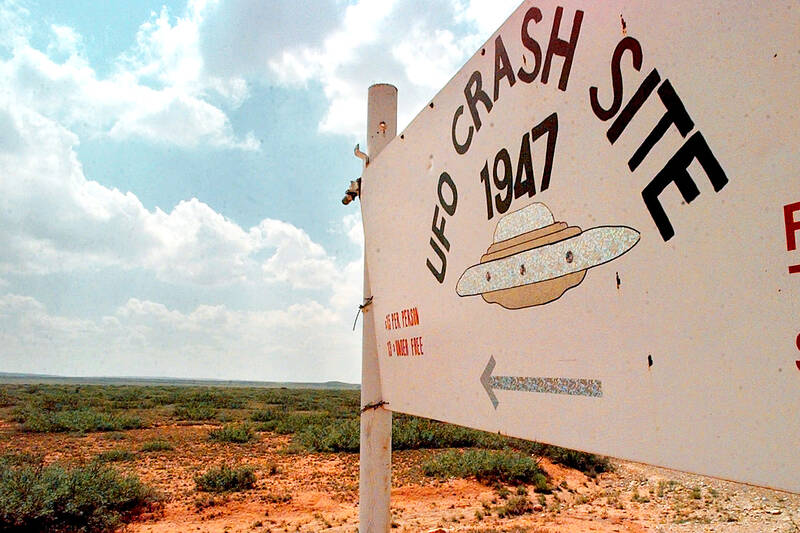
Photo: AP
In a world riven by war, civil unrest, climate change and divisiveness, it’s easy to wonder what newcomers to Planet Earth might make of us and our struggles. Whatever the case, well over a majority of Americans echo the sentiment of the slogan from The X-Files: “The truth is out there.”
A 2021 survey conducted by the Pew Research Center showed about two-thirds of Americans said their best guess is that intelligent life exists on other planets. About half of US adults said UFOs reported by people in the military are “definitely” or “probably” evidence of intelligent life outside Earth.
“We don’t want to think this is the only place in this extraordinarily and incomprehensibly large universe where life and intelligence and even technology have emerged,” says Bill Diamond, president and chief executive of the SETI Institute in Mountain View, California.

Photo: AP
“It sort of says about humans, ‘We don’t want to be alone.’”
SOMETHING IS UP THERE. BUT WHAT?
Americans have been fascinated by the thought of life outside this planet following the recovery of debris in 1947 near Roswell, New Mexico. The military initially said the material was from a flying disc, only to reverse course and tell the public it was from a weather balloon.
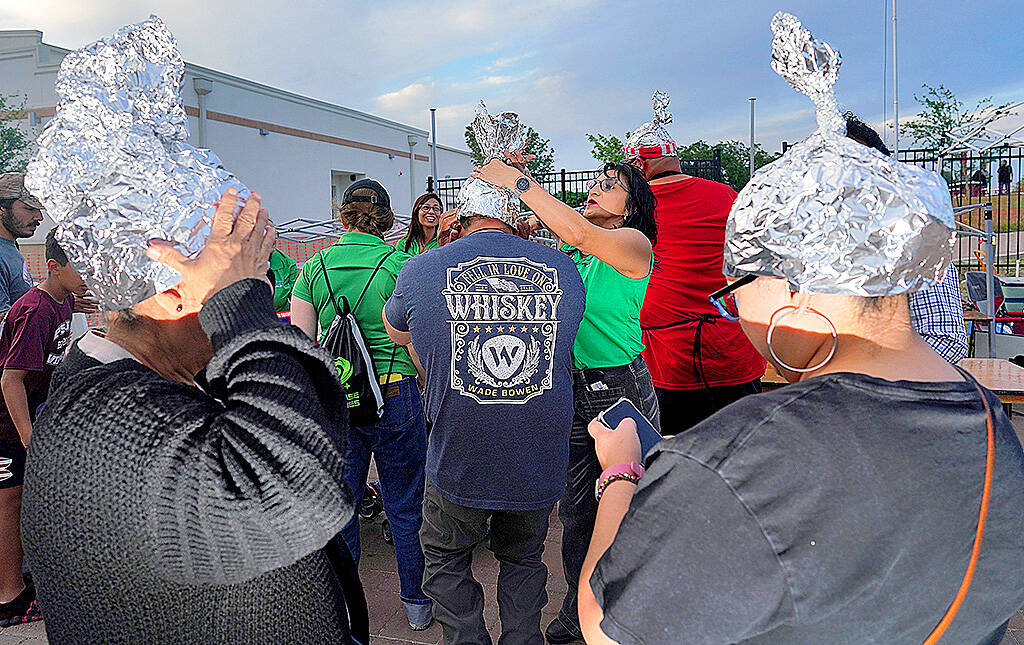
Photo: AP
Hollywood ran with it. Flying saucers, little green men and eventually humanoid gray aliens became part of popular culture. April 5 even is celebrated annually throughout the iconic Star Trek franchise as First Contact Day to mark the date in 2063 when humankind, in Trek canon, first made contact with Vulcans.
Much in the popular culture suggests any aliens might be aggressive. Priscilla Wald, who teaches about science fiction at Duke University, has a theory as to why.
“It seems to me it’s a reflection on who we are, that we’re projecting onto aliens the way we treat each other,” Wald says. “So the aliens are coming down, they want to conquer us, they’re violent. Who does that sound like? It sounds like us.”
In 2024, the Pentagon released hundreds of reports of unidentified and unexplained aerial phenomena. However, that review gave no indications that their origins were extraterrestrial.
On two separate occasions, Debbie Dmytro saw things in the sky over Michigan’s southern Oakland County. The greenish object Dmytro says she saw March 1 in the sky over Royal Oak, Michigan, looked like neither plane nor helicopter. Dmytro, a 56-year-old medical professional, acknowledges that it could have been some type of commercial or delivery drone.
What she saw in 2023 in the same general area north of Detroit is not so easily explained.
“Four yellow lights, yellowish golden lights and they were all flying very, very low,” Dmytro remembers. She says the lights were about 30 meters up at their nearest.
“I’ve never seen anything so low without any noise and flying in complete uniformity,” she says. “Is it something man-made? Is it something that’s not manmade? Who knows?”
Who knows indeed? UFOs, the term for unidentified flying objects, has in recent years given way to UAP — unidentified aerial phenomena or unidentified anomalous phenomena.
“Absolutely, there are such things” as UAPs and UFOs, says Diamond, whose SETI — Search for Extraterrestrial Intelligence — seeks to explore, search and understand the nature of life and intelligence in the universe.
“People observe things in the sky that they can’t immediately identify or recognize as either human engineering such as planes or drones or helicopters, or animals, such as birds, and therefore they don’t know what they are,” Diamond says.
TIME FOR TRUTH
Like so many, Dmytro wants to know what the government knows. “I think there’s more information out there. I’m open to learning more,” she says. “I have an open mind. It’s always about scientific proof.”
Retired Rear Adm. Timothy Gallaudet says evidence clearly shows there are UAP zipping around the airspace and in the oceans.
“The nonhuman intelligence that operates them or controls them are absolutely real,” Gallaudet says. “We’ve recovered crashed craft. We don’t know if they’re extraterrestrial in origin.”
Gallaudet worked as acting administrator for the National Oceanic and Atmospheric Administration. He participated in a 2024 congressional hearing on UAP disclosure and says the release of government files promised by Trump is something people find of interest. He just hopes the president follows through.
There are billions of galaxies in the universe and each has billions of stars, so the likelihood life developed elsewhere is fairly high, according to University of Michigan Astronomy Professor Edwin Bergin, who teaches about looking for life elsewhere. He believes that if intelligent beings navigated vast distances to reach Earth they would make themselves known — despite humanity’s penchant for creating chaos.
“I would think that they would look at us like we were crazy ... but they would come out,” he says. “I mean, why come here otherwise unless you’re going to sit and observe.”
Loeb, director of the Institute for Theory & Computation at Harvard and head of the university’s Galileo Project for the Systematic Scientific Search for Evidence of Extraterrestrial Technological Artifacts, believes in the likely existence of extraterrestrials.
“They might be laughing at us,” he says. “They might be watching us ... to make sure we will not become predators, that we will not become dangerous to them.”
NATIONAL SECURITY
Much of the government’s secrecy around UFOs and UAP is tied to national security concerns, according to Diamond.
“We have pretty advanced technologies, satellite, ground-based that are for various purposes mostly national security and defense that are pointing at the sky or things on board aircraft,” Diamond says. “Sometimes these pick up objects. The technology behind it is sensitive and protected.”
Government data, including a “trove ” of UAP video the Navy is sitting on, should be shared with scientists for research and a better understanding of the characteristics of the objects, says Gallaudet, who spent 32 years in the Navy and viewed classified UAP video.
“When you look at these things in our airspace having near collisions with our aircraft, that’s a real valid concern,” he says. “We are just not sure of what they are and what they intend to do with their interaction with humanity. That could be a national security threat, or not.”
“When has ignorance ever been a good national strategy?” Gallaudet asks. “Whether it be scary, harmful or not, or a mix, I think seeking the truth is in our best interest.”
Meanwhile, Diamond doesn’t think any “true alien encounter could be kept secret.”
“If any civilization has mastered interstellar travel, they have technology and capabilities beyond our wildest comprehension,” he says. “If they want to interact, they will; if they don’t, they won’t. If they want to be seen, they will be, and if not, they won’t be!”

By global standards, the traffic congestion that afflicts Taiwan’s urban areas isn’t horrific. But nor is it something the country can be proud of. According to TomTom, a Dutch developer of location and navigation technologies, last year Taiwan was the sixth most congested country in Asia. Of the 492 towns and cities included in its rankings last year, Taipei was the 74th most congested. Taoyuan ranked 105th, while Hsinchu County (121st), Taichung (142nd), Tainan (173rd), New Taipei City (227th), Kaohsiung (241st) and Keelung (302nd) also featured on the list. Four Japanese cities have slower traffic than Taipei. (Seoul, which has some

Michael slides a sequin glove over the pop star’s tarnished legacy, shrouding Michael Jackson’s complications with a conventional biopic that, if you cover your ears, sounds great. Antoine Fuqua’s movie is sanctioned by Jackson’s estate and its producers include the estate’s executors. So it is, by its nature, a narrow, authorized perspective on Jackson. The film ends before the flood of allegations of sexual abuse of children, or Jackson’s own acknowledgment of sleeping alongside kids. Jackson and his estate have long maintained his innocence. In his only criminal trial, in 2005, Jackson was acquitted. Michael doesn’t even subtly nod to these facts.

Writing of the finds at the ancient iron-working site of Shihsanhang (十 三行) in New Taipei City’s Bali District (八里), archaeologist Tsang Cheng-hwa (臧振華) of the Academia Sinica’s Institute of History and Philology observes: “One bronze bowl gilded with gold, together with copper coins and fragments of Tang and Song ceramics, were also found. These provide evidence for early contact between Taiwan aborigines and Chinese.” The Shihsanhang Web site from the Ministry of Culture says of the finds: “They were evidence that the residents of the area had a close trading relation with Chinese civilians, as the coins can be

During her 2015 trip to Taiwan, Sophia J. Chang (張詠慧) got fewer answers than she’d hoped for, but more revelations than she could have imagined. “That was the year I last saw my grandmother. She was in hospice care in Tainan, and it was painful to see her in bed, barely able to open her eyes,” says Los Angeles-born Chang. “The grandma I’d known, a fantastic cook and incredibly kind, was already gone.” After their visit, Chang and her grandfather went back to his apartment. There she asked him how he’d met her grandmother. “He hesitated, then started talking a bit.


 RSS
RSS