


Big news this last week as President William Lai (賴清德) came out in support of restarting at least two of the nation’s mothballed nuclear plants. The Democratic Progressive Party (DPP) has long advocated a “nuclear-free” homeland. This possibility had been building since 2023 during the run-up to the 2024 presidential election, when then-DPP presidential candidate Lai, who would eventually go on to win, indicated he was open to restarting at least one plant.
As premier, Lai’s policies for addressing Taiwan’s numerous urgent problems displayed neither great imagination nor a propensity to resist the DPP’s drift into the arms of Taiwan’s business sector. This appeasement of Taiwan’s business interests, which want nuclear power, is thus hardly surprising. Naturally, Lai made the announcement at a gathering of business leaders in Taichung.
Lai announced Saturday that the government has begun the process for restarting two nuclear power plants, Guosheng in Wanli District (萬里) in New Taipei City and Ma-anshan in Hengchun Township (恆春) in Pingtung. Headlines were made as the international media suddenly discovered what Lai had been saying for three years.
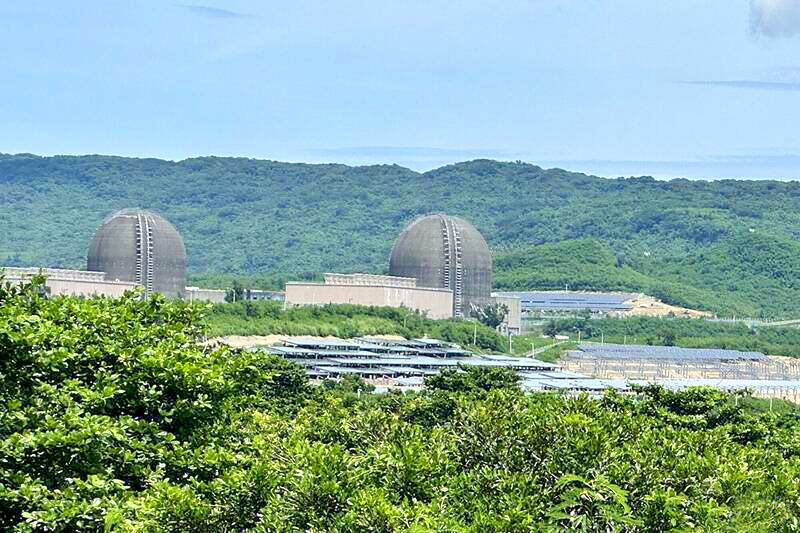
Photo: TT file photo
The political parties aligned with the People’s Republic of China (PRC), the Chinese Nationalist Party (KMT) and the Taiwan People’s Party (TPP), immediately pounced on Lai’s announcement. An “utter failure of a policy,” the KMT said of Lai’s apparent reversal of longstanding DPP policy. “By setting aside its anti-nuclear stance and no longer using ideology to dictate the lives of the Taiwanese people, it has made this important and correct decision,” TPP spokeswoman Chang Tung (張彤) stated.
KMT OBSTRUCTIONISM
The KMT has striven for years to create this moment of defeat for the DPP.
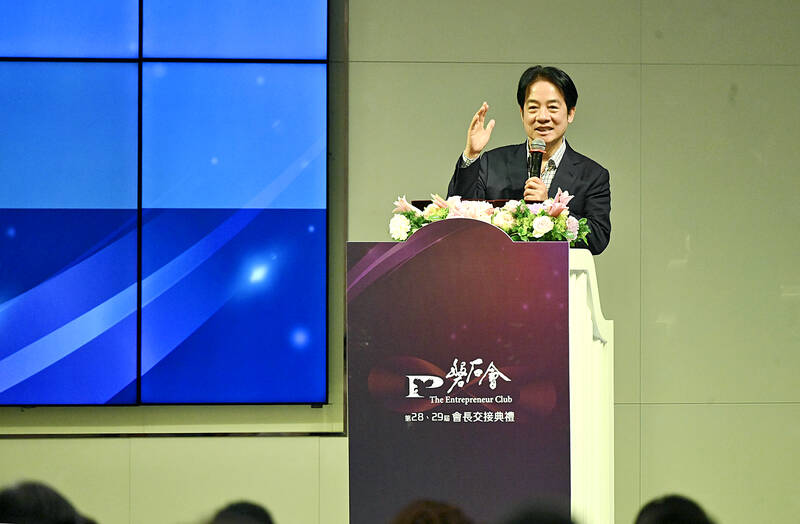
Photo: Liao Yao-tung, Taipei Times
The KMT controlled the legislature and the presidency for years, especially during the Ma Ying-jeou (馬英九) era from 2008 to 2016, when it was obvious the plants would have to be closed, yet never passed legislation nor took any other action to keep the nuclear plants open.
Similarly, for years KMT mayors in New Taipei City blocked efforts to establish safe storage for the high level nuclear waste whose removal would enable the plants there to continue operating. Because storage was never constructed, the plants were forced to close when their spent fuel pools were filled. The KMT pushed for several referendums on nuclear power, but only after nuclear power plants were safely closed. Readers may recall that the KMT shut down the Fourth Nuclear Plant once all of its local contracts had been paid off.
If the KMT’s noises about how much it loves nuclear power are ignored, it is obvious from its actions (or lack thereof) that it does not want nuclear power. Moreover, KMT officials at all levels have obstructed the implementation of renewable energy as well. For example, the KMT-controlled legislature recently passed legislation making it more difficult to install solar PV systems on ponds and certain protected areas.
Taking all this as a whole, it appears the KMT’s real energy policy, never stated aloud, is to increase the nation’s dependence on external fossil fuel supplies. That has obvious implications for a PRC war or blockade scenario. How do the party’s energy policies look, in light of its cleverly reduced defense budget that eliminates spending on domestic weapons production, and its blocking of budgets and defunding of government ministries? How does this policy look, in the light of the recent “offer” of the PRC to annex Taiwan to provide greater energy security to the island?
Current plans call for nuclear fuel for 1.5 years of operation to be ordered this year for Ma-anshan to be restarted in 2028. Since spent fuel rods must be removed from Guosheng, it will not be restarted until 2029.
When added to the grid, they will generate only a small and completely unnecessary fraction of the nation’s power, several years down the road. Their restart is more symbolic then rational, and the issues of defense vulnerability and unreliability that plagued them will remain, unresolved. After all, the PRC military is not going to stop targeting them in a war or blockade scenario. Nor is there a place to evacuate the population of the nation’s largest city if there is a serious problem at Guosheng.
‘CONTINGENCY RESPONSE’
Given all these issues, on Tuesday the DPP clarified its stance, with DPP caucus chief executive Chuang Jui-hsiung (莊瑞雄) saying that it is a misinterpretation to claim that the party has a definite intention to restart nuclear plants. They are a “contingency response,” Chuang said. Lai merely said he is starting the approval process, after all.
The government says that the nation has sufficient electricity supplies through 2032. Where’s the need?
Taiwan’s energy problems are not a result of the reactor shutdowns, which are inevitable given that their spent fuel pools are finite in size. They stem from the slow build-out of renewable energy and the lack of conservation efforts. This shows how one key function of KMT rhetoric on nuclear power is to redirect attention away from serious problems with grid hardening, grid defense and distributed energy sourcing, and away from topics like renewable energy, conservation and energy policy in light of security needs. The KMT positions nuclear power as an endless distraction simply by keeping the mere existence of functioning nuclear power plants in front of the public via referendums and public criticism of the DPP.
Fortunately, Lai came out with a statement yesterday saying that wind, solar, small-scale hydropower and hydrogen energy infrastructure development will continue. The government wants to raise renewables to account for 20 percent of power generation by the end of the year, and 30 percent by 2030.
One important issue with nuclear power is that it doesn’t truly help with the AI issue. Many tech firms source products from firms whose energy sources are RE100 compliant. RE100 is a renewable energy certification program that sets up rules for firms to follow in sourcing and expanding their renewable energy use. Taiwan tech firms must follow RE100 protocols when sourcing renewable energy if they are to sell to US tech companies who demand RE100 compliance. Nuclear power is not a renewable energy source under RE100.
The energy, human resources and funds that should be going into ramping up renewable energy, plowing down obstacles and browbeating and sweet-talking local officials into implementing renewable energy projects, is instead being diverted to a short-term nuclear plant revival that does nothing for wartime energy security or long-term energy resilience.
This is thus a great victory for the KMT, for both its ostensible and actual policies.
Notes from Central Taiwan is a column written by long-term resident Michael Turton, who provides incisive commentary informed by three decades of living in and writing about his adoptive country. The views expressed here are his own.
And so, in the wake of US President Donald Trump’s trip to the People’s Republic of China (PRC), all the experts on the Strait of Hormuz suddenly became experts on US-China-Taiwan relations. The Internet has certainly expanded human knowledge. Lots of these sudden experts made noise this week about Trump’s words after the meeting with PRC dictator Xi Jin-ping (習近平). Trump is going to sell out Taiwan! Longtime Taiwan commentator J. Michael Cole summed the situation up neatly in the Guardian: “We need to keep in mind that he has a tendency to say many things — sometimes contradicting himself within
There is considerable frustration and confusion among many, both in Taiwan and abroad — including in Washington — as to why the Chinese Nationalist Party (KMT) seems so dead set on using their legislative leverage to slash defense spending and disrupt the ability of the ruling Democratic Progressive Party (DPP) administration to function. Are they pawns of the Chinese Communist Party (CCP)? Are they traitors? In reality, there are multiple reasons. In the first column in this series on this subject, “Donovan’s Deep Dives: How and why the TPP and KMT help Beijing” (Sat May 16, page 12), we examined three

It took 12 years and months of standing in the same mountain location for director Liang Chieh-te (梁皆得) to capture a few seconds of footage: Taiwan’s largest resident raptor locking talons with its mate and spinning through the air in a courtship ritual. With only about 1,000 left in the wild and very short flight windows, the mountain hawk-eagle remains among Taiwan’s most elusive birds. The species generally produces only one offspring per year. Using forest cameras, the film crew and research teams document the arduous process the monogamous pairs go through for the chick to hatch and grow up, weathering

Last week US President Donald Trump was asked by a reporter whether he would speak on the phone to the President of Taiwan. “l’ll speak to him. I speak to everybody. We have that situation very well in hand,” Trump said. This marked the second time in a couple of weeks he had said he would talk to the President of Taiwan. In 2016 he famously took a call from then-president Tsai Ing-wen (蔡英文), when he was president-elect. Despite warnings that the apocalypse was nigh because of a phone call, the world quickly forgot about the conversation between two democratically-elected presidents.


 RSS
RSS