


The Chinese Nationalist Party (KMT) and the Taiwan People’s Party (TPP) on March 14 held a joint “Chasing Dreams in Taiwan, Building Our Future” press conference headlined by their respective chairs, Huang Kuo-chang (黃國昌) and Cheng Li-wun (鄭麗文). They laid out a joint framework for cross-party cooperation in this year’s nine-in-one local elections.
It was a substantive event, and both party leaders were mutually gracious and friendly. Some negotiations on specifics remain, but they are clearly committed to making their coalition work.
In November 2023, then-TPP party chair and presidential candidate Ko Wen-je (柯文哲) signed a six-point deal with the KMT leadership on forming a joint presidential ticket. The winner of public opinion polling would head the ticket, with the loser becoming the candidate for vice president.
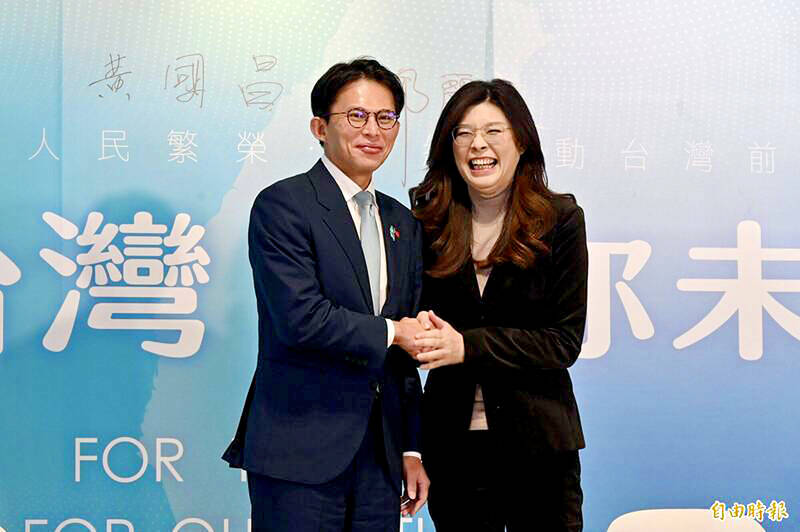
Photo: George Tsorng, Taipei Times
Within days, the deal began to break down over the details. Negotiations to resolve the impasse were held on live television and collapsed in a very public and spectacular fashion.
Relations between the parties soured badly. To this day, especially on the KMT side, this acrimonious split is blamed for splitting the ticket, leading to victory by the Democratic Progressive Party’s (DPP) William Lai (賴清德). That may not be entirely accurate, but it would have undoubtedly been a much closer race.
Similarly, there are still-to-be-negotiated details regarding specifics on public polling in determining which party’s candidate will be jointly supported to lead New Taipei City, Yilan County and Chiayi City, as well as the details on forming coalition governments under those candidates should they win in November.
So, will this deal fall apart as well?
Probably not, this deal looks far more likely to succeed, and that is very bad news for the DPP.
THE DIFFERENCE IS IN THE DETAILS
The current situation is very different.
KMT leaders at the time were suspicious of Ko, and the feeling was mutual. Worse from Ko’s perspective, during the negotiations, his aides were kept out of the meeting, and when he disclosed the details to them, they were appalled. He had been completely outclassed and maneuvered into a poor deal, and for good reason, doubted the KMT’s sincerity.
Though Ko had more closely aligned the TPP with the KMT, he frequently commented that the two parties had “different DNA” and fretted that if his party were to grow too close, they would be perceived as a “little blue” subsidiary party. He feared if that happened, the TPP would be “swallowed up” by the KMT, as happened to previous third parties like the New Party (NP) and People’s First Party (PFP).
The relationship between Huang and Cheng could not be more different. Both frequently stated they would approach negotiations with the “utmost sincerity,” and all indications are that they were sincere in that sincerity.
Cheng appears to have approached the negotiations more as between equals, unlike in 2023, when KMT elders appeared arrogant and manipulative.
The 52-year-old Huang and the 56-year-old Cheng also appear to get along well. Reportedly, they are frequently in contact, and their personal interactions appear comfortable and relaxed.
Huang also apparently has no concerns about appearing to be a “little blue” party. This is curious; when he was with the New Power Party, he frequently expressed his concerns about becoming a “little green” adjunct to the DPP.
WELL THOUGHT OUT
This time, the negotiations were held over a longer period of time, and are clearly better thought out.
Negotiations started on forming a common policy platform, which a KMT press release described this way: “The two parties unveiled a shared policy platform focusing on four major areas: social welfare, housing justice, environmental sustainability and AI governance. The initiative seeks to respond to the public’s most pressing livelihood concerns through concrete policy proposals.”
During the press conference, over a full hour, Huang and Cheng took turns laying out those policies. Their proposals were substantive, and the tag team approach underscored their unity.
In the same press release, Cheng is cited as saying: “Taiwan currently faces a number of structural challenges, including low wages, declining birth rates, housing affordability, industrial transformation and population aging.” Their joint ticket is going for the jugular, hitting issues where the DPP is weak.
In the final stage negotiations, things could break down in Chiayi City or Yilan over how the polling is conducted or the makeup of a proposed local coalition government. However, by all appearances, both Huang and Cheng are committed to making this work.
Shrewdly, they plan to form cross-party teams both at the top and local levels to smooth out differences and coordinate their campaigns.
For the TPP, this framework opens the possibility of party members gaining real governing experience and name recognition — two of the party’s biggest weaknesses. Already, in Keelung and Miaoli, TPP members have been appointed as second-in-command, a leg up and a potential future path to higher office.
The KMT hopes to draw TPP voters to their side, which offers demographics where the party is weak, and potentially could give them the edge over the DPP in close races. It is not out of the realm of possibility that this could give the KMT enough of an edge to seriously challenge the DPP in their strongholds of Tainan and Kaohsiung.
Both leaders are also united in their animosity towards the DPP, and especially President Lai and his New Tide faction.
RISKS VERSUS REWARDS
For Cheng and the KMT, the downside risks are minimal. They might have to back away and hand over Yilan and more likely, Chiayi City.
For Huang and the TPP, both the risks and rewards are far higher. The party is small and has a weak talent bench of largely inexperienced candidates with little name recognition. This deal could help make a dent in this problem.
However, the risk is that the TPP gets “swallowed up” by the larger, better-funded (despite debt issues) and far better organized KMT. By joining the party at the hip to the KMT, there is a risk that voters could view them as interchangeable.
So could party members. If they do join coalition governments, they will likely be enticed to join the KMT, which has far more to offer.
Ko worried about this and frequently spoke of preserving the party’s independent character. Huang appears sanguine, and if he has any long-term strategic vision for the party, he is being tight-lipped about it.
Perhaps Huang is confident that the TPP’s “DNA” is different enough to remain independent, and their members will resist absorption into the KMT. Unlike the NP and PFP, they were largely built from the ground up, not from KMT defectors.
Or perhaps he has no strategic vision and is focused on more short-term goals. It is hard to tell.
I expect their alliance to hold this year, but the 2028 national elections will be far more complicated. Almost certainly Ko remained in the race in 2023 to attract government subsidies, which are apportioned to presidential campaigns and the party list legislative vote.
A viable presidential candidate not only raises a lot of subsidy cash directly, the press attention provides a big platform to promote their party list and downstream candidates. This is the primary source of funding for third parties that draw enough votes to meet the minimum thresholds.
That will put them in more direct competition, and in ways that could be financially existential. Huang will also have to clarify the TPP’s stances on China, national defense and foreign policy. Assuming Cheng remains party chair, if the TPP fully endorses her strongly ideological stances, that would erase what little independence the party maintains with voters.
Though not impossible, maintaining their alliance under those circumstances will be far tougher.
Donovan’s Deep Dives is a regular column by Courtney Donovan Smith (石東文) who writes in-depth analysis on everything about Taiwan’s political scene and geopolitics. Donovan is also the central Taiwan correspondent at ICRT FM100 Radio News, co-publisher of Compass Magazine, co-founder Taiwan Report (report.tw) and former chair of the Taichung American Chamber of Commerce. Follow him on X: @donovan_smith.

Taiwan’s English education system is being pulled apart by three opposing forces. Bilingual Nation 2030 pulls students toward English and global communication. Artificial Intelligence (AI) readiness pulls them toward digital judgment, verification and AI-mediated work. But Taiwan’s old exam culture pulls them back toward memorization, grammar drills, timed reading and correct answers. If the education system keeps using old exams to define success, it risks producing graduates who are neither genuinely bilingual nor genuinely AI-ready, but trained for tasks machines can already perform. The first force is Bilingual Nation 2030. Launched in 2018, the policy aimed to “help Taiwan’s workforce connect
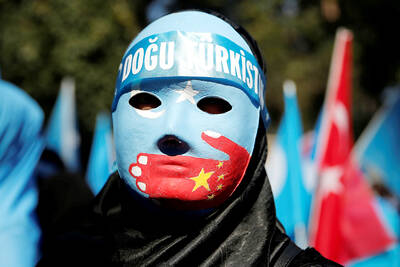
It seems every few days one bumps into one of those “real man” comments in which Taiwan is urged to “face reality” or similar, and “make a deal,” with the speaker implying that soon it will be too late. “Deal” advocates always present themselves as having a superior grip on reality, and the manly ability to make the “hard choice.” Their testosterone-laden language often echoes that of Taiwan sellout advocates. Note that such commentary always specifies a process (“make a deal, work with, make progress”), never the end state of what occupation by a violent authoritarian colonialist state will entail. In
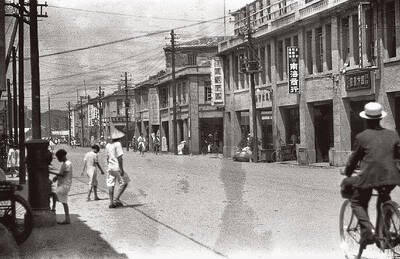
June 1 to June 7 "If all Taiwanese were as afraid of dying as you, then what would happen?” Physician Shih Chiang-nan (施江南) reportedly said this to his wife Chen Chiao-tung (陳焦桐) after she urged him to stop intervening on behalf of Taiwanese soldiers stranded overseas after serving in the Japanese Army during World War II. Shih had clashed with high-ranking officials over the issue, engaged in several heated arguments with Taiwan governor-general Chen Yi (陳儀) and allegedly shouted at general Ko Yuan-fen (柯遠芬), chief of staff of the Taiwan Garrison Command, over

“Taiwan’s Opposition Leader Comes to US With a Message Straight Out of Beijing” read a May 31 headline in the Wall Street Journal. Top US administration officials and members of Congress almost certainly read the WSJ, and if there was a bullet point takeaway that people in Washington should absorb ahead of Chinese Nationalist Party (KMT) Chair Cheng Li-wun’s (鄭麗文) arrival in DC on June 9, that headline is it. The last few columns have discussed this very topic, and the timing is not coincidental. While those top officials likely do not read the Taipei Times, judging by the number


 RSS
RSS