


It sounded innocuous enough. On the morning of March 12, a group of Taichung political powerbrokers held a press conference in support of Deputy Legislative Speaker Johnny Chiang’s (江啟臣) bid to win the Chinese Nationalist Party (KMT) primary in the Taichung mayoral race. Big deal, right?
It was a big deal, one with national impact and likely sent shivers down the spine of KMT Chairwoman Cheng Li-wun (鄭麗文). Who attended, who did not, the timing and the messaging were all very carefully calibrated for maximum impact — a masterclass in political messaging.
In October last year, the Democratic Progressive Party (DPP) nominated legislator Ho Hsin-chun (何欣純) as their candidate. She is one of the most popular lawmakers in the country in her Taichung 7 district, which encompasses Dali (大里) and Wufeng (霧峰) districts, but was less known in the rest of Taichung.
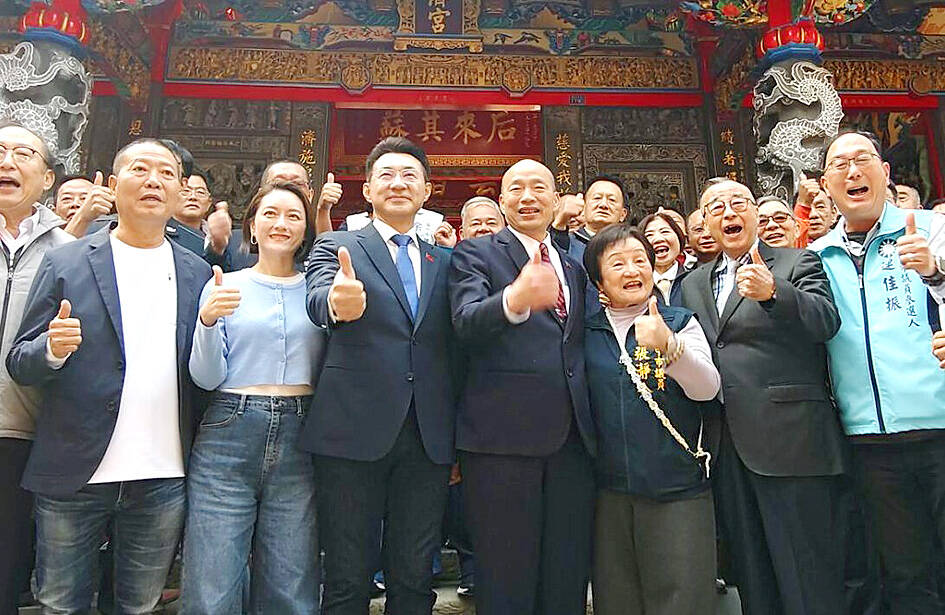
Photo: Chang Hsuan-che, Liberty Times
She has had months to campaign and raise her profile. Her billboards are scattered across the city, raising her name recognition. How effectively she has translated that into support is unclear: according to DPP internal polling, Chiang’s lead over her has shrunk to “single digits,” while an internal KMT poll suggests the gap has widened and she now trails by over 20 points.
CHENG FUELS LOCAL KMT FRUSTRATION
Chiang’s primary opponent is lawmaker Yang Chiung-ying (楊瓊瓔). Awkwardly, both are from the KMT’s Taichung Red Faction.
In public opinion polling, Chiang has consistently been far ahead. However, Yang has dug in her heels, and it is widely suspected that Chairwoman Cheng favors her.
Chiang is her ideological opposite within the party, a former party chair and a serious potential rival. Chiang is pro-American, and when he took office as party chair he was the first in decades to not receive a congratulatory message from Beijing. Additionally, during his tenure, he tried — but failed — to remove the “1992 consensus” from the party platform.
It is likely that Cheng, reviving a rarely used provision in the party rules, pushed for the primary to also include party members in addition to the usual public polling. The negotiations settled on 85 percent public polling and 15 percent party members, with a surprisingly large number of poll respondents required and a long polling period.
The primary has been delayed and delayed, to much frustration within the party. Taichung Mayor Lu Shiow-yen (盧秀燕) pushed for primaries to be held in January, then last month, but Cheng and Yang continued to push the date further and further back. This is likely to give Yang time to campaign, and crucially to line up support with party members.
Cheng may have calculated that the base of support that elected her chair would take the hint and back Yang. However, the delays have caused concern within the party. As a China Times article describes: “For the KMT, whether it can nominate its strongest candidate to retain this important central Taiwan stronghold has become a pressing question, and anxiety is spreading throughout the party’s grassroots supporters.”
As Taiwan’s second most populous city, this race matters. For more background, see this column “Drama brewing in drama-hating Taichung” (Jan. 24, page 12).
Taichung’s KMT political establishment is known for practicality, not ideology — much like the city itself. They want to win, and think they should have united around a candidate months ago. Cheng’s encroaching on their turf has likely not gone down well.
SUMMIT MEETING
The March 12 press conference was reportedly organized by the two towering giants of the Red Faction, former Taichung County Commissioner Liao Liao-i (廖了以) and former Taichung County Council Speaker Lin Min-lin (林敏霖). These two are old masters of the political game.
Standing in front of a backdrop featuring Chiang’s smiling face, the text read “set Taichung on a journey, solely support Johnny Chiang (ie, in the primary).” The assembled Taichung power elite was probably enough to send the message that Yang’s hopes of winning the party member polling were probably doomed.
Front and center was former Taichung Mayor Jason Hu (胡志強), a towering figure locally. The Taichung City Council Speaker Chang Ching-tang (張清堂) of the Red Faction and three legislators widely considered Mayor Lu’s “next generation army”: Gary Huang (黃健豪), Lo Ting Wei (羅廷瑋) and Liao Wei-hsiang (廖瑋翔).
Not only were the leaders of Yang’s Red Faction lining up against her, but legislator Yen Kuan-heng (顏寬恆) showed up representing the Black Faction. In total, four of the six Taichung lawmakers attended, with unsurprisingly Yang herself not present.
Who did not attend was also carefully calculated and calibrated. The remaining KMT legislator not attending was Johnny Chiang himself, who was escorting a Spanish delegation around Giant’s bicycle museum.
This was clever and sent several messages. The Red Faction’s Liao and Lin wanted to underscore that this event was not organized by Chiang, but was a message directly from them, backed by other key figures in the political elite, including former enemies (Black faction), forming a united front. They were flexing their muscles, underscoring they are the real power brokers in Taichung, not Yang, Chiang or Cheng Li-wun.
It also kept Chiang’s image as a nice guy intact by keeping his hand off the knife in Yang’s back. That he was escorting European dignitaries was the cherry on top; a reminder of the importance of his position as deputy speaker, his international credentials (which Yang lacks) and his English-language skills, while simultaneously promoting Taichung’s bicycle industry (a local source of pride) to the world.
Another no-show was the patriarch of the Black Faction, the (in)famous Yen Ching-piao (顏清標), who instead sent his son, Yen Kuan-heng. This is appropriate; this event was organized by the Red Faction to deal with one of their own, too heavy a Black Faction presence would have distracted from the core message and would have been disrespectful. His son’s presence sent a strong enough message of support, plus it leaves the elder Yen’s options open for future dealings with Yang.
TAKING A HIT FOR LU
Crucially, this event was scheduled one day after Mayor Lu left on her trip to the US, providing a face-saving reason for her not to attend. This was intentional; this situation is a significant headache for Lu.
In 2018, Lu unexpectedly beat Chiang in the KMT primary by only 0.6 percent. Chiang could easily have contested the upset, but instead gracefully accepted the result and even joined her campaign team.
After this press conference, Jason Hu revealed that he had been behind this arrangement, and that while Yang was a friend of his, he gave his promise to Chiang eight years earlier to back him this time around.
Lu would have known the details of this and, explicitly or implicitly, was expected to back Chiang as her successor. The problem for Lu is that Yang also served as one of her vice mayors, and no doubt both Chiang and Yang feel Lu owes them her support.
Lu is also the current mayor, and a presumed frontrunner to be the KMT presidential candidate in 2028. Lu needs to keep as much of her political capital intact as possible, which the Red Faction is well aware of. They took the hit on this and spared her. The benefit for them is a grateful potential future president they know well.
Ostensibly, this was a press conference to raise support for Chiang in the primary. In reality, the real targets were within the party.
Ensuring that Yang cannot win the party member poll was a big goal, but this was also a stark reminder to everyone in the party who is really in control in Taichung.
Chairwoman Cheng Li-wun, did you get the message?
Donovan’s Deep Dives is a regular column by Courtney Donovan Smith (石東文) who writes in-depth analysis on everything about Taiwan’s political scene and geopolitics. Donovan is also the central Taiwan correspondent at ICRT FM100 Radio News, co-publisher of Compass Magazine, co-founder Taiwan Report (report.tw) and former chair of the Taichung American Chamber of Commerce. Follow him on X: @donovan_smith.


Taiwan’s English education system is being pulled apart by three opposing forces. Bilingual Nation 2030 pulls students toward English and global communication. Artificial Intelligence (AI) readiness pulls them toward digital judgment, verification and AI-mediated work. But Taiwan’s old exam culture pulls them back toward memorization, grammar drills, timed reading and correct answers. If the education system keeps using old exams to define success, it risks producing graduates who are neither genuinely bilingual nor genuinely AI-ready, but trained for tasks machines can already perform. The first force is Bilingual Nation 2030. Launched in 2018, the policy aimed to “help Taiwan’s workforce connect

“Taiwan’s Opposition Leader Comes to US With a Message Straight Out of Beijing” read a May 31 headline in the Wall Street Journal. Top US administration officials and members of Congress almost certainly read the WSJ, and if there was a bullet point takeaway that people in Washington should absorb ahead of Chinese Nationalist Party (KMT) Chair Cheng Li-wun’s (鄭麗文) arrival in DC on June 9, that headline is it. The last few columns have discussed this very topic, and the timing is not coincidental. While those top officials likely do not read the Taipei Times, judging by the number
With weighty, anxiety-inducing geopolitical topics dominating the headlines, checking in on the wild and weird state of local politics can take some of the edge off. This November’s elections will determine who will be in charge of fixing potholes in your neighborhood, not the potholes in Taiwan’s complicated geopolitical space. Recently, after an online interview with a Taipei-based journalist, I commented that Taipei journalists never go further than the MRT can take them. He laughed and agreed. Naturally, the Taipei mayoral race is eating up much of the press attention. TAIPEI CITY Democratic Progressive Party (DPP) candidate Puma Shen (沈伯洋) has
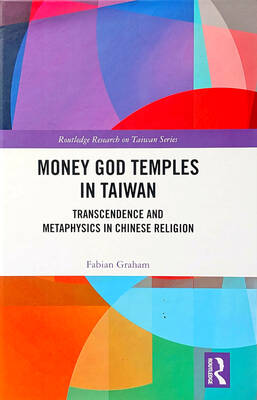
As someone who normally steers clear of books with “transcendence” or “metaphysics” in their subtitles, this reviewer — a casual observer of local belief systems since the 1990s — found Fabian Graham’s Money God Temples in Taiwan a challenging read. Those who’ve only dipped their toes into temple culture will likely need to parse several sections with special care if they’re to keep up with the author, a British ethnographic researcher whose previous books have investigated religious practices among ethnic Chinese in Southeast Asia. This scholarly volume examines a facet of Taiwan’s religious landscape that didn’t exist a century ago, and


 RSS
RSS