


The US says it has destroyed more than a dozen mine-laying Iranian vessels to prevent any attempt to close the Strait of Hormuz, highlighting the important role the narrow passageway plays in global energy supply.
The war in Iran has ground tanker traffic through the Strait of Hormuz to a halt and oil prices have been swinging sharply, highlighting the important role the narrow passageway plays in global energy supply as the Islamic Republic vowed to block the region’s oil exports, saying it would not allow “even a single liter” to be shipped to its enemies.
US President Donald Trump also said in social media posts that there were no reports of Iran planting mines in the Strait of Hormuz, the mouth of the Persian Gulf through which 20 percent of the world’s oil and natural gas is shipped.
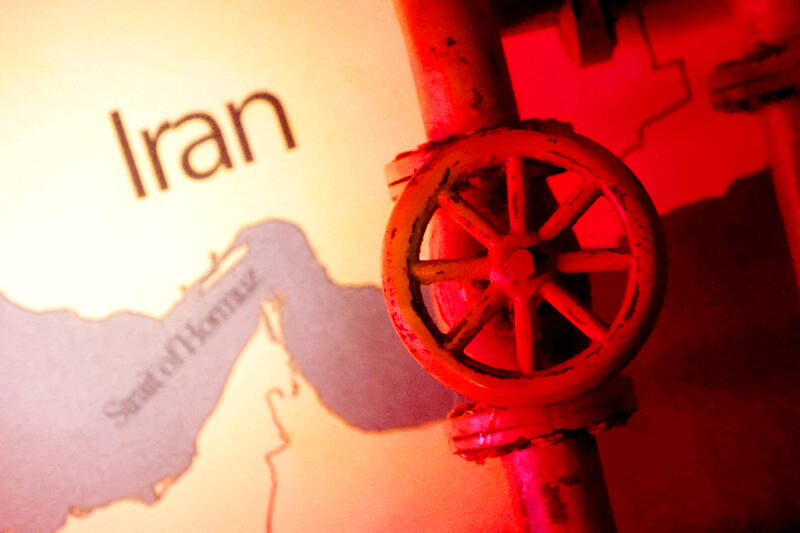
Photo: Reuters
Any disruption to traffic through the Strait of Hormuz affects the oil trade — and several ships in and around it have come under attack from Iran during the war. Fears about the strait caused oil to spike Monday, only for it to swiftly fall back after Trump suggested the war could be near an end.
“The scale of what is at stake cannot be overstated,” said Hakan Kaya, senior portfolio manager at investment management firm Neuberger Berman. He said a partial slowdown lasting a week or two could be absorbed by oil companies. But a full or near full closure lasting a month or more would push crude oil prices “well into triple digits” and European natural gas prices “toward or above the crisis levels seen in 2022.”
Here’s what to know about the strait and the widening Iran war.
KEY WATERWAY
The Strait of Hormuz is a bending waterway, about 33km wide at its narrowest point. It connects the Persian Gulf to the Gulf of Oman. From there, ships can then travel to the rest of the world. While Iran and Oman have their territorial waters in the strait, it’s viewed as an international waterway all ships can ply. The UAE, home to the skyscraper-studded city of Dubai, also sits near the waterway.
The Strait of Hormuz through history has been important for trade, with ceramics, ivory, silk and textiles moving from China through the region. In the modern era, it is the route for supertankers carrying oil and gas from Saudi Arabia, Kuwait, Iraq, Qatar, Bahrain, the UAE and Iran. The vast majority of it goes to markets in Asia, including Iran’s only remaining oil customer, China.
While there are pipelines in Saudi Arabia and the UAE that can avoid the passage, the US Energy Information Administration says “most volumes that transit the strait have no alternative means of exiting the region.”
Threats to the route have spiked global energy prices in the past, including during the Israel-Iran war in June.
IS THE STRAIT CLOSED?
Iran has attacked several ships in the Strait of Hormuz and threatened any ships that try to pass through, effectively but not officially closing it.
Trump said on social media that the US would dramatically increase attacks if Iran tried to close the Strait of Hormuz. Iran has been targeting energy infrastructure and traffic through the strait.
Previously, Iran temporarily shut down parts of the strait in mid-February for what it said was a military drill. In past times of tension and conflict, Iran has at times harassed shipping though the narrows, and during the 1980s Iran-Iraq war, both sides attacked tankers and other vessels, using naval mines to completely shut down traffic at points. But Iran up until now not carried out repeated threats to close the waterway altogether since then, even during last year’s 12-day war when Israel and the U.S. bombarded Iran’s key nuclear and military sites.
The US is rolling out ship reinsurance in the region through the US International Development Finance Corp, a government agency that partners with the private sector to back global investment projects, in an effort to get ships moving through the strait again.
Political risk insurance is a type of coverage intended to protect firms against financial losses caused by unstable political conditions, government actions or violence. Marine insurers had been canceling or raising rates for insurance in the region.
The US reinsurance facility will insure losses up to approximately US$20 billion on a rolling basis, according to the International Development Finance Corp, focusing on insuring cargo and physical damage to a ship’s structure and operating machinery to start.
Trump said that, if necessary, the US Navy would escort oil tankers through the strait, though that has yet to happen.
There is a French-led initiative in the works that could involve European and non-European nations helping to escort tankers with the aim of gradually reopening the strait “as soon as possible after the most intense phase of the conflict is over.”
MINE FEARS
On Tuesday, Trump said the US military “completely destroyed” 16 inactive Iranian mine-laying ships.
Trump in his social media post added that there would be “more to follow,” suggesting the US would target additional mine-laying vessels.
The announcement of the targeting of the ships came soon after two other social media posts by the US president in which he said he has no reports of Iran putting explosive mines in the strategic waterway, but also warned Tehran if mines were laid he wanted them immediately removed.
Global shippers have issued service alerts saying they have suspended operations in the area. Danish shipping company Maersk, the world’s biggest shipping company, said Sunday it is suspending all vessel crossings in the Strait of Hormuz until further notice. Other ocean carriers including Hapag-Lloyd, CMA-CGM and MSC made similar announcements.
“Those ships that got stuck in the Gulf are not going anywhere,” said Tom Goldsby, logistics chairman in the Supply Chain Management Department at the University of Tennessee. “There’s also a whole host of ships that were heading into the Gulf to replace them, and of course they’re anchored or going elsewhere now.”
There are currently about 400 oil and product tankers idle in the Gulf, and one oil tanker passed through the Strait of Hormuz without incident on Monday, according to data from the website MarineTraffic.
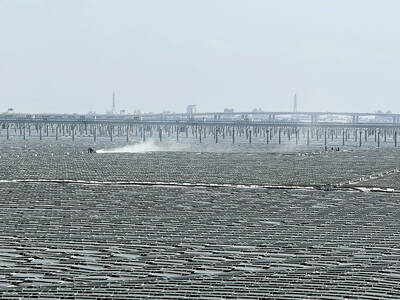
The arithmetic is straightforward and uncomfortable. By the end of 2025, Taiwan had committed itself to a 50-30-20 electricity mix — half natural gas, 30 per cent coal, 20 per cent renewables. The Ministry of Economic Affairs’s (MOEA) own monthly energy reports tell a different story. Natural gas reached 47.8 per cent of generation last year. Coal stood at 35.4 per cent, comfortably above its target ceiling. Renewables came in at 13.1 per cent, well short of the 20 per cent Taipei had pledged a decade earlier. Installed renewable capacity reached roughly half of the 12 gigawatts (GW) the government

There are shadowy cabals plotting to sell out Taiwan to be annexed by China, by invasion if necessary. Fortunately, they are buffoons. In 2019, former Bamboo Union gangster and founder of the China Unification Promotion Party (CUPP), Chang An-le (張安樂, colorfully known as “White Wolf”), led a protest at the Legislative Yuan against comments made by then-premier Su Tseng-chang (蘇貞昌) that in the event of an attack by China, he would never surrender, but would protect the nation by fighting to the end, even if he only had a broom. Chang had party members bring a wooden casket that they
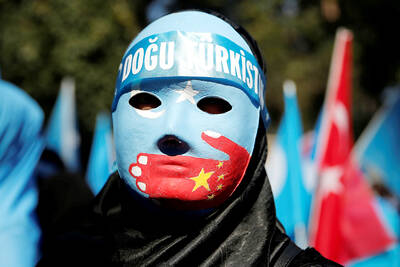
It seems every few days one bumps into one of those “real man” comments in which Taiwan is urged to “face reality” or similar, and “make a deal,” with the speaker implying that soon it will be too late. “Deal” advocates always present themselves as having a superior grip on reality, and the manly ability to make the “hard choice.” Their testosterone-laden language often echoes that of Taiwan sellout advocates. Note that such commentary always specifies a process (“make a deal, work with, make progress”), never the end state of what occupation by a violent authoritarian colonialist state will entail. In

Taiwan’s drone exports are taking off, fuelled by the war in Ukraine, as Taiwanese companies seek a stake in the fast-growing global market for unmanned aerial vehicles (UAV). Low-cost drones used for reconnaissance and strikes are in high demand as governments around the world boost defense spending in the face of intensifying conflicts. A relative new player in the increasingly competitive industry, Taiwan’s pitch is to be an “Asian hub” for the production of UAVs and components free of Chinese materials, or “non-red.” That means its UAVs can be up to three times more expensive than their Chinese competitors, like the world’s biggest


 RSS
RSS