


Earlier this week Nikkei Asia published an op-ed titled “The myth of Taiwan’s ‘pro-China’ defense budget blockade” by Michael Cunningham, a China Program senior fellow at the Stimson Center. The essay contended that the Chinese Nationalist Party (KMT) blocks the Democratic Progressive Party’s (DPP) proposed special defense budget because of the nation’s difficult budget issues, not because of the KMT’s political alignment with the People’s Republic of China (PRC).
“Blaming the budget impasse solely on partisan infighting may galvanize much-needed spending in the short-term, but it harms Taiwan in the long run. Not only does it deepen domestic polarization, but it feeds a false narrative that Taiwan’s military preparedness is held hostage by pro-Beijing sympathies,” Cunningham writes.
MALICIOUS OR IGNORANT
Photo: Bloomberg
Cunningham raises the important issue of whether Taiwan can afford the special defense budget, presented as a defense of the KMT’s actions. While it is rightfully concerned with Taiwan’s low government spending (we’ll get into that later), this narrative is a textbook example of how writing that makes the KMT seem rational can only make sense by creating bubble worlds in which demonstrated KMT behavior does not exist. In other contexts, this is known as fiction.
Both the KMT and the Taiwan People’s Party (TPP), Cunningham writes, “have offered alternatives to [President William] Lai’s (賴清德) special budget that, although much smaller, would still add tens of billions of US dollars for defense.”
Trivially true. But Cunningham neglects to mention that the smaller KMT budget is qualitatively different. It reduces the DPP proposal by roughly 70 percent from NT$1.25 trillion to NT$380 billion and does not support domestic weapons production. It supplies funding only for purchases of weapons from the US.
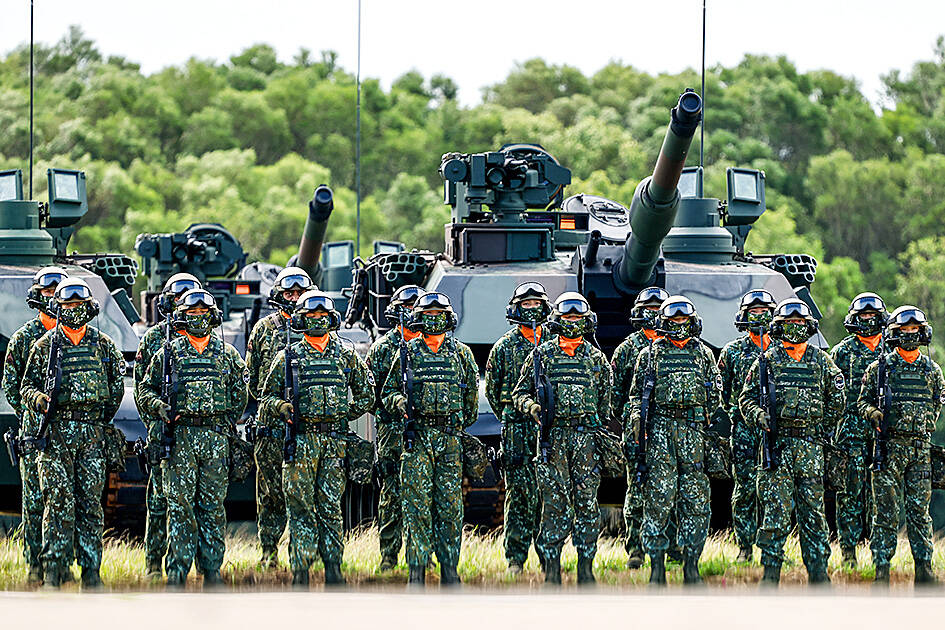
Photo: EPA
The KMT proposal thus presents an amusing moment of KMT hypocrisy. For years it has been a talking point among pro-China supporters that the US only sells Taiwan second-hand, lower-quality weapons systems. Now offered an opportunity to enhance procurement from home, the KMT eliminates all that in favor of purchasing eight existing US weapons systems, the very type of weapon it has always criticized.
More seriously, the KMT’s budget removes Lai’s proposed T-Dome domestic missile defense system and domestic weapons systems such as unmanned suicide and minelaying drones. It is easy to understand why Beijing might want such a system eliminated, but difficult to explain why anyone actually interested in defending Taiwan would want it gone, especially without proposing an alternative. As is usual with such commentaries, the reader is forced to decide whether Cunningham is being malicious, or merely ignorant.
Like almost all commentators outside Taiwan, Cunningham treats the KMT’s special budget obstructionism as if it exists in a bubble of space-time all its own. He ignores the connection between the KMT’s defense budget behavior and its other budget behavior, and between the current KMT campaign against Lai and the previous campaign against former DPP president Chen Shui-bian (陳水扁). There is no mention of the KMT’s systematic deep cuts to other ministries, its blocking of the overall 2026 government budget, and similar, and how the special budget impasse fits into that program of degrading governance and fiscal responsibility — the same program it carried out against Chen during his two terms.
Think this is new? “Taiwan’s Arms Procurement Debate and the Demise of the Special Budget Proposal: Domestic Politics in Command” is the title of a scholarly paper from 2008. Once again, the reader is compelled to decide whether Cunningham’s problem is malice or ignorance.
FINANCES
Although Cunningham’s discussion of Taiwan’s budgetary issues is good as as far as it goes, he never asks why, if the KMT is interested in saving the government’s finances, it has voted to wipe out the pension reforms of the previous administration intended to preserve fiscal discipline, and increase pensions to favored constituencies, something the government has warned would harm the nation’s finances.
Nor does he raise the issue of the budgetary effects of KMT plans to redistribute government funds from the central to local governments, something Premier Cho Jung-tai (卓榮泰) has refused to sign off on. Nor does Cunningham observe that the function, and probably the intention, of these budgetary expansions is to reduce the money available for defense. Again, Cunningham’s presents us with a malice or ignorance choice.
The final omission from this bubble world is the KMT’s pro-PRC stance and its Chinese ideology. Apparently Cunningham is not aware that KMT Chairwoman Cheng Li-wun (鄭麗文) and other officials have repeatedly claimed they, and all Taiwanese, are Chinese. He does not appear to know that KMT officials at all levels regularly meet with Chinese Communist Party (CCP) officials, apparently to coordinate policy, and that KMT officials frequently regurgitate CCP talking points, and vice versa. All that is AWOL from Cunningham’s “analysis.” Ignorance? Or malice?
Cunningham’s budget analysis, by contrast, contains many truths. A serious problem, which many of us have written on, is low government spending. He notes: “Government spending accounts for only 12 percent to13 percent of Taiwan’s GDP. By comparison, many OECD countries’ public outlays routinely exceed 40 percent.” He also highlights Taiwan’s low tax take. But how does this affect the DPP’s planned special budget for defense?
The DPP program is spread out over 8 fiscal years from this year to 2033. The 2026 portion of the budget raises overall defense spending to 3.3 percent of Taiwan’s GDP, moving in coming years to 5 percent. To put that in perspective, the 2024 defense budget as proposed in 2023 was NT$440.6 billion (roughly US$13.8 billion). An additional US$6 billion was planned for the supplemental budget for that year, bringing it to a total of NT$606.8 billion.
That one year supplemental budget was greater than the average annual special budget currently proposed by the DPP. Taiwan did not fall into fiscal disrepair because of that. The current proposal is an average of US$5 billion annually. To reach the DPP’s goals, the base defense budget will also have to rise over the next few years as well. But Cunningham regards only the trivially small average special defense budget expenditure of US$5 billion as a budgetary threat.
Lets contextualize that another way. In April of last year the government spent US$2.8 billion on a support package for Trump’s tariffs. If US commentators want to make things easier for Taiwan, they could advocate complete removal of tariffs to reduce government emergency support expenditures and increase Taiwan’s export revenues. But as always with US commentators, the problem is never anything the US does.
The other context missing from Cunningham’s jumble of omissions and misunderstandings is Taiwan’s GDP performance. Right now it is sizzling, riding AI demand and the chip industry’s export prowess (but the Iran war could wreck that). Assuming good growth over the next few years as tech demand remains steady — and chip industry investment in domestic and foreign fabs under construction tends to suggest that it will — Taiwan should have plenty of money to spend on defense.
The issue is whether the KMT will permit that to happen.
Notes from Central Taiwan is a column written by long-term resident Michael Turton, who provides incisive commentary informed by three decades of living in and writing about his adoptive country. The views expressed here are his own.

Taiwan’s English education system is being pulled apart by three opposing forces. Bilingual Nation 2030 pulls students toward English and global communication. Artificial Intelligence (AI) readiness pulls them toward digital judgment, verification and AI-mediated work. But Taiwan’s old exam culture pulls them back toward memorization, grammar drills, timed reading and correct answers. If the education system keeps using old exams to define success, it risks producing graduates who are neither genuinely bilingual nor genuinely AI-ready, but trained for tasks machines can already perform. The first force is Bilingual Nation 2030. Launched in 2018, the policy aimed to “help Taiwan’s workforce connect
It seems every few days one bumps into one of those “real man” comments in which Taiwan is urged to “face reality” or similar, and “make a deal,” with the speaker implying that soon it will be too late. “Deal” advocates always present themselves as having a superior grip on reality, and the manly ability to make the “hard choice.” Their testosterone-laden language often echoes that of Taiwan sellout advocates. Note that such commentary always specifies a process (“make a deal, work with, make progress”), never the end state of what occupation by a violent authoritarian colonialist state will entail. In
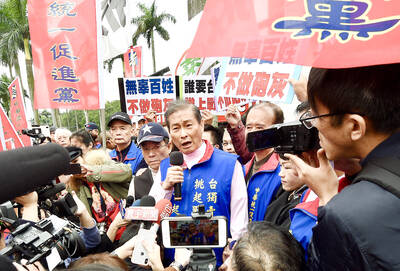
There are shadowy cabals plotting to sell out Taiwan to be annexed by China, by invasion if necessary. Fortunately, they are buffoons. In 2019, former Bamboo Union gangster and founder of the China Unification Promotion Party (CUPP), Chang An-le (張安樂, colorfully known as “White Wolf”), led a protest at the Legislative Yuan against comments made by then-premier Su Tseng-chang (蘇貞昌) that in the event of an attack by China, he would never surrender, but would protect the nation by fighting to the end, even if he only had a broom. Chang had party members bring a wooden casket that they
June 1 to June 7 "If all Taiwanese were as afraid of dying as you, then what would happen?” Physician Shih Chiang-nan (施江南) reportedly said this to his wife Chen Chiao-tung (陳焦桐) after she urged him to stop intervening on behalf of Taiwanese soldiers stranded overseas after serving in the Japanese Army during World War II. Shih had clashed with high-ranking officials over the issue, engaged in several heated arguments with Taiwan governor-general Chen Yi (陳儀) and allegedly shouted at general Ko Yuan-fen (柯遠芬), chief of staff of the Taiwan Garrison Command, over


 RSS
RSS