

The Bulletin of the Atomic Scientists moving the Doomsday Clock to 85 seconds before midnight last month symbolized the closest humanity has ever been to global catastrophe
In this context, the legislature remains gridlocked over the general budget, mirroring tensions simmering across the globe.
According to local soothsayers, this “extreme speed and violent conflict” is no coincidence as the Year of the Horse is the year of bingwu (丙午), the rare “Fire Horse Year” (火馬年) that occurs once every 60 years, a configuration carrying an energy that shapes everything from personal fortunes to international crises.
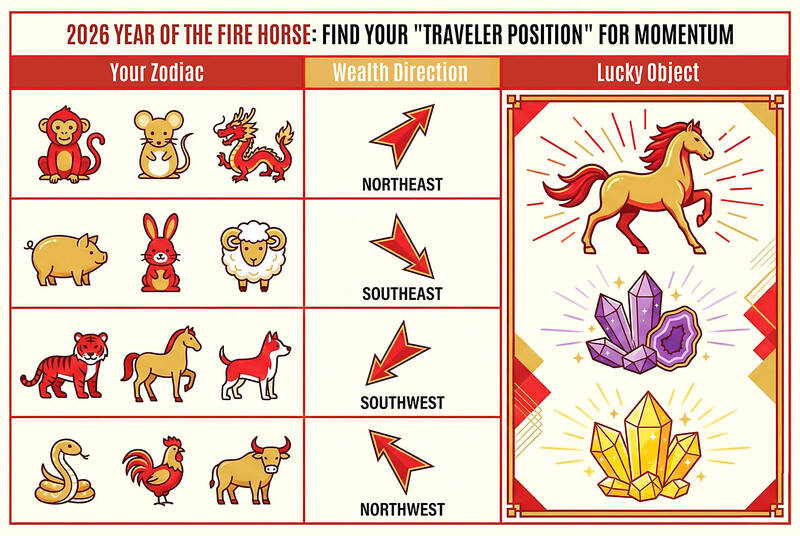
Graphic: Billy Wu
“For some people, it can be a year of upheaval and change,” says Chiang Dai-shan (蔣岱珊), a fortune teller with 25 years of experience.
WHEN FIRE MEETS FIRE
In the Chinese calendrical system, the “Fire Horse Year” combines two forces that create a “Double Fire” configuration that practitioners say can amplify restlessness and bring simmering tensions to the surface.
.jpg)
Photo: Billy Wu
Folklorists also reference the phrase “Scarlet Horse and Crimson Sheep” (赤馬紅羊劫), a nod to historical periods known for social upheaval and institutional shifts.
The previous bingwu year, 1966, coincided with the escalation of the Vietnam War and the expansion of anti-war protests in the US and elsewhere.
While locals traditionally favor bright red to invite luck, Chiang warns that for those whose birth charts are already “fire-heavy,” or those born in the Year of the Horse, wearing red is a spiritual taboo this year.
.jpg)
Graphic: Billy Wu
“Wear white, blue or green to stabilize the mind,” she says. “In a year of movement, stability is the guideline.”
Soothsayer Wisdom Tsai (蔡上機) interprets the year through another traditional framework.
He notes that the star governing this year is Lian-Zhen (廉貞), which symbolizes a nature that is both righteous and evil.
Tsai compared this symbolism to volatility in US President Donald Trump’s birth chart, which he says echoes the star’s disruptive shift and carries malevolent energy.
With a “Trump 2.0” administration pushing aggressive protectionism, Tsai warns that trade is being weaponized, with escalating tariff battles wielding a destructive power that rivals warfare.
“Taiwan’s semiconductor and AI supply chains remain the global backbone, but the nature of this year means we must survive through high-speed competition,” Tsai says.
DO YOU HAVE A HORSE IN YOUR SOUL?
In a Fire Horse year, this inherent restlessness is often amplified. For some, it manifests as positive momentum: a sudden career pivot, or the arrival of “benefactors” (貴人) offering unexpected opportunities.
However, the intense energy can also lead to “blind busyness,” impulsive investments and emotional volatility.
“If you feel unsettled, seek spiritual grounding,” Chiang says. “Turning to a familiar ritual can help transmute potential misfortune into luck.”
FINDING THE DIVINE STEED
For readers who find birth charts opaque, Taiwan’s temple culture offers simpler forms of reassurance.
At Sinjhuang’s 213-year-old Wenchang Temple (文昌祠), worshippers turn to Bai Te (白特), a mythical creature who serves as the mount of Wenchang, the God of Literature.
“Baite accompanies the deity when he descends to Earth to inspect the human world, bringing blessings,” said Chen Ching-chieh (陳清潔), director of temple affairs.
Temple staff in the 1990s brought back incense ash from China and commissioned a local artisan to craft the current figure, Chen said.
Today, visitors pray here for academic or career advancement. The ritual itself is simple: worshippers state their name, address and birth details, and describe the examination or goal they are pursuing.
TRADITION GOES ONLINE
Beyond temple visits, a growing number of worshippers are now opting for online lamp-lighting (線上點燈) , a modern way to seek blessings that turns what once meant hours in a queue into a few clicks.
The shift has also pulled a longstanding tradition into the digital age: “pacifying Tai Sui” (安太歲), which followers believe can help avert misfortune during an inauspicious zodiac year.
Practitioners say those born in the year of the horse, rat, ox, rabbit or rooster are among the signs that need to pray to the year’s governing deity, and so should pacify Tai Sui.
While skeptics question whether a virtual ritual carries the same weight, users like Izzie Lee (李思葦) say the service offered emotional reassurance when a friend was diagnosed with cancer.
Lee says she was unable to visit a temple in person and instead registered for blessing lamps online.
“Even at the temple, they enter your information into a computer now,” she said. “Whether you type it or they type it, the sincerity is the same.”
Some devotees also view the digital shift as reflecting broader social changes, saying that remote registration may reduce the environmental footprint.
BRIDLING THE STALLION
Yet, some risks cannot be simply ritualized away. Tsai’s keywords for the year remain sobering: “evil” (邪) and “calamity” (劫).
He expects geopolitical pressure on Taiwan to persist, and he also warns that AI could accelerate job disruption worldwide.
As a counterweight, Tsai suggests utilizing “vital energy” (生氣) by incorporating white or silver tone into one’s daily environment to help the body “sync” with the year’s energy.
Folklorists and temple keepers tend to frame this year less as a threat than as a test of inner balance: not whether people can outrun uncertainty, but whether they can keep their hands steady on the reins.
“The essence of ‘luck-boosting’ (開運) is really a form of life management,” Tsai says.

Back in 2022, I wrote about an idea then on the fringe: that the Batanes Islands in the Bashi Strait between Taiwan and the Philippines could belong to Taiwan (“Yet another reason to save Taiwan,” June 20, 2022). Such an argument would be completely wrong and irrational, but that would not stop it from being made. I observed at the time: “For example, a piece in the Taipei Times, dated Sept 23, 2004, ‘Bashi Strait: a lesson in geography’ by Chen Hurng-yu (陳鴻瑜), asserts that Spanish, Japanese and Americans never really did nail down who the Batanes belonged to, and the

Bonnie Glaser, who over decades has built her career as one of America’s top experts on China and East Asia security, believes it is no longer safe for her to visit China. “I have not been back since 2019, nor would I go,” said Glaser, managing director of the Indo-Pacific Program at the German Marshall Fund, in an interview with the Taipei Times last week. “And the Chinese know that,” she added. Glaser’s last China visit was to the 2019 Beijing Xiangshan Forum (香山論壇), a high-profile defense summit organized by Chinese military-related and state-sponsored think tanks. Her reason for staying away? “I don’t feel safe,
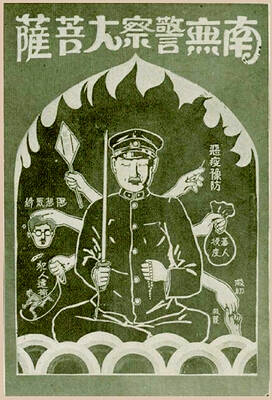
July 13 to July 19 “Police Bodhisattva” sits in the lotus position on a cloud, holding a sword in one hand and prayer beads in the other. Six additional hands behind him perform the main duties of Japanese-era law enforcement: maintaining left-hand traffic, ideological policing, arresting criminals, rescue and relief, livelihood assistance for Indigenous people and epidemic prevention. This image, with the words “Namo Police Great Bodhisattva” (南無警察大菩薩) above it, appeared on a promotional poster at the Taihoku Prefecture Police Public Health Exhibition in November 1925. It was just one of 1,249 posters displayed at the event, but it appears to
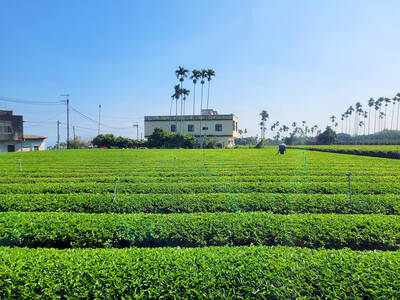
The next time you see a satellite image of Taiwan, look at the eastern edge of Changhua County and notice the long snake-like dark patch. These are the steep hills where the terrain rises up from the plains of Changhua to higher, flat ground in Nantou County to the east. This abrupt change in topography, known as the Bagua Plateau (八卦台地), naturally lends itself to hiking and cycling trails, while the edge of the plateau makes for a beautiful drive, with plenty of viewpoints along the way. County Roads 139 and 139乙 follow a north-south course along the edge of


 RSS
RSS