


Once upon a time, Aphrodite — the Greek goddess who ruled over love, lust, beauty and desire — was forced to flee from the attack of the giant Mimas. In her haste, she plunged into the water for refuge, only to realize too late that she had left her son, Eros, behind.
She immediately returned to the shore, gathered her child and together they transformed into fish, diving once more beneath the surface. Fearing that they might be separated in the turbulent waters, Aphrodite bound their fish tails together with a cord, descending into the depths as one.
Later, Zeus lifted the image of these two entwined fish into the sky, where they became what we now know as Pisces.
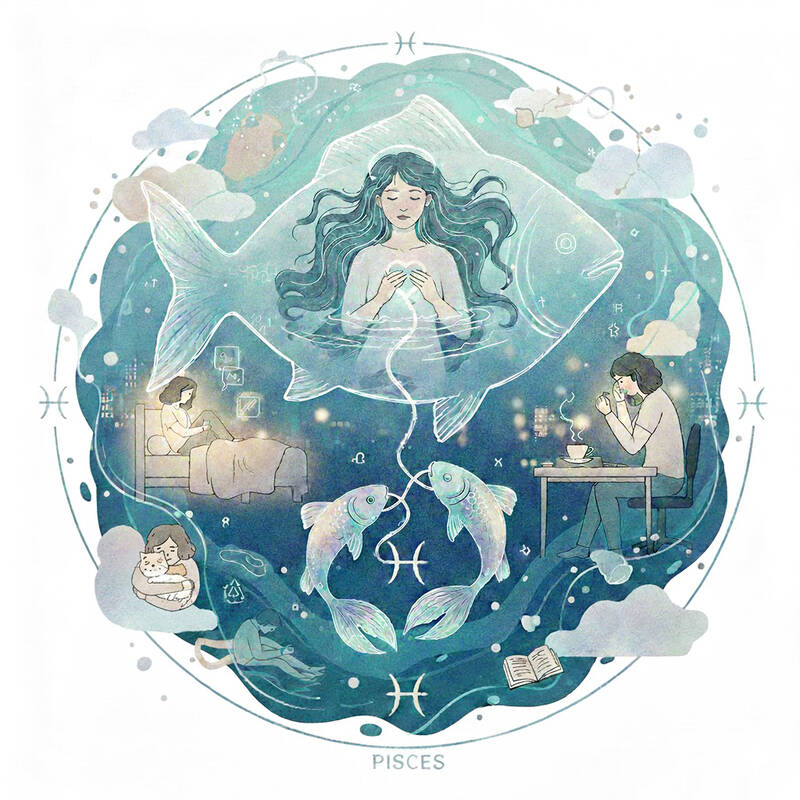
illustration: Morin K.Y.
Yet when viewed from the perspective of the 21st century, myth is rarely just myth. It is more like a preserved memory of consciousness. Seen through a contemporary lens, this story may not be about gods fleeing in chaos and changing form — but about us, living in unstable times, choosing to remain connected: to ourselves, and to one another.
During the season of Pisces, we are invited to reconnect with ourselves through deep sleep and dreams. The repeated motif of “diving into the water” in this myth points toward the realm of the subconscious. To sink beneath the surface is to approach those inner feelings that have not yet found their way into language.
This is precisely why Pisces’ energy always carries an air of mystery and haze. It resembles a vast body of water — impossible to grasp at a single glance. This does not mean that people with Piscean qualities are deliberately hiding something; rather, they often move through the world instinctively in a way that is soft, fluid and guided by feeling.
And so the question arises:
Who, exactly, am I talking about? Those born between Feb. 20 and March 20? Those whose Moon or Ascendant lies in Pisces? Or anyone who has ever been labeled “Pisces” by definition?
In truth — none of the above.
In astrology, every individual chart contains all 12 signs and all 12 houses. Over the course of our lives, we move through spring, summer, autumn and winter; through 12 months, 12 archetypal phases, again and again.
This means that this column — and all future writings about the zodiac — isn’t about a specific group of people. It is about each of us, and a particular facet of our lives. The only difference lies in the angle from which we choose to observe, and the standpoint from which we choose to identify.
Therefore, in this Pisces season, we are all encouraged to slow down — using deep sleep and dream states to heal or reinforce our connection with the subconscious.
If you find yourself sleeping more than usual, feeling more emotional or longing for actual hugs, know that this is natural. Pisces energy does not demand immediate decisions; it invites us to be honest with what we are feeling as it unfolds.
However, because sensitivity is heightened, those who struggle with addictive tendencies may find this month especially suited for gentle self-inquiry. Ask yourself with patience: do the substances or behaviors that offer temporary escape truly meet your needs — or are they merely shielding you from the beasts of reality chasing close behind?
If you are drawn to exploring your subconscious more deeply, this is also an excellent time to seek psychotherapy or to work with spiritual, somatic, or divinatory practitioners with whom you feel safe and resonant. During Pisces season, encounters with the right guides often arrive more easily than expected.
As for the movement between signs — Aries may soften their grip this month. Your time to fully ignite comes next month; until then, allowing yourself to rest and gather energy is not avoidance, but preparation.
Cancer, if you are hoping to bring change into your daily life, this month may present opportunities that feel calm or quietly joyful. Pay attention, and resist the urge to dismiss small invitations too quickly.
And to everyone else: this month, you may safely “become Pisces.” Allow yourself to sink into the inner world, to receive healing, and to return to a deeper connection with yourself. As for tangible progress and concrete answers in the outer world — those can wait until next month. There is no hurry.
Holding In-between is a column about the zodiac published on the third Friday of every month, but is appearing today due to the adjusted printing schedule for the Lunar New Year. As a Projector in Human Design, Morin K.Y. is intrigued by the interplay between the tangible and the intangible. She enjoys perceiving life as a vast experiment of the soul, where everyday life simply unfolds as a series of different experiences. For collaborations please reach out to: aramaeaky@gmail.com
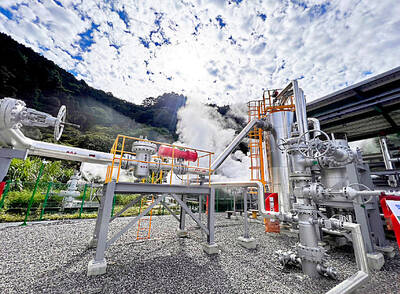
Taiwan’s semiconductor industry consumes electricity at rates that would strain most national grids. Taiwan Semiconductor Manufacturing Co (TSMC) alone accounted for more than 9 percent, or 2,590 megawatts (MW), of the nation’s power demand last year. The factories that produce chips for the world’s phones and servers run around the clock. They cannot tolerate blackouts. Yet Taiwan imports 97 percent of its energy, with liquefied natural gas reserves measured in days. Underground, Taiwan has options. Studies from National Taiwan University estimate recoverable geothermal resources at more than 33,000 MW. Current installed capacity stands below 10 MW. OBSTACLES Despite Taiwan’s significant geothermal potential, the

In our discussions of tourism in Taiwan we often criticize the government’s addiction to promoting food and shopping, while ignoring Taiwan’s underdeveloped trekking and adventure travel opportunities. This discussion, however, is decidedly land-focused. When was the last time a port entered into it? Last week I encountered journalist and travel writer Cameron Dueck, who had sailed to Taiwan in 2023-24, and was full of tales. Like everyone who visits, he and his partner Fiona Ching loved our island nation and had nothing but wonderful experiences on land. But he had little positive to say about the way Taiwan has organized its
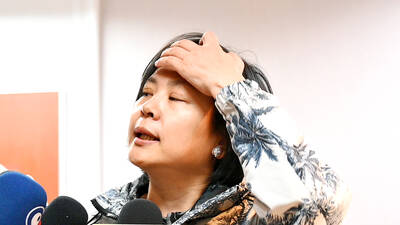
The entire Li Zhenxiu (李貞秀) saga has been an ugly, complicated mess. Born in China’s Hunan Province, she moved to work in Shenzhen, where she met her future Taiwanese husband. Most accounts have her arriving in Taiwan and marrying somewhere between 1993 and 1999. She built a successful career in Taiwan in the tech industry before founding her own company. She also served in high-ranking positions on various environmentally-focused tech associations. She says she was inspired by the founding of the Taiwan People’s Party (TPP) in 2019 by Ko Wen-je (柯文哲), and began volunteering for the party soon after. Ko
Chinese Nationalist Party (KMT) Chair Cheng Li-wun (鄭麗文) returned from her trip to meet People’s Republic of China (PRC) dictator Xi Jinping (習近平) bearing “a gift” for the people of Taiwan: 10 measures the PRC proposed to “facilitate the peaceful development of cross-strait relations.” “China on Sunday unveiled 10 new incentive measures for Taiwan,” wrote Reuters, wrongly. The PRC’s longstanding habit with Taiwan relations is to repackage already extant or once-existing policies and declare that they are “new.” The list forwarded by Cheng reflects that practice. NEW MEASURES? Note the first item: establishing regular communication mechanisms between the Chinese Communist Party


 RSS
RSS