


Taiwan is especially vulnerable to climate change. The surrounding seas are rising at twice the global rate, extreme heat is becoming a serious problem in the country’s cities, and typhoons are growing less frequent (resulting in droughts) but more destructive. Yet young Taiwanese, according to interviewees who often discuss such issues with this demographic, seldom show signs of climate anxiety, despite their teachers being convinced that humanity has a great deal to worry about.
Climate anxiety or eco-anxiety isn’t a psychological disorder recognized by diagnostic manuals, but that doesn’t make it any less real to those who have a chronic and sometimes paralyzing dread of environmental doom. Rather than examine the extent and consequences of climate anxiety, mental health researchers in Taiwan have so far focused on the psychological impacts of extreme weather, finding that rates of depression, post-traumatic stress disorder and suicide increase in the wake of heat waves or catastrophic floods.
Cheng Tsu-jui (鄭祖睿), an assistant professor in the Department of Transportation and Communication Management Science at National Cheng Kung University, says that, when teaching Sustainable Transportation to graduate students, he asks each class if there are students who’ve had climate anxiety.
Photo: Steven Crook
“Usually the answer is ‘no,’ but I’ve got ‘yes’ from several international students. I also do a quick show of hands to see whether students are aware of rising temperatures and extreme rainfall. Most are aware of extreme weather conditions, but very few, if any, say they worry about the climate or their living environment getting worse,” he says.
Cheng says that he’s discussed this lack of concern with those who’ve researched environmental awareness, and he now thinks there are a couple of possible reasons for such indifference: Taiwanese prioritize economic development over environmental protection, he suggests, and the government hasn’t led by example when it comes to in climate issues. The latter is especially true when it comes to decarbonizing transportation, including electric vehicle targets and low-carbon commuting among its own employees, he says.
“I understand that at their stage in life, students are more worried about immediate concerns, such as exams and jobs,” Cheng says. “As for my colleagues, they understand climate issues, but only those who work knee-deep in environmental issues express greater concerns.”
Photo: Steven Crook
“I myself have climate anxiety,” Cheng says. “It used to keep me up in the middle of the night, but now I guess I’m getting used to the status quo. To be honest, I don’t know how best to deal with climate anxiety. I just try to be as environmentally friendly as I can.”
When he meets with government officials, Cheng takes every opportunity to advocate for climate action. While endeavoring to stimulate his students’ environmental awareness, he tells them that he worries more about water shortages than regional geopolitical conflicts. “The former could come sooner than the latter. With a drought, we’d be on our own. All we could do is pray.”
“I do worry that the planet won’t be as habitable as it is now when my kid grows up,” Cheng says. He’s noticed that most of his friends who work in environmental advocacy are childless; while this could be a result of personal choices that have nothing to do with the state of the planet, “it seems like the percentage is much higher compared to other fields,” he says.
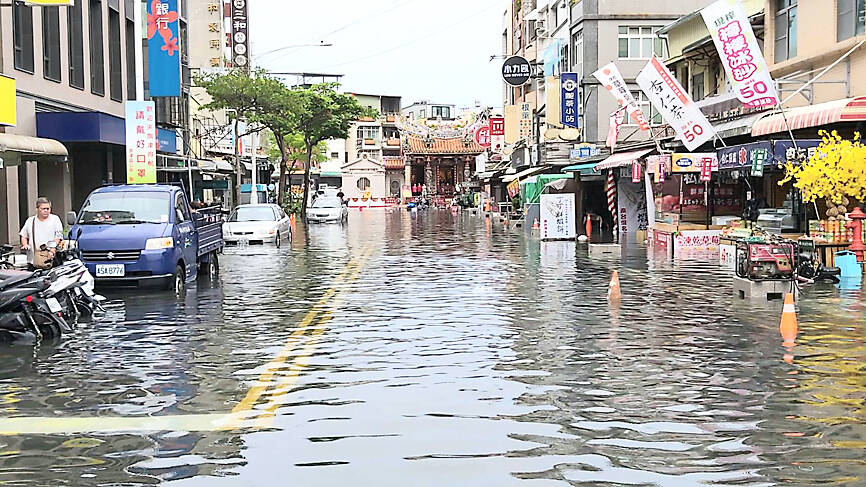
Photo: Chen Wen-chan, Liberty Times
DROWNING IN INFORMATION
“From my interactions with youngsters, I feel that the proportion of young people in Taiwan concerned about climate change and the preservation of pristine natural environments has actually declined in recent years,” says Huang Tai-hua (黃泰華), executive director of the Taiwan Owl Conservation and Wildlife Coexistence Association (台灣鴞生態共融協會). However, he goes on to say, some young citizens are active in “genuine ecological conservation work, diligently investigating habitats and protecting rare species. They have firsthand field experience and professional backgrounds. But they’re still a minority, and more social energy is needed when facing major issues.”
Huang thinks that, while the public is more knowledgeable than before, a combination of apathy and information overload has made it more difficult to start “discussions that allow for deep reflection and empathy on environmental issues.”
Photo: Liu Hsin-de, Taipei Times
Arguing that environmental stewardship is born of both scientific literacy and a raw appreciation for nature’s beauty, Huang finds encouragement in the growing popularity of outdoor recreation. “More people than ever are experiencing nature’s hidden gems. However, when it comes to preventing environmental damage, some young people who’d otherwise care are led astray by private-sector ESG practices and assumptions that the government balances economic development and conservation,” he says.
Because environmental issues are complex, he explains, some people think they should “leave what they don’t understand to the professionals.” As a result, problems that are already difficult to address “sink further into the void in today’s information-saturated world. This is why many developers invest in public relations and marketing.”
Bemoaning the ineffectiveness of the government’s Environmental Impact Assessment (EIA) system, Huang says that on-site protests, “like people holding hands to stop excavators from entering virgin forest, or indigenous people uniting to protect their streams, are still the purest and most moving expressions of solidarity.”
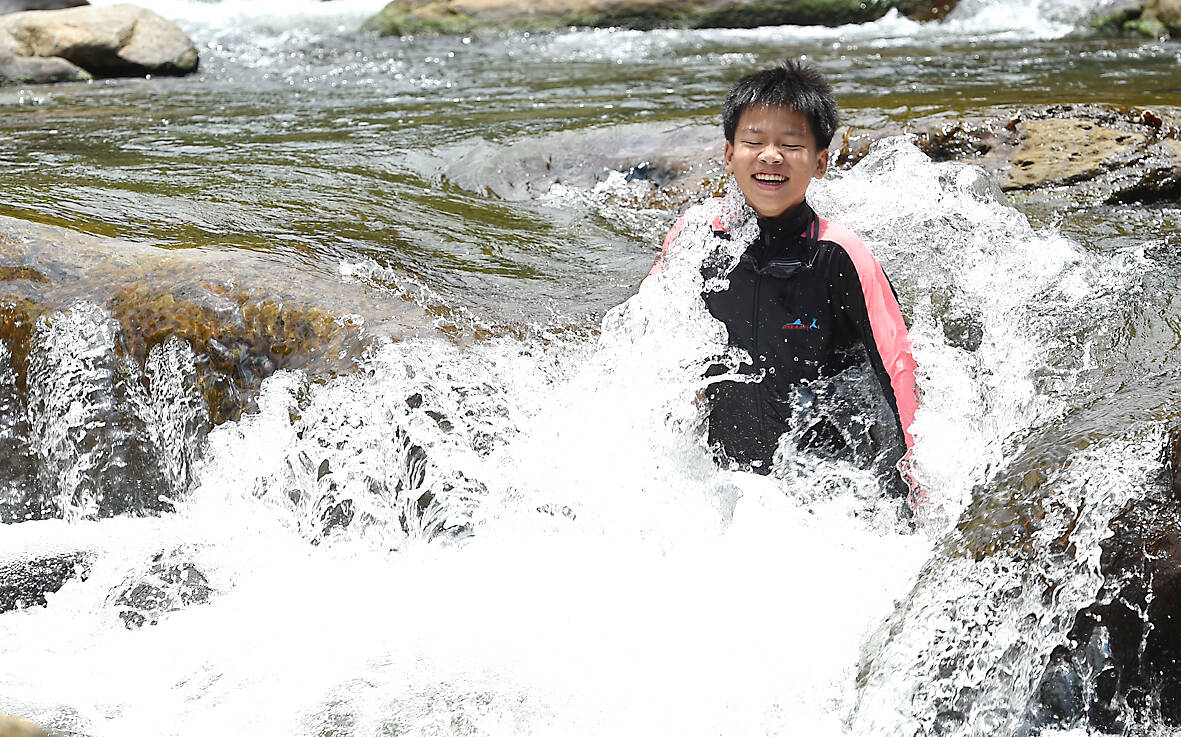
Photo: Liu Hsin-de, Taipei Times
He argues that, to get young people to care about these issues, “We must use simple and effective appeals to make them understand that many development projects are lose-lose in both economic and environmental terms, and that once a species’ unique habit has been destroyed, it cannot be restored.”
Recalling the successful campaign against the Nanshi Creek (南勢溪) water diversion project, in which he played a leading role (see “Will Nanshi Creek be sacrificed on the altar of economic development?” in the July 27, 2022 edition of the Taipei Times), Huang says mobilizing opposition requires, “strong local support, solid ecological data, deciphering the developer’s arguments, making complex content easily understandable to young people and prominent figures, and providing firsthand footage from the site at risk. No matter how times change, images still have the power to touch people’s hearts.”
CONCRETE EFFECTS
Photo: Steven Crook
Stressing that he’s not a mental-health professional, National Taiwan Normal University Department of Geography Associate Professor Mucahid Mustafa Bayrak says that while his students “think that the climate crisis is real, and are more environmentally conscious than people I meet outside the classroom, I’ve not really noticed that they experience the kind of negative emotions often referred to as ‘climate anxiety.’”
Bayrak has led students on field trips relating to climate-change impacts and adaptation among coastal and indigenous communities (see “Taiwan’s Aborigines and the concept of ‘country’” in the March 24, 2021 Taipei Times), and says he’s noticed that, as the students’ awareness of climate risks has increased, “this tends to motivate them to learn more, rather than making them feel anxious or helpless. They’re particularly inspired by these communities, by their resilience, but also by their general hospitality and warmth, to do more.”
Saying he doesn’t recall any notable instances of people expressing “climate anxiety per se,” a few students have told him about striking personal experiences. “Often, it’s not the global phenomenon itself that causes anxiety, but rather its concrete and lived effects. In Taiwan, almost everyone has experienced a typhoon, flooding or extreme precipitation,” the Dutchman points out.
He’s also noticed that, for students in both Taiwan and the Netherlands, much of their time is occupied with personal and career development, and navigating the complexities of personal relationships. As a result, he says, “challenges like the climate crisis, as well as the miserable state of humanity in general, aren’t often at the forefront of students’ minds unless they’ve a particular personal interest in these issues.”
Bayrak himself isn’t optimistic, saying: “World leaders have clearly shown that they don’t care about the climate crisis, so feeling anxious about the global challenges we’re facing as humanity is entirely normal.”
He says that the way to cope with this is to confront it meaningfully and strive for a different world. Bayrak would like to see all humans treated equally, and the economy subordinated to social and environmental justice. “This may sound like a dream, but if enough people share the dream, it may become reality, before advanced capitalism brings devastation not only to marginalized communities but ultimately to all,” he contends.
Steven Crook, the author or co-author of four books about Taiwan, has been following environmental issues since he arrived in the country in 1991. He drives a hybrid and carries his own chopsticks. The views expressed here are his own.
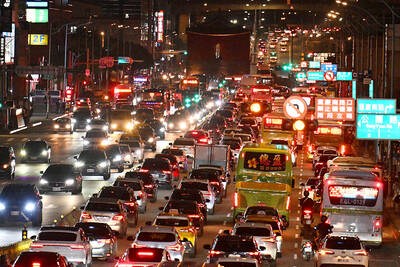
By global standards, the traffic congestion that afflicts Taiwan’s urban areas isn’t horrific. But nor is it something the country can be proud of. According to TomTom, a Dutch developer of location and navigation technologies, last year Taiwan was the sixth most congested country in Asia. Of the 492 towns and cities included in its rankings last year, Taipei was the 74th most congested. Taoyuan ranked 105th, while Hsinchu County (121st), Taichung (142nd), Tainan (173rd), New Taipei City (227th), Kaohsiung (241st) and Keelung (302nd) also featured on the list. Four Japanese cities have slower traffic than Taipei. (Seoul, which has some

In our discussions of tourism in Taiwan we often criticize the government’s addiction to promoting food and shopping, while ignoring Taiwan’s underdeveloped trekking and adventure travel opportunities. This discussion, however, is decidedly land-focused. When was the last time a port entered into it? Last week I encountered journalist and travel writer Cameron Dueck, who had sailed to Taiwan in 2023-24, and was full of tales. Like everyone who visits, he and his partner Fiona Ching loved our island nation and had nothing but wonderful experiences on land. But he had little positive to say about the way Taiwan has organized its

Michael slides a sequin glove over the pop star’s tarnished legacy, shrouding Michael Jackson’s complications with a conventional biopic that, if you cover your ears, sounds great. Antoine Fuqua’s movie is sanctioned by Jackson’s estate and its producers include the estate’s executors. So it is, by its nature, a narrow, authorized perspective on Jackson. The film ends before the flood of allegations of sexual abuse of children, or Jackson’s own acknowledgment of sleeping alongside kids. Jackson and his estate have long maintained his innocence. In his only criminal trial, in 2005, Jackson was acquitted. Michael doesn’t even subtly nod to these facts.
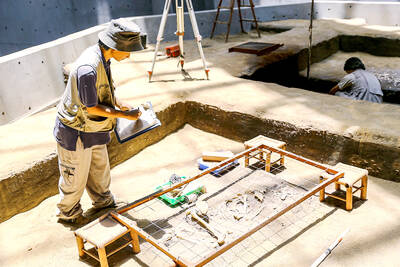
Writing of the finds at the ancient iron-working site of Shihsanhang (十 三行) in New Taipei City’s Bali District (八里), archaeologist Tsang Cheng-hwa (臧振華) of the Academia Sinica’s Institute of History and Philology observes: “One bronze bowl gilded with gold, together with copper coins and fragments of Tang and Song ceramics, were also found. These provide evidence for early contact between Taiwan aborigines and Chinese.” The Shihsanhang Web site from the Ministry of Culture says of the finds: “They were evidence that the residents of the area had a close trading relation with Chinese civilians, as the coins can be


 RSS
RSS