


In all the dystopian visions of the future that the movies have trotted out over the last few decades, the one that sticks the most, surprisingly, is WALL-E. That’s not just because of the chastening sight of an over-polluted Earth or those sedentary humans glued to their screens. It’s because those quite plausible possibilities mean something different in a kids movie. It’s their future, after all.
Some of the same can be said about Ugo Bienvenu’s Arco, a charming and dreamy sci-fi animated movie where environmental catastrophe and cartoony fun collide. Like WALL-E, there are heroic robots in Arco, an Oscar nominee for best animated feature. But it’s the film’s plucky young protagonists that give Bienvenu’s future-set film its heart.
The film opens in a distant future where a family lives on Jetsons-like platforms in the clouds. They wear drab onesies (fashion sense has seemingly been lost along with the Earth’s surface) but sport rainbow cloaks that enable them to fly through time, leaving a rainbow streak behind.
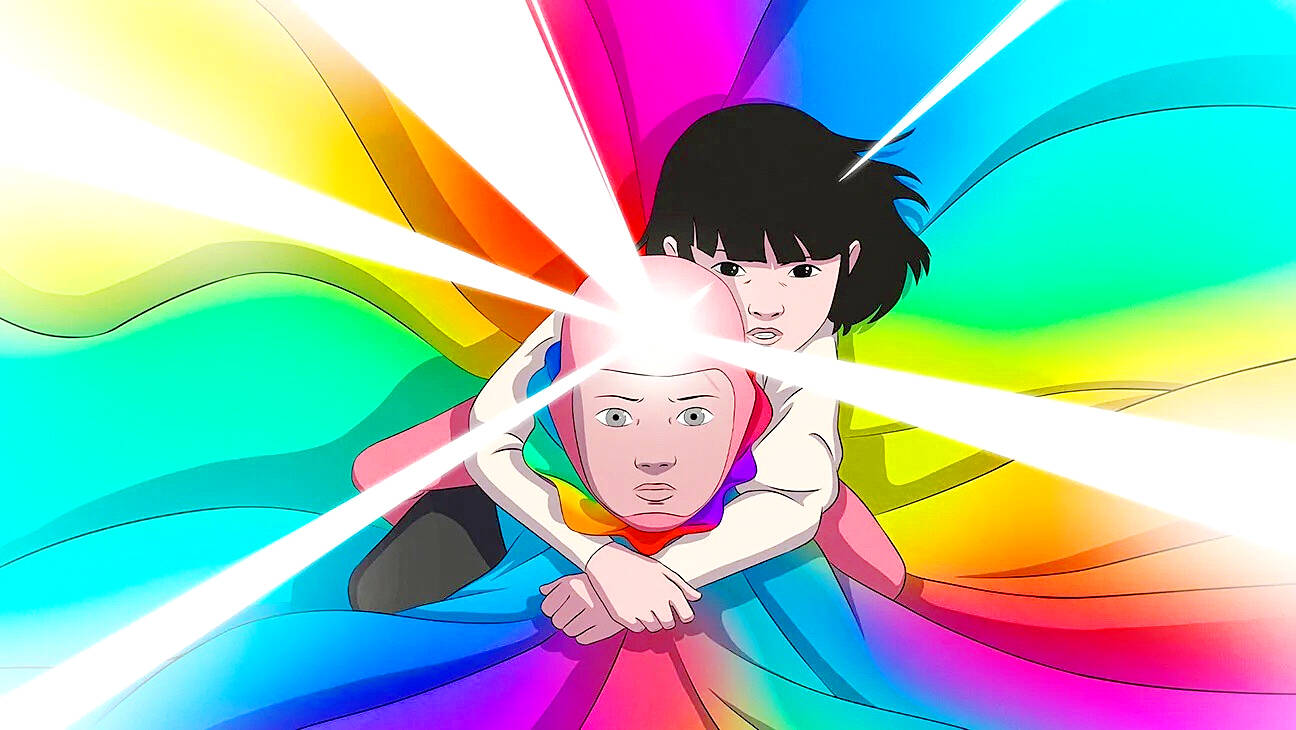
Photo: AP
Though 10-year-old Arco (voiced by Juliano Krue Valdi in the English dub) has been told he can’t fly until he’s older, he sneaks off with his sister’s cape and, hoping for a glimpse of the dinosaurs, accidentally crash lands in 2075.
Arco is the unusual movie to exist in two future times, never our present. And it can take a moment to acclimate to both its jumbled timeline and the sheer amount of rainbows. But Bienvenu, a French comic-book artist making his directorial debut, richly imagines a 2075 future of recognizable extremes.
Storms have become so violent that homes now have protective bubbles around them. Adults work such long hours in a distant city that they are usually mere holograms to their kids — an image that will send shudders down the spine of any parent who Zooms from a work trip. For Iris (voiced by Romy Fay) and her baby brother, the family robot does most of the parenting. In fact, robots do most things: teaching, construction, medical aid.
Iris, a sharp young girl, sees Arco’s rainbow fly into the woods and runs to find him. At the same time, three bumbling, oddly dressed fellows, dressed in primary colors and wearing rainbow glasses, come looking for him. This trio — voiced in the English dub by Will Ferrell, Andy Samberg and Flea — are a goofy and very French addition to the movie. Ferrell and company are a marked improvement from the original.
But there’s no harm in giving Arco some Saturday-morning-cartoon slapstick to go with the apocalyptic doom. Those three, believing they’re hot on a time-travel trail, stay in pursuit while Arco and Iris develop a friendship and learn about each’s eras.
Parents remain largely absent. In Arco, kids are left to fend for themselves in a world of technology and ecological disaster. (In one of the movie’s most damning moments, the kids find refuge in a library because no one goes in there anymore.) But while there’s no shortage of films that comment on our overly digital lives, technology is far from a villain in Arco. It is closer to the savior.
So while Bienvenu’s film bears similarities to movies before it — Arco is far from the first future boy to fall from the sky — it’s the first that I recall that so directly confronts ecological apocalypse and yet still finds a thrillingly optimistic note to end on. Thrilling because it puts the future in the hands of the young. Arco dares to imagine a fate for them, somewhere over the rainbow.
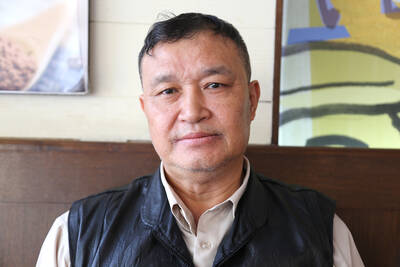
Taiwan has next to no political engagement in Myanmar, either with the ruling military junta nor the dozens of armed groups who’ve in the last five years taken over around two-thirds of the nation’s territory in a sprawling, patchwork civil war. But early last month, the leader of one relatively minor Burmese revolutionary faction, General Nerdah Bomya, who is also an alleged war criminal, made a low key visit to Taipei, where he met with a member of President William Lai’s (賴清德) staff, a retired Taiwanese military official and several academics. “I feel like Taiwan is a good example of

Institutions signalling a fresh beginning and new spirit often adopt new slogans, symbols and marketing materials, and the Chinese Nationalist Party (KMT) is no exception. Cheng Li-wun (鄭麗文), soon after taking office as KMT chair, released a new slogan that plays on the party’s acronym: “Kind Mindfulness Team.” The party recently released a graphic prominently featuring the red, white and blue of the flag with a Chinese slogan “establishing peace, blessings and fortune marching forth” (締造和平,幸福前行). One part of the graphic also features two hands in blue and white grasping olive branches in a stylized shape of Taiwan. Bonus points for

“M yeolgong jajangmyeon (anti-communism zhajiangmian, 滅共炸醬麵), let’s all shout together — myeolgong!” a chef at a Chinese restaurant in Dongtan, located about 35km south of Seoul, South Korea, calls out before serving a bowl of Korean-style zhajiangmian —black bean noodles. Diners repeat the phrase before tucking in. This political-themed restaurant, named Myeolgong Banjeom (滅共飯館, “anti-communism restaurant”), is operated by a single person and does not take reservations; therefore long queues form regularly outside, and most customers appear sympathetic to its political theme. Photos of conservative public figures hang on the walls, alongside political slogans and poems written in Chinese characters; South

March 9 to March 15 “This land produced no horses,” Qing Dynasty envoy Yu Yung-ho (郁永河) observed when he visited Taiwan in 1697. He didn’t mean that there were no horses at all; it was just difficult to transport them across the sea and raise them in the hot and humid climate. “Although 10,000 soldiers were stationed here, the camps had fewer than 1,000 horses,” Yu added. Starting from the Dutch in the 1600s, each foreign regime brought horses to Taiwan. But they remained rare animals, typically only owned by the government or


 RSS
RSS