


Chinese Communist Party (CCP) Secretary-General Xi Jinping (習近平) has effectively decapitated the People’s Liberation Army (PLA) leadership, with his purges finally taking down Zhang Youxia (張又俠), the last PLA general with widespread power and respect.
Speculation is rife on why this is happening, who will rise to form the new PLA leadership and what this all means for Taiwan. Some of this speculation is thoughtful and well-informed, some is based on wishful thinking and feeble, well-worn tropes.
Meanwhile, the messaging from Washington is whiplash-inducing. Regardless of what one thinks of the former administration of president Joe Biden, it was clear from the beginning that they had a plan of action regarding Taiwan that was consistent and coordinated across the government as a whole, with top officials even speaking off the same script. Describing the relationship with Taiwan as “rock solid” was repeated regularly by top officials.
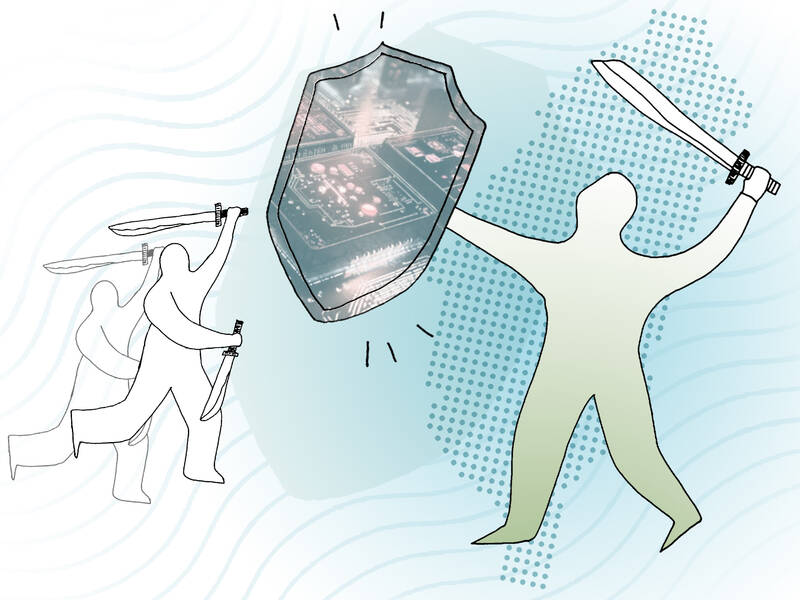
illustration: Tania Chou, Taipei Times
Though uncoordinated, the first Trump administration was packed with pro-Taiwan, or at least anti-China, figures. This provided some semblance of coherence, but not only is the second Trump administration uncoordinated in its approach to Taiwan, even within departments, the message can change from day to day, and we never know what they are going to say and do next. Strategic ambiguity has been replaced with strategic incoherence.
Amid all this, partisan political warfare domestically is making it hard for Taiwan to respond strategically or coherently.
Flowing through all three issues is frequent discussion of Taiwan’s so-called “silicon shield.” This is not just misguided, it is dangerous because it is a mirage conjured up with dollops of wishful thinking, gross oversimplifications and misunderstandings.
At the core of the theory is Taiwan Semiconductor Manufacturing Co (TSMC), whose fabs produce over 90 percent of the most cutting-edge chips, while Taiwanese chipmakers as a whole are credited with producing half of the entire market.
These chips are at the core of our entire technological civilization. They are essential components not just in our cell phones, but in every computer, satellite and data center that keep communications, infrastructure and even fighter jets functioning. They are often referred to as the “new oil,” or likened to the spice in the Dune science fiction series.
There are two main variants to the “silicon shield” myth. One is that due to the crucial role chips play in the world economy, the world would ride to the rescue to defend Taiwan, led by the US.
The second is that China’s export-led economy would seize up and grind to a halt without Taiwan’s chips, and would not dare to invade due to the enormous economic costs that it would impose domestically.
Both are wrong.
THE PROBLEM IS BIGGER
The first problem is that while impressive, TSMC is simply one node on a supply chain that includes hundreds of individual nodes, all critical in their own way, even if less high profile. If suppliers of suppliers are included, this chain extends into the thousands of companies and hundreds of weak points.
Without those suppliers, TSMC cannot function, and many suppliers are equally unique and essential to the entire chain. These range from the highest-tech inputs from Holland, Germany, the US and Japan, all the way to the raw materials, chemicals and gases needed to produce the final product — and those supply chains extend across the planet.
It gets worse: focusing on Taiwan and TSMC misses the bigger picture. An often cited statistic from Bloomberg is that half of the world’s trade passes through the Taiwan Strait, but even that figure obscures the true scale of the problem.
If the CCP launched an attack on Taiwan, it would inevitably draw in Japan and possibly South Korea. China would almost certainly be under blockade, while it would blockade Taiwan and target Japanese shipping. South Korea is boxed in geographically, so even in the best-case scenario, what little shipping could make it in and out of Japan and South Korea would be hit with ruinously high shipping insurance.
China’s exports would shrivel to what minuscule quantities they can get out via Russia and central Asia to reach small markets — largely disappearing from the world economy. Japan and South Korea would struggle, and Taiwan would be cut off entirely.
The lack of chips would be just a tiny fraction of the economic impact; taking everything these economies produce off the world market would cause trillions in devastating economic ripple effects. It is not just Taiwan, but also Japan, South Korea and especially China that play critical roles in the supply chains of virtually all modern manufacturing.
In that environment, chips are the least of the world’s problems. Even if the materials are available for factories to produce low-tech products outside of this region, it is only a matter of time before the technologies those factories rely on to manufacture those products begin to break down, lacking key components reliant on East Asia.
Even where key production remains viable outside of the region, prices will skyrocket. So will prices of secondhand goods.
And what if North Korea, Russia or even Southeast Asia gets drawn into this war?
PARASITIC BEAST
Of course, aside from Taiwan, the most devastated economy would be China’s. Alone, it accounts for over a quarter of global manufacturing output. Cut off from world markets, the economic impact would be devastating.
Chips would be low on the list of China’s problems. Crucial inputs like food and fuel travel through chokepoints like the Strait of Malacca, and would be almost entirely cut off. Additionally, they would also be largely cut off from global financial markets, leaving them only a trickle of outlets through countries like Russia.
No rational leader would willingly choose to destroy their own country’s economy, right?
The CCP is rational, but not in terms most people are used to. It is fundamentally a parasitic, extractive beast.
It feeds and sustains itself on power. The CCP’s priority is to maintain power, and ideally expand it.
They are well aware that their base of power and control is in the resources it commands domestically. In this system, people are just resources to exploit.
If Xi calculates that the benefits of extending the CCP’s power and control domestically by an invasion of Taiwan outweigh the risks, he will order the PLA to attack.
There is no mercy in the CCP’s history. Unleashing widespread starvation, destruction, terror and violence are features, not bugs, in feeding their power and control.
In this calculus, the fear in Zhongnanhai is not widespread death in an orgy of ideological and ethnonationalistic fury and destruction unleashed by war, but of internal revolt.
Aware of these weaknesses, Beijing has been stockpiling essential goods and expanding its financial alternatives for some time. These could keep the lights on and people fed for some time, but they would not do much beyond that.
Joblessness would be massive, leaving many in a situation where even if food is available, they may not be able to afford it. The government would likely release just enough food to avoid widespread unrest, but not much more.
The CCP has been practicing mass civilian control since it came to power. In recent years, mass repression of minorities like the Uighurs and Tibetans, and draconian lockdowns during COVID, served as dry runs for a mass crackdown.
While they will initially count on propaganda-fed ethnonationalism to rally people to support a war, how confident is the CCP in its ability to contain the public if the people turn against it as the costs rise, livelihoods are destroyed and the body bags stack up?
How loyal would the PLA remain if it were repeatedly defeated in battle? How loyal would the CCP’s rank-and-file be?
These are just some of the calculations that will weigh on Xi’s mind.
Chips do not factor into these calculations; much less provide any sort of shield.
Donovan’s Deep Dives is a regular column by Courtney Donovan Smith (石東文) who writes in-depth analysis on everything about Taiwan’s political scene and geopolitics. Donovan is also the central Taiwan correspondent at ICRT FM100 Radio News, co-publisher of Compass Magazine, co-founder Taiwan Report (report.tw) and former chair of the Taichung American Chamber of Commerce. Follow him on X: @donovan_smith.

Yesterday, the Democratic Progressive Party (DPP) nominated legislator Puma Shen (沈伯洋) as their Taipei mayoral candidate, the Chinese Nationalist Party (KMT) put their stamp of approval on Wei Ping-cheng (魏平政) as their candidate for Changhua County commissioner and former legislator Tsai Pi-ru (蔡壁如) of the Taiwan People’s Party (TPP) has begun the process to also run in Changhua, though she has not yet been formally nominated. All three news items are bizarre. The DPP has struggled with settling on a Taipei nominee. The only candidate who declared interest was Enoch Wu (吳怡農), but the party seemed determined to nominate anyone
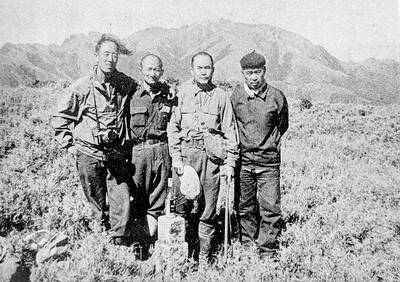
May 18 to May 24 Gathered on Yangtou Mountain (羊頭山) on Dec. 5, 1972, Taiwan’s hiking enthusiasts formally declared the formation of the “100 Peaks Club” (百岳俱樂部) and unveiled the final list of mountains. Famed mountaineer Lin Wen-an (林文安) led this effort for the Chinese Alpine Association (中華山岳協會). Working with other experienced climbers, he chose 100 peaks above 10,000 feet (3,048m) that featured triangulation points and varied in difficulty and character. The list sparked an alpine hiking craze, inspiring many to take up mountaineering and competing to “conquer” the summits. A common misconception is that the 100 Peaks represent Taiwan’s 100 tallest
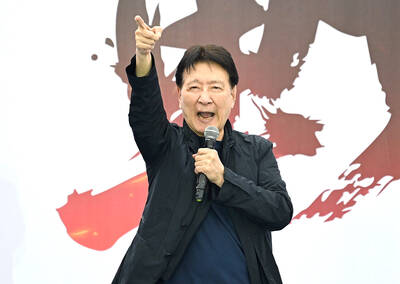
In a sudden move last week, opposition lawmakers of the Chinese Nationalist Party (KMT) and Taiwan People’s Party (TPP) passed a NT$780 billion special defense budget as a preemptive measure to stop either Chinese leader Xi Jinping (習近平) or US President Donald Trump from blocking US arms sales to Taiwan at their summit in Beijing, said KMT heavyweight Jaw Shaw-kong (趙少康), speaking to the Taipei Foreign Correspondents Club on Wednesday night in Taipei. The 76-year-old Jaw, a political talk show host who ran as the KMT’s vice presidential candidate in 2024, says that he personally brokered the deal to resolve
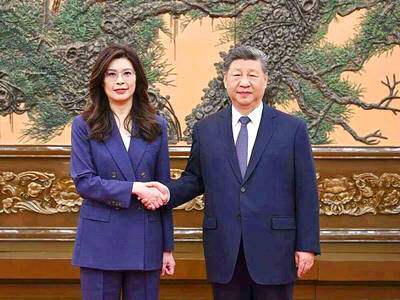
The Chinese Nationalist Party (KMT), alongside their smaller allies the Taiwan People’s Party (TPP), are often accused of acting on behalf of the Chinese Communist Party (CCP). Some go so far as to call them “traitors.” It is not hard to see why. They regularly pass legislation to stymie the normal functioning of the ruling Democratic Progressive Party’s (DPP) administration, and they have yet to pass this year’s annual budget. They slashed key elements of the government’s proposed NT$1.25 trillion (US$40 billion) special military budget, and in the smaller NT$780 billion package they did pass, it is riddled with provisions that


 RSS
RSS