


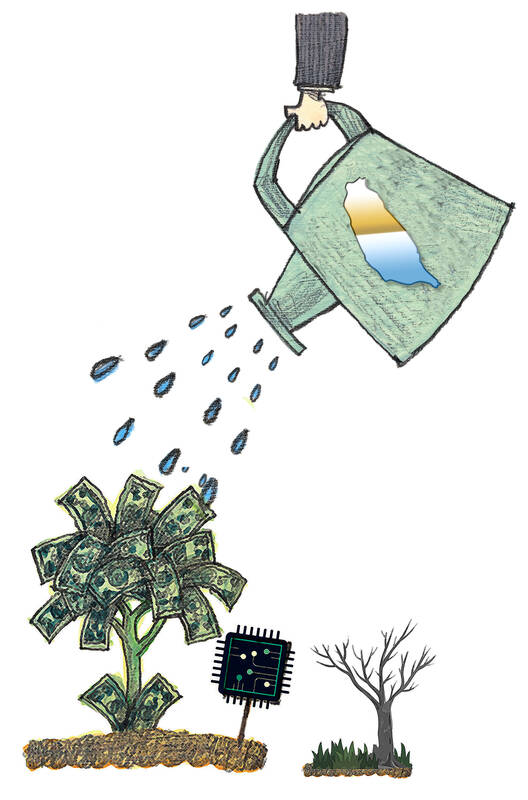
In the American west, “it is said, water flows upwards towards money,” wrote Marc Reisner in one of the most compelling books on public policy ever written, Cadillac Desert. As Americans failed to overcome the West’s water scarcity with hard work and private capital, the Federal government came to the rescue. As Reisner describes: “the American West quietly became the first and most durable example of the modern welfare state.” In Taiwan, the money toward which water flows upwards is the high tech industry, particularly the chip powerhouse Taiwan Semiconductor Manufacturing Co (TSMC, 台積電).
Typically articles on TSMC’s water demand toss out numbers intended to amaze and alarm the reader. “From 2015 to 2019, TSMC’s total water consumption surged by an astonishing 70 percent,” observed a 2024 Diplomat piece on TSMC’s water needs. It continued: “By 2036, Taiwan’s overall water consumption is projected to be 7.3 percent higher than in 2021, creating a daily supply deficit of 680,000 cubic meters” (2037 is when half the nation’s workforce will be over 45). No doubt there will be a water deficit, but the high tech industry will not be affected. Government policy is both to assure the semiconductor industry an uninterrupted flow of water, and to conceal the industry’s actual consumption of water. The social and ecological costs of these policies are borne by rural regions, aging, silent and powerless.
The semiconductor industry and its associated firms and R&D houses reside in the nation’s numerous science parks. The National Science and Technology Council manages the operations of the parks, special economic zones exempt from land laws and treated by environmental agencies with a weak and timorous hand. Firms in science parks receive favorable permitting and tax status, and enjoy special access to officials. The state and its agencies also run policymaking bodies and the energy and water infrastructure, “including the Taiwan Sugar Company, which acts as a central government land bank,” as one scholarly piece put it. As numerous observers have argued, the semiconductor industry is indeed a construction of state policy. They have missed, however, that its blooming took place in a resource hothouse also constructed by state policy.
GRAPHIC: tt
The National Development Fund was an early investor in TSMC, and its stake generates billions in dividend revenues for the government. As Andrew Stokols and Justin Kollar observe in a research article on development in Taiwan and Thailand, this means that government policy on TSMC is shaped by a profound conflict of interest. It also gives TSMC great leverage in negotiating with the government, which it does directly at the highest levels.
In another piece Kollar describes how Taiwan’s water infrastructure policy frameworks have been reconstructed to meet the semiconductor industry’s unceasing need for more water. During droughts in the 2000s the government stopped agricultural water flows to agricultural land, “fallowing” the land to reserve water for science park needs. Emergency fallowing “began as an extraordinary response,” Kollar avers, but “has become a routine tool for stabilizing industrial supply.” In every public policy space where massive demand meets resource restrictions, tools intended for emergency management become normalized as policy choices, generating the system of permanent fixes for permanent crisis familiar to any observer of the island’s political economy. Kollar then adds: “Second, large-scale infrastructural fixes — inter-basin pipelines, desalination plants and reclaimed water facilities — promise to ease the social and political tensions produced by repeated fallowing.”
Fallowing began during the terrible drought of 2002-4, which forced the government to fallow 65,000 acres of farmland, Kollar observes. Seven more droughts followed between 2002 and 2023. Each time the government forced farmers to fallow land, and bought them off with compensation (secondary industries such as farm equipment suppliers got nothing). Hence, such subsidies to farmers are, in effect, subsidies to semiconductor makers — a classic policy approach of directly subsidizing Peter to indirectly subsidize Paul. The point of this policy was not to cut water use per se, but to preserve the flow of water to the semiconductor industry.
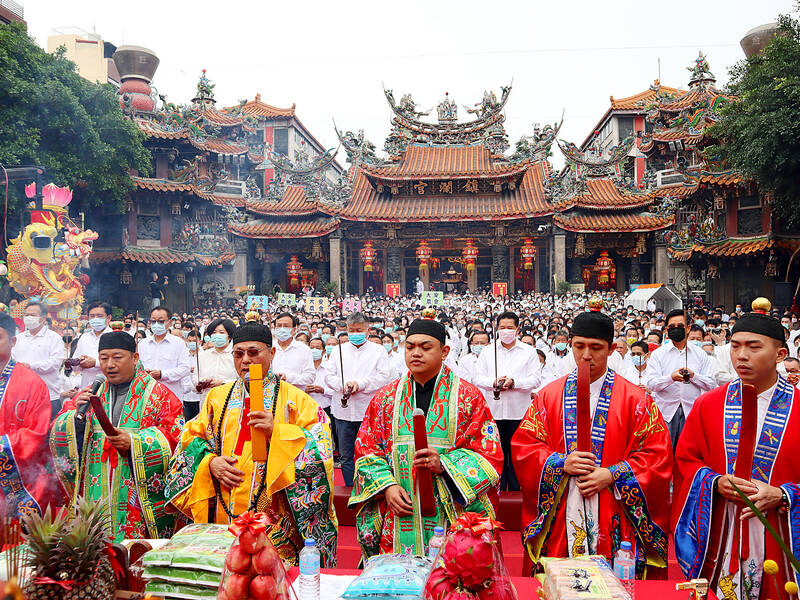
Photo: Ou Su-mei, Taipei Times
One goal of water policy for the semiconductor industry is to conceal its actual consumption. For decades, Kollar observed, the government used a crude statistical system developed in 1983 to measure water consumption. When this was revised in 2019-2020, semiconductor industry water consumption skyrocketed (review the quote from the Diplomat above). In reality, only the measurement method had changed. In southern Taiwan, according to local media reports, science parks often take water from “residential” lines to avoid public scrutiny. Another approach, since the 2010s, has been to jointly develop infrastructure for agriculture and the tech industry, ostensibly to alleviate farmers’ concerns. The government upgrades irrigation facilities to enhance the water supply and reduce waste, with the increased amount of water being diverted to the semiconductor industry.
Many observers of the semiconductor industry view it, falsely, as a “silicon shield” that helps protect Taiwan. This mantra recasts semiconductor industry needs as national security needs, downgrading the competing needs of less powerful industries.
“Subsiding farmland, declining aquifers and increasingly precarious rural livelihoods,” writes Kollar, “reveal how the burdens of adaptation are unevenly distributed across Taiwan’s socio-ecological landscape.”
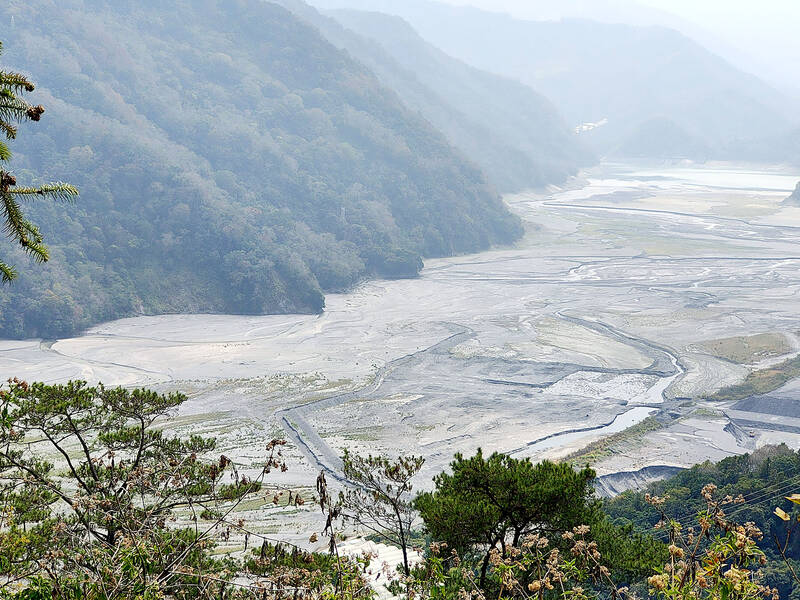
Photo: Tung Chen-kuo, Taipei Times
The 2016 Spatial Planning Act (國土計畫法) was designed to submit the nation’s land to a set of integrated, rational management policies. However, the major government water infrastructure projects for the semiconductor industry of the Democratic Progressive Party (DPP) era have been implemented outside of the framework specified by the National Spatial Act, Kollar says, “structured instead by ministerial workarounds and often behind-the-scenes coordination between central government agencies and corporate stakeholders.” Such collusion can only make voters more cynical about the ruling party.
Many of these projects are taking place in the high tech industry corridor the DPP has been extending southward in Taiwan. The water for these science parks and semiconductor manufacturing supply chain firms comes from the south, where water resources are already under great strain. When President William Lai (賴清德) was mayor of Tainan, he once approved transfer of irrigation water from Chiayi to the Southern Taiwan Science Park. At that time, 43 percent of Chiayi’s farmland was fallowed because of drought. Farmers have long memories.
The romantic dichotomy inherent in this farmer-semiconductor conflict is an easy reach, but it is a false one. Agriculture, even when the entire food processing production chain is counted, is under 10 percent of GDP, whereas TSMC alone is nearly 15 percent of economic output. Even agricultural export powerhouses like high mountain teas, groupers, orchids or edamame are boutique products aimed at specific markets with little effect on GDP. Nor do they feed the island. By contrast, TSMC’s export prowess ensures a flow of food from abroad for Taiwan, a net importer of food.
Can semiconductors influence Taiwan’s security? Not the way everyone imagines. For the nation’s security the DPP must continue to win elections at the national level. Yet the ecological and social costs of supplying water to the semiconductor industry fall heavily on the marginalized, precarious south, the DPP’s traditional stronghold. If the south is up for grabs in the next couple of election cycles, these policy choices could come to haunt the DPP.
Notes from Central Taiwan is a column written by long-term resident Michael Turton, who provides incisive commentary informed by three decades of living in and writing about his adoptive country. The views expressed here are his own.

Yesterday, the Democratic Progressive Party (DPP) nominated legislator Puma Shen (沈伯洋) as their Taipei mayoral candidate, the Chinese Nationalist Party (KMT) put their stamp of approval on Wei Ping-cheng (魏平政) as their candidate for Changhua County commissioner and former legislator Tsai Pi-ru (蔡壁如) of the Taiwan People’s Party (TPP) has begun the process to also run in Changhua, though she has not yet been formally nominated. All three news items are bizarre. The DPP has struggled with settling on a Taipei nominee. The only candidate who declared interest was Enoch Wu (吳怡農), but the party seemed determined to nominate anyone
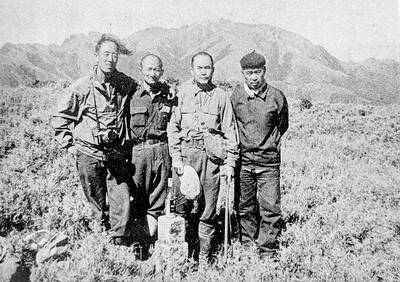
May 18 to May 24 Gathered on Yangtou Mountain (羊頭山) on Dec. 5, 1972, Taiwan’s hiking enthusiasts formally declared the formation of the “100 Peaks Club” (百岳俱樂部) and unveiled the final list of mountains. Famed mountaineer Lin Wen-an (林文安) led this effort for the Chinese Alpine Association (中華山岳協會). Working with other experienced climbers, he chose 100 peaks above 10,000 feet (3,048m) that featured triangulation points and varied in difficulty and character. The list sparked an alpine hiking craze, inspiring many to take up mountaineering and competing to “conquer” the summits. A common misconception is that the 100 Peaks represent Taiwan’s 100 tallest
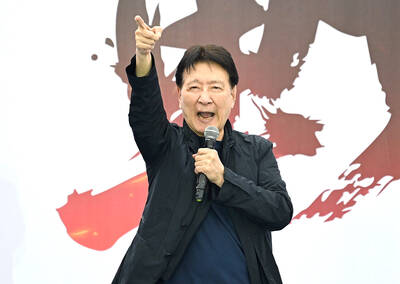
In a sudden move last week, opposition lawmakers of the Chinese Nationalist Party (KMT) and Taiwan People’s Party (TPP) passed a NT$780 billion special defense budget as a preemptive measure to stop either Chinese leader Xi Jinping (習近平) or US President Donald Trump from blocking US arms sales to Taiwan at their summit in Beijing, said KMT heavyweight Jaw Shaw-kong (趙少康), speaking to the Taipei Foreign Correspondents Club on Wednesday night in Taipei. The 76-year-old Jaw, a political talk show host who ran as the KMT’s vice presidential candidate in 2024, says that he personally brokered the deal to resolve
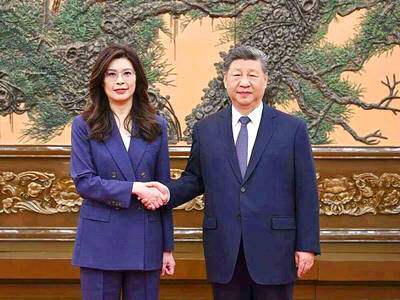
The Chinese Nationalist Party (KMT), alongside their smaller allies the Taiwan People’s Party (TPP), are often accused of acting on behalf of the Chinese Communist Party (CCP). Some go so far as to call them “traitors.” It is not hard to see why. They regularly pass legislation to stymie the normal functioning of the ruling Democratic Progressive Party’s (DPP) administration, and they have yet to pass this year’s annual budget. They slashed key elements of the government’s proposed NT$1.25 trillion (US$40 billion) special military budget, and in the smaller NT$780 billion package they did pass, it is riddled with provisions that


 RSS
RSS