


Rest of World, which reports global tech stories, had a piece out this week on wind energy and farmers and fishers in the south that was widely passed around.
The title didn’t mince words: “AI’s green-energy goal is devastating Taiwan’s coastal villages.”
The article summarized the situation, which it described as wind machines versus poor rural folk.

Photo courtesy of Huang San-min
“Since installation of the offshore cables began around 2022, silt buildup has increased, coating oyster shells with mud, shrinking viable farming areas and cutting yields, Li and three other oyster farmers in Fangyuan told Rest of World.”
This vision of small oyster farmers being mercilessly destroyed by greed for wind power is a pile of romantic crap.
Offshore wind power perhaps destroys individual oyster production sites. It isn’t destroying the industry. What’s slowly killing the oyster industry is the usual mix of factors and changes that we see in so many industries across the island: global warming, competition from abroad, aging and shrinking populations, labor shortages and changing government development priorities.

Photo courtesy of Taiya Renewable Energy
COASTLINE DEVELOPMENT
A research article last year by Baker Matovu, based on interviews with oyster producers in Yunlin, observes that the frequency of typhoons is increasing. Typhoons wreck small oyster farms and their support infrastructure.
The coast is also being reshaped by Taiwan’s overdevelopment mania, especially of rivers. Silt and sand no longer reach the coast in the right places (they are held behind dams and other infrastructure on the land, slowly destroying them). Hence, the Waisanding Sandbar (外傘頂洲), in whose protective shadow Chiayi’s Taiwan-leading oyster production takes place, is slowly shrinking and retreating towards the coast. Some studies estimate it could be completely underwater before the decade is out. It is quite vulnerable: a brutal cold spell in January 2021 caused the Waisanding Sandbar to shift several dozen meters, burying over 150 oyster racks.
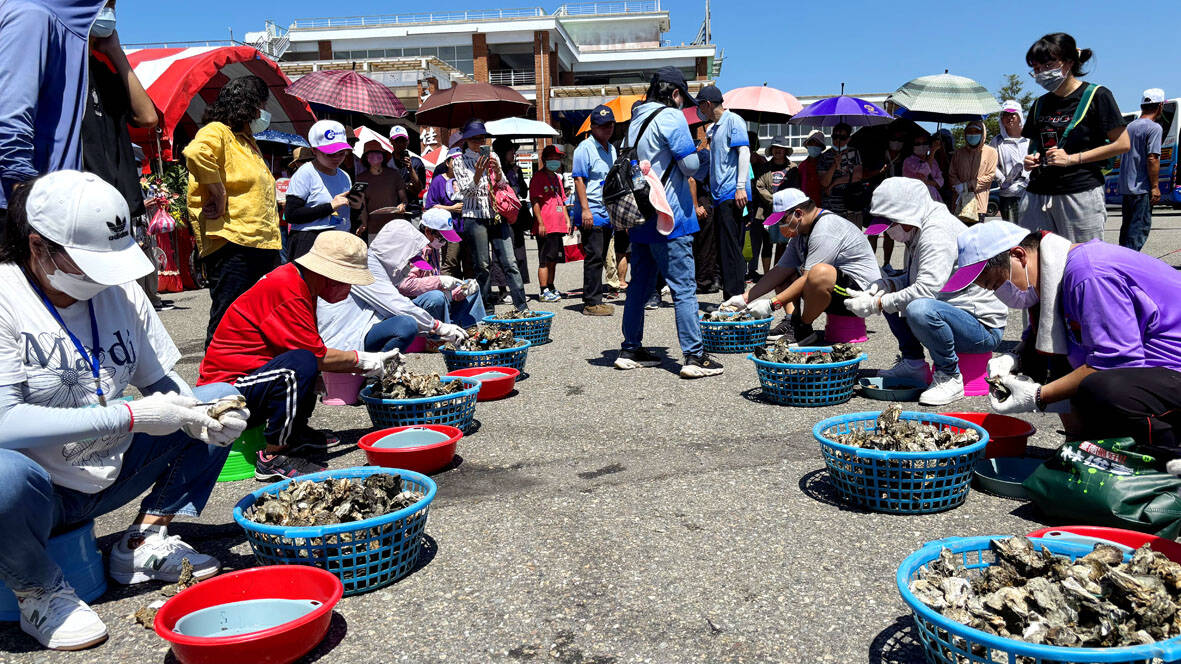
Photo: Wang Shan-yen, Taipei Times
The government set up a system in 2006 to demarcate underwater areas for oyster fishing. This enables it to identify who needs to be compensated for natural disasters. Farmers must first register where and how much they are producing. But the system implies coastline stability that does not exist. For example, Waisanding and other sandbars off Chiayi are receding towards the coast, disrupting the demarcations. In 2010, one study notes, the shallow sea oyster farm area near Waisanding was 4,780 hectares, falling to 2,862 hectares in 2020. In interviews with Matovu, farmers pointed out that the massive naptha cracker complex at Mailiao dug up sand during its construction, then dumped it a few kilometers offshore. It is now making its way back to the oyster farms. Interviewees also told Matovu that increased siltation in oyster farming areas is a problem in many places, along with eutrophication (algae blooms).
Water quality is falling off for other reasons. Coastline development is leading to sand and silt entering oyster farming areas. Fish farmers are altering their mix of products, using fish that do not release nutrients into the waters around them, reducing oyster output.
Moreover, small-scale oyster and shrimp farmers, the people centered in the Rest of World article, “are facing cut-throat competition emanating from the importation of Vietnamese products into the local market,” Matovu observes.
Two years ago the Ministry of Agriculture highlighted smuggling of both Vietnamese and Chinese oysters into Taiwan, where they are passed off as local products. Taiwan does not require oyster labeling, meaning that consumers do not know what they are eating. Chinese oysters are first smuggled into the outlying islands of Kinmen and Matsu, and then transferred to Taiwan proper, Minister of Agriculture Chen Junne-jih (陳駿季) said. Note that route: at present the Chinese Nationalist Party (KMT) is advocating free trade zones on the islands off China, which will certainly facilitate smuggling of a broader range of products.
In Taisi Township (台西) in Yunlin County, orders for oyster spat have declined roughly 60 percent due to outdated methods and competition from China, according to local media. Chinese spat are grown in labs, and are tougher and offer more consistent yield than Taiwan spat, which are harvested naturally. In Taiwan, such research has lagged.
DEMOGRAPHICS
Fishing and oyster production are also impacted by the aging workforce. Migrant labor is often used in processing. Young people do not want to enter the industry, an issue across the traditional economy. Low government support, coupled with aging workforces, means that as “traditional” industrial practices are being killed by regional trade, climate change and coastal development, oyster farmers cannot upscale to more capital-intensive farming: funds and knowledge for investment, upgrading, research and marketing of produce are lacking.
When fishers and farmers are romantically positioned in stories as “traditional” against “modern” wind machines, we forget what seafood producers are doing: removing organisms from ecosystems and engaging in massive pollution and disruption of the environment. Their methods are just as “modern” as offshore wind machinery.
A 2019 article on pollution from oyster farming observed that the beaches of western Taiwan are littered with styrofoam from oyster production. Author Grayson Shor wrote: “standing on Tainan’s coast, I saw this “snow” in the endless piles of discarded and broken Styrofoam buoys.”
The buoys are used to suspend the lines of oyster spat in the water on oyster farms. They deteriorate over time and are discarded, usually within a year, according to Shor. Sometimes they are illegally released into the water, or blown away by storms. The government and local fishers are working to develop alternatives.
Taiwan’s Fisheries Research Institute (FRI) has been exploring ways to exploit offshore wind platforms in fisheries production. One scholar noted in a 2023 paper published in Energy and Environment that “FRI-bred seaweed and oysters nearby OWF in 2017, and the richness of plankton and fish increments were found. Similar experiments of aquaculture were conducted at Miaoli, Penghu, and Changhua with the same results in 2019”.
A scuba assessment of offshore wind machines last year found that they resembled artificial reefs in their ability to produce new, diverse assemblages of fish and other organisms, “supporting vibrant fish communities in places that were once underwater deserts.”
Another study found similar results, noting that wind machines were helpful in sheltering juvenile fish and economically useful species.
“A wind turbine typically can operate more than 20 years without structural damage, collapse or subsidence problems found with many regular [artificial reefs],” it observed.
Dongshi Township (東石), where the Waisanding Sandbar and its associated oyster farming is located, was once home to a booming salt production industry, the Budai Salt Field. It was dead by the 1980s, killed by rising labor costs, the global opening to trade in salt and increasing mechanization in the salt production industry. As any economist would say, Taiwan as a whole is better off having cheaper salt and using the labor in higher value-added industries.
The same process is slowly unwinding in the farmed oyster industry. It cannot compete against Vietnamese oysters selling for much less, cheaper and better oyster spat from China and the melting away of its work force. The wind machines in the Taiwan Strait are thus more harbingers than causes of the oyster industry’s declining future.
Notes from Central Taiwan is a column written by long-term resident Michael Turton, who provides incisive commentary informed by three decades of living in and writing about his adoptive country. The views expressed here are his own.
If one asks Taiwanese why house prices are so high or why the nation is so built up or why certain policies cannot be carried out, one common answer is that “Taiwan is too small.” This is actually true, though not in the way people think. The National Property Administration (NPA), responsible for tracking and managing the government’s real estate assets, maintains statistics on how much land the government owns. As of the end of last year, land for official use constituted 293,655 hectares, for public use 1,732,513 hectares, for non-public use 216,972 hectares and for state enterprises 34 hectares, yielding

The small platform at Duoliang Train Station in Taitung County’s Taimali Township (太麻里) served villagers from 1992 to 2006, but was eventually shut down due to lack of use. Just 10 years later, the abandoned train station had become widely known as the most beautiful station in Taiwan, and visitors were so frequent that the village had to start restricting traffic. Nowadays, Duoliang Village (多良) is known as a bit of a tourist trap, with a mandatory, albeit modest, admission fee of NT$10 giving access to a crowded lane of vendors with a mediocre view of the ocean and the trains

For many people, Bilingual Nation 2030 begins and ends in the classroom. Since the policy was launched in 2018, the debate has centered on students, teachers and the pressure placed on schools. Yet the policy was never solely about English education. The government’s official plan also calls for bilingualization in Taiwan’s government services, laws and regulations, and living environment. The goal is to make Taiwan more inclusive and accessible to international enterprises and talent and better prepared for global economic and trade conditions. After eight years, that grand vision is due for a pulse check. RULES THAT CAN BE READ For Harper Chen (陳虹宇), an adviser

Traditionally, indigenous people in Taiwan’s mountains practice swidden cultivation, or “slash and burn” agriculture, a practice common in human history. According to a 2016 research article in the International Journal of Environmental Sustainability, among the Atayal people, this began with a search for suitable forested slopeland. The trees are burnt for fertilizer and the land cleared of stones. The stones and wood are then piled up to make fences, while both dead and standing trees are retained on the plot. The fences are used to grow climbing crops like squash and beans. The plot itself supports farming for three years.


 RSS
RSS