


Sure, Nvidia, AMD and Intel all had important chip and AI platform announcements on the first day of CES 2026, but all audiences wanted to see more of was Star Wars and Jensen Huang’s (黃仁勳) little robot buddies.
CES is a huge opportunity annually for companies both large and small to parade products they plan to put on shelves this year. And, as predicted, artificial intelligence was anchored in nearly everything as tech firms continue to look for AI products that will attract customers.
NVIDIA GETS PHYSICAL

Photo: AP
The biggest buzzword in the air at CES is “physical AI,” Nvidia’s term for AI models that are trained in a virtual environment using computer generated, “synthetic” data, then deployed as physical machines once they’ve mastered their purpose.
CEO Jensen Huang showed off Cosmos, an AI foundation model trained on massive datasets, capable of simulating environments governed by actual physics. He also announced Alpamayo, an AI model specifically designed for autonomous driving. Huang revealed that Nvidia’s next generation AI superchip platform, dubbed Vera Rubin, is in full production, and that Nvidia has a new partnership with Siemens. All of this shows Nvidia is going to fight increased competition to retain its reputation as the backbone of the AI industry.
But once Huang called for two little, waddling, chirping robots to join him on stage, that’s all the audience wanted to see more of.
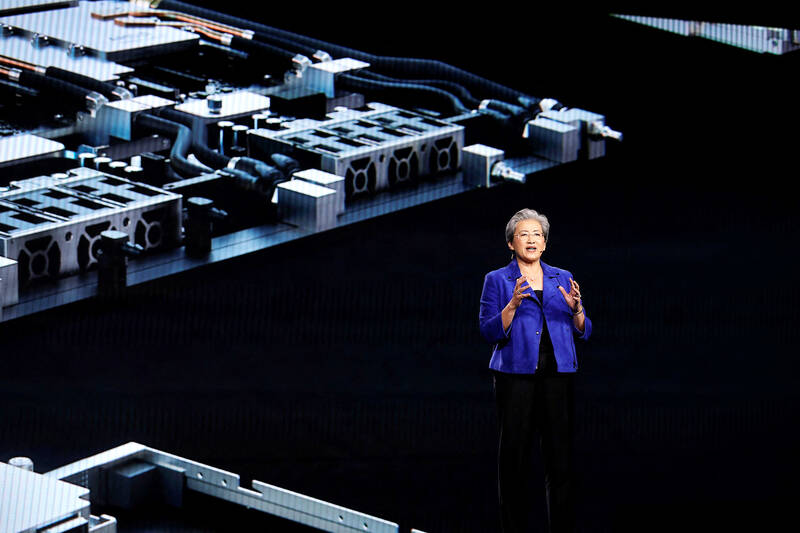
Photo: Reuters
THE CHIPS ARE BACK IN TOWN
AMD CEO Lisa Su (蘇姿丰) announced a new line of its famed Ryzen AI processors as the company continues to expand its footprint in the world of AI-powered personal computers.
For gamers, AMD also showed off the latest version of its gaming-focused processor, the AMD Ryzen 7 9850X3D.
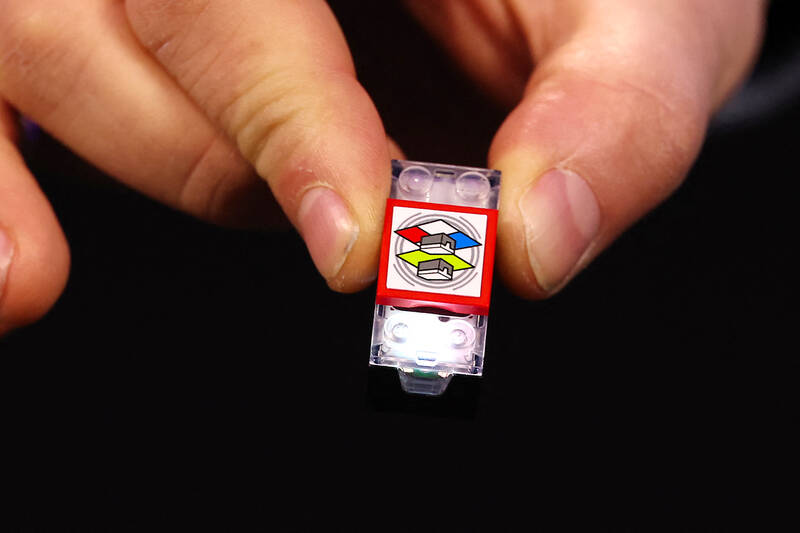
Photo: AFP
Meanwhile, Intel announced its new AI chip for laptops, Panther Lake (also known as the Intel Core Ultra Series 3), and said the company has plans to launch a new platform to address a growing market for handheld video gaming machines.
Intel, a Silicon Valley pioneer that enjoyed decades of growth as its processors powered the personal computer boom, fell into a slump after missing the shift to the mobile computing era unleashed by the iPhone. It fell further behind after the AI boom propelled Nvidia into the spotlight.
US President Donald Trump’s administration stepped in recently to secure a 10 percent stake in the company, making the government one of Intel’s biggest shareholders. Federal officials said they invested in Intel to support US technology and domestic manufacturing.
ROBOTAXI GAME
Uber is giving the public a first look at their robotaxi at this CES this week. Uber, along with luxury electric vehicle manufacturer Lucid Motors and vehicle tech company Nuro, introduced an autonomous vehicle with an Uber-designed in-cabin experience.
Uber calls it the most luxurious robotaxi yet. It features cameras, sensors and radars that provide 360-degree perception and a low-profile roof “halo” with integrated LEDs that will display riders’ initials to help them spot their car and track their ride status. Inside, riders can personalize everything from climate and seat heating to music, while real-time visuals show exactly what the vehicle is seeing on the road and the route it plans to take.
Autonomous on-road testing began last month in San Francisco, led by Nuro, marking a major step toward what the companies said is a planned launch before the end of the year.
STAR WARS AND LEGO PARTNER UP
When Lucasfilm chief creative officer David Filoni brought out an array of X-Wing pilots, Chewbacca, R2D2 and C-3PO, he won the Star Wars fandom for Lego.
Lego announced its Lego Smart Play platform on Monday, which introduces new smart bricks, tags and special minifigs for your collection. The new bricks contain sensors that enable them to sense light and distance, and to provide an array of responses, essentially lights and sounds, when they are used in unison.
Combine this with a newly announced partnership with the Star Wars franchise and now you can create your own interactive space battles and light-saber duels.
NEW LG ROBOT
File this one under intrigued, for now.
The Korean tech giant gave the media a glimpse Monday of its humanoid robot that is designed to handle household chores such as folding laundry and fetching food. Although many companies have robots on display at CES, LG certainly is one of the biggest tech companies to promise to put a service robot in homes.
It will be on display — and we assume demonstrating some of its purported abilities — beginning Tuesday, so we’ll have more to report soon.
WHAT’S NEW WITH LOLLIPOPS
Music you can taste was on display Monday at CES: Lollipop Star unveiled a candy that plays music while you eat it. The company says it uses something called “bone induction technology,” which lets you hear songs — like tracks from Ice Spice and Akon — through the lollipop as you lick it or bite it in the back of your mouth, according to spokesperson Cassie Lawrence.
The musical lollipops will go on sale after CES on Lollipop Star’s Web site for US$8.99 each.
Hyundai-owned Boston Dynamics publicly demonstrated its humanoid robot Atlas for the first time at the CES tech showcase, ratcheting up a competition with Tesla and other rivals to build robots that look like people and do things that people do.
The company said a version of the robot that will help assemble cars is already in production and will be deployed by 2028 at Hyundai’s electric vehicle manufacturing facility near Savannah, Georgia.
Delta Air Lines is taking entertainment to new heights as the “official airline” of the Sphere in Las Vegas. The airline announced a new multiyear partnership with Sphere Entertainment Co. that it says will deliver premium experiences to the venue, including a Delta SKY360° Club lounge.
The carrier said SkyMiles members can unlock exclusive access to other experiences at the Sphere, starting during the final weekend of the Backstreet Boys’ residency in February with features including private suite seating, food and beverages. The partnership brings Delta branding to the Sphere’s massive exterior LED screen. Delta says more exclusive SkyMiles experiences will roll out in this year and beyond.
It seems every few days one bumps into one of those “real man” comments in which Taiwan is urged to “face reality” or similar, and “make a deal,” with the speaker implying that soon it will be too late. “Deal” advocates always present themselves as having a superior grip on reality, and the manly ability to make the “hard choice.” Their testosterone-laden language often echoes that of Taiwan sellout advocates. Note that such commentary always specifies a process (“make a deal, work with, make progress”), never the end state of what occupation by a violent authoritarian colonialist state will entail. In

There are shadowy cabals plotting to sell out Taiwan to be annexed by China, by invasion if necessary. Fortunately, they are buffoons. In 2019, former Bamboo Union gangster and founder of the China Unification Promotion Party (CUPP), Chang An-le (張安樂, colorfully known as “White Wolf”), led a protest at the Legislative Yuan against comments made by then-premier Su Tseng-chang (蘇貞昌) that in the event of an attack by China, he would never surrender, but would protect the nation by fighting to the end, even if he only had a broom. Chang had party members bring a wooden casket that they

June 1 to June 7 "If all Taiwanese were as afraid of dying as you, then what would happen?” Physician Shih Chiang-nan (施江南) reportedly said this to his wife Chen Chiao-tung (陳焦桐) after she urged him to stop intervening on behalf of Taiwanese soldiers stranded overseas after serving in the Japanese Army during World War II. Shih had clashed with high-ranking officials over the issue, engaged in several heated arguments with Taiwan governor-general Chen Yi (陳儀) and allegedly shouted at general Ko Yuan-fen (柯遠芬), chief of staff of the Taiwan Garrison Command, over
Food prices have often played a major role in Taiwan’s history. The first major wave of migration from China occurred in 1628. A moderate drought, the Ming Dynasty maritime ban that prohibited fishing and trading (intended to reduce piracy) and a temporary tax, conspired to exhaust local resources, leading to famine in Fujian Province. The famed pirate and trader Zheng Zhilong (鄭芝龍), scooped up starving people from Fujian and transported them across the Taiwan Strait, where they settled under the Dutch. Two factors enabled Zheng. First, by 1624 he had settlements around today’s Beigang (北港) in Yunlin County with a small


 RSS
RSS