


For a week in November, Facebook and Instagram featured ads that showed cash and cryptocurrency raining down on a man at his computer. The ads asked viewers if they wanted to make a weekly return of 10 percent on their money — a highly improbable annualized rate of more than 14,000 percent.
The ads tested policies at Meta, owner of the social media platforms, against promotions for get-rich-quick schemes. But they ran anyway. They appeared in the feeds of more than 20,000 users in the US, Europe, India and Brazil, according to statistics Meta provided the person who placed the ads, and prompted dozens of inquiries about the promo.
I know this because I was that person.
Photo: Reuters
I created the ads and ran them with the help of advertising agencies listed publicly by Meta in its official “Partner Directory.” Though described in the directory as “trusted experts” with status as a Meta “Badged Partner,” some of the agencies actively recruit businesses looking to run banned advertisements.
Some of the agencies promise customers an edge — access to special ad accounts given leeway by Meta’s enforcement systems. Those accounts are rented out by big Chinese advertising agencies that are the foundation of Meta’s ad business in China. They enjoy special protections from the social media giant.
Beijing prohibits its citizens from using Facebook, Instagram and other Western social media. But China’s government doesn’t prohibit businesses there from advertising on those platforms abroad. Meta relies on 11 top Chinese agency partners to sell the ads.
The big agency partners often work with intermediaries, operating from China but also in other countries, that sometimes flout Meta’s stated rules. Meta itself has internally acknowledged widespread abuse in this system, according to internal documents, and, in many instances, tolerated it — reaping billions of dollars in revenue each year as a result.
As part of my reporting into the phenomenon, I decided to see how difficult it would be for an advertiser to thwart Meta’s anti-fraud policies. I had no intention to take anyone’s money, or violate strict rules reporters must follow when they gather and report information. I would also be transparent, giving my true name and stating clearly that I wanted to run banned cryptocurrency ads.
To get started, I set up a flimsy Web site and Facebook pages for a crypto-themed entity: “Jeff Horwitz Research.”
Then I began searching for an agency to help me run the ads.
I wasn’t surprised to see agency accounts available on shady digital forums, where online marketers openly discuss ways to sell black-market products. It was more of a shock to see them for sale in Meta’s own partner directory, a listing of companies that Meta said had been “vetted for their expertise.” I was also surprised that once I found agencies happy to run my fake ads, Meta’s systems offered to use artificial intelligence to improve them.
Within a few minutes of starting my search, I found Bluefocus Agency, a Vietnam-based Meta partner. It touts a trusted relationship with Meta but tells potential clients it knows how to get around Facebook and Instagram rules.
“We’ve spent years building a robust relationship with Facebook,” Bluefocus’ Web site reads.
Yet among tutorials it offers is one called: “How to Advertise Illegal Products on Facebook.”
A representative of Bluefocus, who identified themselves as Isabelle Tran, said by text that the company doesn’t run banned ads. A day later, an unidentified person using Bluefocus’ official WhatsApp account texted to offer me US$500 to help them create fake US-based accounts. I declined and didn’t hear further from Bluefocus.
Andy Stone, a Meta spokesperson, said company policy prohibits Meta’s Chinese partners, meant to serve only their home market, from working with foreign resellers. That’s because Meta generally works directly with locals in other countries.
After Reuters presented Meta with evidence the social media company had granted “Badged Partners” status to agencies that explicitly offered to break its advertising rules, Meta deleted its partner directory and said it was putting some of those partners and the program itself under review, Stone added.
TIRED OF LIVING PAYCHECK TO PAYCHECK?
In addition to Bluefocus, I reached out to Green Orange, a Hong Kong company that is also a “Badged” second-tier reseller. I also contacted Uproas, an Estonian firm not listed in Meta’s directory, but that prominently markets access to protected Meta ad accounts online.
Upon engaging with the resellers by text message — they preferred encrypted communications on Telegram or WhatsApp — all three began by asking if I intended to comply with Meta’s advertising rules. I told them I didn’t and shared my ad copy.
None of the agencies balked.
Instead, they merely charged me a slightly higher commission. For a signup fee of US$30 or less, along with a cut of whatever I spent on Meta advertisements, each agreed to do business with me. Payment was due up front, using cryptocurrency.
Green Orange and Uproas didn’t respond to requests for comment.
Within hours of my payment, each reseller set up an ad account for me.
On each account, I could see the name of the Chinese agency each worked with. Bluefocus, its account showed, acts as a reseller for GatherOne, one of Meta’s top Chinese partners. The Uproas account showed it worked with a unit of Beijing-based Cheetah Mobile. Green Orange’s account listed an entity identified as Coty Tuqa.
Cheetah Mobile and GatherOne didn’t respond to requests for comment. Reuters couldn’t reach Coty Tuqa. The Meta spokesperson said Coty Tuqa wasn’t among its official partners.
Now that I had access to multiple accounts, I planned to buy about US$300 worth of Meta advertisements — that is, if Meta didn’t block them. By working with official agency partners, the smaller resellers in theory would enjoy special protections that Meta offers those agencies, like requiring human review of any ad flagged as suspicious by its computers before it gets taken down. For advertisers who don’t work with such agencies, the systems often shut down flagged ads immediately, as I confirmed in an early test.
To proceed, I needed to choose geographies for my experimental scam. Meta’s advertising system required me to choose where in the world my ads would run. It imposed a few restrictions: Taiwan and Singapore, countries that have strict anti-scam laws and require advertiser verification, were off limits.
In addition to the US, Britain and the EU, I chose India and Brazil, two markets where Meta’s tools suggested engagement would be cheaper. To avoid committing actual crimes, I cleared my ads’ language and images with lawyers. To be safe, I limited the language to my question about big returns.
Meta’s systems had other ideas.
A feature called Advantage+ used AI to generate alternates of my ads that might be more enticing. Meta Chief Executive Mark Zuckerberg earlier this year noted how effective such tools could be.
“We’re gonna be able to come up with, like, 4,000 different versions of your creative and just test them and figure out which one works best,” he told an audience at a San Francisco conference in May.
In my case the system suggested 10 variants that featured new visuals, including AI-generated people of different ethnicities. It also suggested different text: “Tired of living paycheck to paycheck?” one asked. “Break the cycle and start earning a steady weekly income with our proven system.”
Instead of asking me to choose one, Meta suggested I authorize all of the alternates. Its platform would then test each variant, directing my money to those that performed best. I declined. My ads felt scammy already, and some of the claims featured in Meta’s ads violated Reuters policy against making false statements.
I clicked publish.
Within 20 minutes, my ads’ status began shifting from “In Review” to “Active.” After four days, my ads had logged well over 100 clicks. I received more than three dozen inquiries via my Web site and Facebook Messenger.
One came from a man in Gastonia, North Carolina, who saw it while “up all night looking for work.” I replied to him and the others that I was a reporter and that 10 percent weekly returns were too good to be true.
The arithmetic is straightforward and uncomfortable. By the end of 2025, Taiwan had committed itself to a 50-30-20 electricity mix — half natural gas, 30 per cent coal, 20 per cent renewables. The Ministry of Economic Affairs’s (MOEA) own monthly energy reports tell a different story. Natural gas reached 47.8 per cent of generation last year. Coal stood at 35.4 per cent, comfortably above its target ceiling. Renewables came in at 13.1 per cent, well short of the 20 per cent Taipei had pledged a decade earlier. Installed renewable capacity reached roughly half of the 12 gigawatts (GW) the government
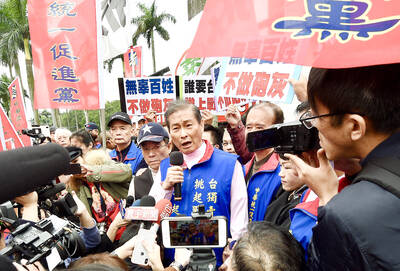
There are shadowy cabals plotting to sell out Taiwan to be annexed by China, by invasion if necessary. Fortunately, they are buffoons. In 2019, former Bamboo Union gangster and founder of the China Unification Promotion Party (CUPP), Chang An-le (張安樂, colorfully known as “White Wolf”), led a protest at the Legislative Yuan against comments made by then-premier Su Tseng-chang (蘇貞昌) that in the event of an attack by China, he would never surrender, but would protect the nation by fighting to the end, even if he only had a broom. Chang had party members bring a wooden casket that they

Taiwan’s drone exports are taking off, fuelled by the war in Ukraine, as Taiwanese companies seek a stake in the fast-growing global market for unmanned aerial vehicles (UAV). Low-cost drones used for reconnaissance and strikes are in high demand as governments around the world boost defense spending in the face of intensifying conflicts. A relative new player in the increasingly competitive industry, Taiwan’s pitch is to be an “Asian hub” for the production of UAVs and components free of Chinese materials, or “non-red.” That means its UAVs can be up to three times more expensive than their Chinese competitors, like the world’s biggest

June 1 to June 7 "If all Taiwanese were as afraid of dying as you, then what would happen?” Physician Shih Chiang-nan (施江南) reportedly said this to his wife Chen Chiao-tung (陳焦桐) after she urged him to stop intervening on behalf of Taiwanese soldiers stranded overseas after serving in the Japanese Army during World War II. Shih had clashed with high-ranking officials over the issue, engaged in several heated arguments with Taiwan governor-general Chen Yi (陳儀) and allegedly shouted at general Ko Yuan-fen (柯遠芬), chief of staff of the Taiwan Garrison Command, over


 RSS
RSS