


Many news outlets and pollsters lump the Taiwan People’s Party (TPP) in the pan-blue camp, this column included.
Many TPP supporters bristle at the pan-blue designation and would prefer to be viewed as being outside of the blue/green divide. Are they right?
As explained in the previous column (“The origins of Taiwan’s blue-green politics,” Nov. 22, page 12), the terms came out of a specific time and place, with a specific meaning that later grew to encompass far more than they were originally intended to.
Graphic: Courtney Donovan Smith, Taipei Times
Though in use months earlier by politicos, the transition to widespread common usage occurred roughly around the December 2021 legislative elections, when the Chinese Nationalist Party (KMT) lost their legislative majority and two blocs formed of parties allied with the KMT on one side, and the Democratic Progressive Party (DPP) on the other. The colors come from the primary colors used in the flags of the KMT (blue) and DPP (green).
The colors were used to identify the two camps, which were divided by what previously might have been termed “Taiwanese nationalists” and “Chinese nationalists.” The description soon not only applied to the alliances, but also to apply to the parties themselves and the ideologies they represented.
It is when it became applied to supporters of parties that the picture gets fuzzier, though broadly speaking, there remains a clear and distinct divide in opinions on issues related to Taiwanese identity and sovereignty, and opinions on China’s territorial claims on Taiwan and Chinese identity.
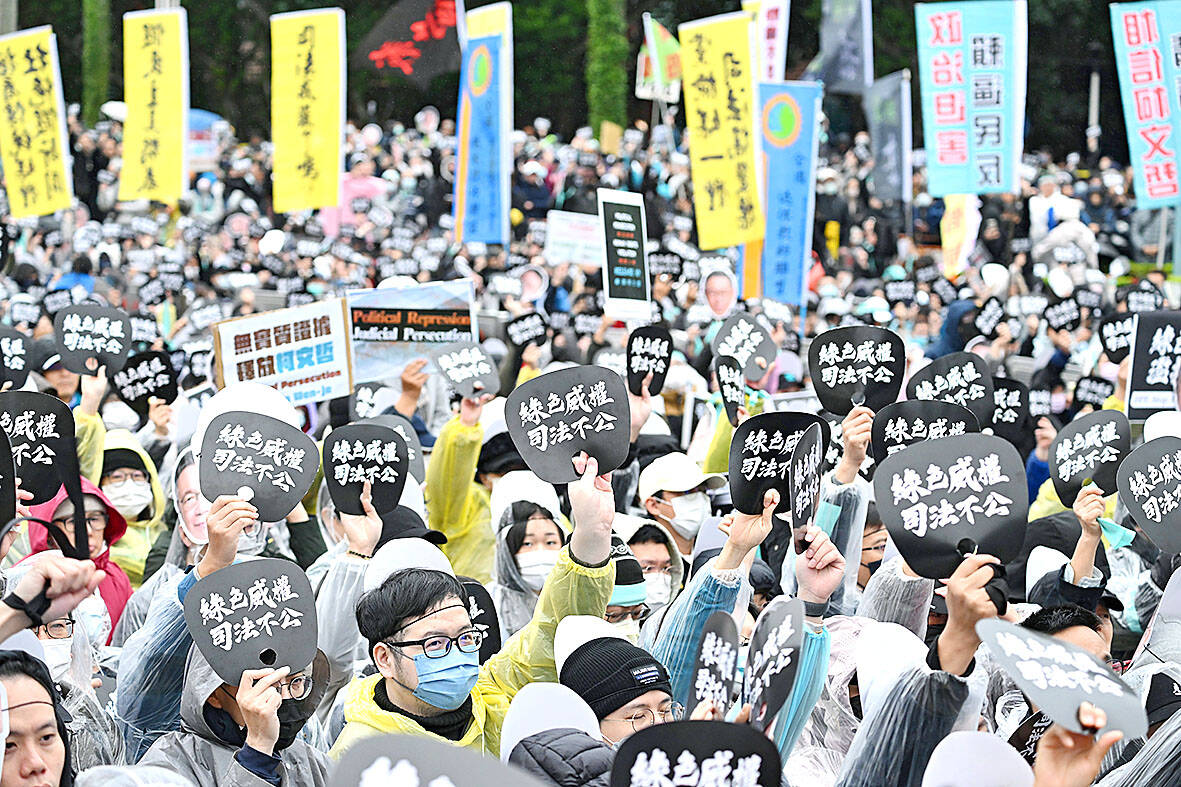
Photo: Chen Yi-kuan
ENTER THE TPP
The Taiwan People’s Party (TPP) is unique in that they were originally intended to be outside of the blue/green divide. Though both party founder Ko Wen-je (柯文哲) and the current party Chairman Huang Kuo-chang (黃國昌) were once considered to be close to — or even in — the pan-green camp, their opinions have shifted over time.
Ko considered running for Taipei mayor in 2014 as the DPP candidate, but instead opted to run as a DPP-backed independent and won. By the time of his successful re-election campaign in 2018, he had fallen out with the DPP administration, and the DPP ran their own candidate.
Huang co-founded the New Power Party (NPP), which largely voted with the DPP in the legislature (including Huang himself). He grew disenchanted with the NPP — and they with him — and he switched allegiance to the TPP in 2023, eventually becoming the TPP’s legislative caucus convener and party chair.
Ko founded the TPP in 2019. They promoted the party as “white” in contrast to blue/green, and briefly translated their slogan as “white power” into English, before realizing the horrendous implications of that term in English, and re-translated it as “white force.”
White does not make for a great flag color, so Ko specified a color midpoint between blue and green, which is commonly used to represent the party today visually.
The color he chose became famous as the color of the packaging used for luxury brand Tiffany & Co’s jewelry boxes. Confusingly, this color can be referred to as “Tiffany green” or “Tiffany blue” in both English and Chinese, though Tiffany themselves have settled on “Tiffany Blue hue.”
Ko himself initially used both Tiffany blue/green interchangeably, though later appears to have settled on Tiffany Blue, though if that is due to the company’s official designation or political messaging is unclear.
IS THE PARTY PAN-BLUE?
In the original sense of the term related to legislative caucus alliances, the answer is unambiguously yes. The TPP and KMT legislative caucuses almost always vote in lockstep, with negotiations on each party’s priorities handled beforehand, and when they vote differently, it is done in such a way that the KMT’s goals are still reached (such as the votes on the speaker and nominees for the Constitutional Court).
Is the party functionally pan-blue beyond the behavior of the legislative caucus? This year, the party has stood unambiguously behind the KMT in the recall votes, actively cooperated with the KMT on this year’s nuclear referendum, and shared stances and terminology when attacking the DPP administration. So in practice, the answer is also yes.
How about ideologically? Here, the picture starts to become less clear.
Since taking over as party chair, Huang has arguably shifted the tone and style of the TPP, but has not made any official changes to the party’s ideology. To do so so soon would be rightly seen as unseemly and disrespectful to Ko in a cultural context, and the party’s “core principles” section on the Web site has not changed since Ko’s presidential run last year.
This creates uncertainty as to where the TPP stands today on some of the key Taiwanese versus Chinese nationalist ideological viewpoints that the blue/green divide was intended to be shorthand for.
Huang’s caucus has backed pan-blue legislation to sharply curtail growth in defense spending, foreign affairs and so-called “desinification” efforts by the DPP in the cultural and educational sphere. However, unlike the KMT, he has outright rejected China’s offering of bounties that would lead to the arrest and conviction of “Taiwan separatists” such as DPP lawmaker Puma Shen (沈伯洋) and two online influencers.
The TPP also does not endorse the “1992 consensus” that the KMT uses as their basis for outreach to Beijing. This decision was made by Ko, but not because he did not want to endorse it per se, but because he said there was “no market for it” among Taiwanese voters. His efforts to formulate a new “consensus” to replace it — such as both sides are “one family” — have failed to gain traction.
On balance, the TPP ideologically comes across as light blue. Like the KMT, they support cross-Strait dialogue to promote peace, but without explicit support of the “1992 consensus” or the “one-China principle” embedded in it, it will not happen. Beijing refuses to enter talks without Taiwan first lowering itself to the status of “Taiwan province” within China.
TPP SUPPORTERS
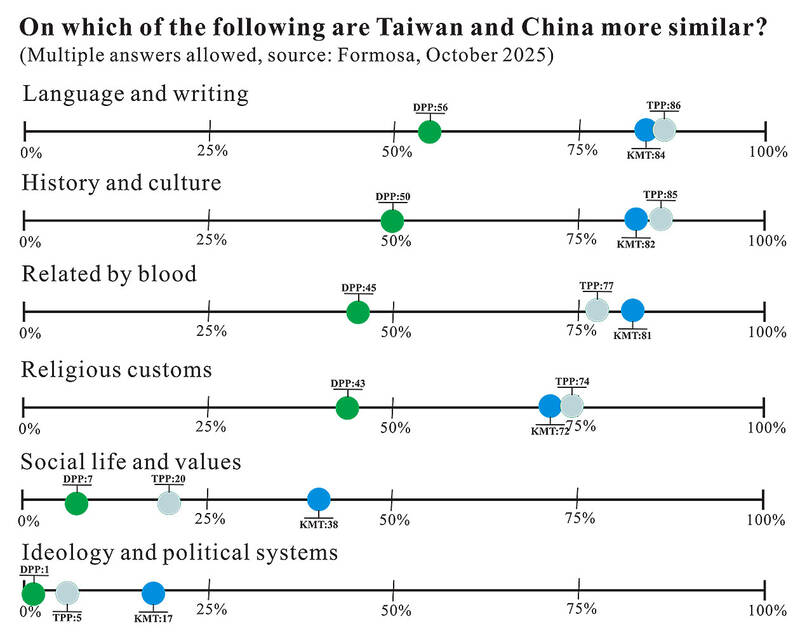
What about TPP supporters? On cross-Strait ideological issues that define blue/green, TPP supporters are generally — but not uniformly — pan-blue.
The above chart demonstrates how, within the DPP and KMT, opinions are far from uniform, but there is an unmistakable gap between the two. Notice that as the questions get more political, TPP supporters move from closer to the KMT to closer to the DPP.
The same poll asked: “Some people say that if the long-accumulated political disputes between Taiwan and China are to be resolved, a military war between the two sides is ultimately inevitable. Do you agree or disagree?”
On this question, TPP supporters agreeing to the statement were closer to the DPP (38.7% to 42.2%) than the KMT (22.6%). However, the percentage disagreeing was in the middle (KMT 73.4%, TPP 61%, DPP 50.2%).
They also asked: “Some people say that to protect Taiwan’s sovereignty and prevent unification by the Chinese Communist Party, each of us should pay any price, and if necessary, sacrifice our lives.” On this, the TPP was very close to the KMT, (agree: DPP 69.7%, TPP 30%, KMT 24.4%, disagree: DPP 27.6%, TPP 69%, KMT 73.4%).
On “Which approach do you think better maintains Taiwan’s security and avoids cross-strait war?” both KMT and TPP supporters chose “governments on both sides to resume negotiations and relax civilian exchanges,” with 89.9 and 84.4 percent, respectively, while only 27.8 percent of DPP supporters chose that option.
DPP supporters were more likely to support “increase the annual budget to purchase weapons and strengthen national defense” at 58.7 percent, with the KMT at only six percent and the TPP at 9.1 percent.
Broadly speaking, it is accurate to describe the TPP and its supporters as pan-blue, but with caveats and exceptions.
Donovan’s Deep Dives is a regular column by Courtney Donovan Smith (石東文) who writes in-depth analysis on everything about Taiwan’s political scene and geopolitics. Donovan is also the central Taiwan correspondent at ICRT FM100 Radio News, co-publisher of Compass Magazine, co-founder Taiwan Report (report.tw) and former chair of the Taichung American Chamber of Commerce. Follow him on X: @donovan_smith.
For many people, Bilingual Nation 2030 begins and ends in the classroom. Since the policy was launched in 2018, the debate has centered on students, teachers and the pressure placed on schools. Yet the policy was never solely about English education. The government’s official plan also calls for bilingualization in Taiwan’s government services, laws and regulations, and living environment. The goal is to make Taiwan more inclusive and accessible to international enterprises and talent and better prepared for global economic and trade conditions. After eight years, that grand vision is due for a pulse check. RULES THAT CAN BE READ For Harper Chen (陳虹宇), an adviser
Traditionally, indigenous people in Taiwan’s mountains practice swidden cultivation, or “slash and burn” agriculture, a practice common in human history. According to a 2016 research article in the International Journal of Environmental Sustainability, among the Atayal people, this began with a search for suitable forested slopeland. The trees are burnt for fertilizer and the land cleared of stones. The stones and wood are then piled up to make fences, while both dead and standing trees are retained on the plot. The fences are used to grow climbing crops like squash and beans. The plot itself supports farming for three years.
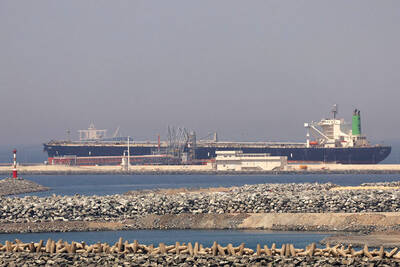
The breakwater stretches out to sea from the sprawling Kaohsiung port in southern Taiwan. Normally, it’s crowded with massive tankers ferrying liquefied natural gas from Qatar to be stored in the bulbous white tanks that dot the shoreline. These are not normal times, though, and not a single shipment from Qatar has docked at the Yongan terminal since early March after the Strait of Hormuz was shuttered. The suspension has provided a realistic preview of a potential Chinese blockade, a move that would throttle an economy anchored by the world’s most advanced and power-hungry semiconductor industry. It is a stark reminder of
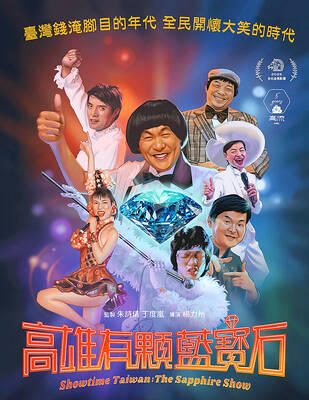
May 4 to May 10 It was once said that if you hadn’t performed at the Sapphire Grand Cabaret (藍寶石大歌廳), you couldn’t truly be considered a star. Taking the stage at the legendary Kaohsiung club was more than just a concert. Performers were expected to entertain in every sense, wearing outlandish or revealing costumes and staying quick on their feet as sharp-tongued, over-the-top hosts asked questions and delivered jokes that would be seen as vulgar, even offensive, by today’s standards. Opening in May 1967 during a period of strict political and social control, Sapphire offered a rare outlet for audiences in


 RSS
RSS