


Exceptions to the rule are sometimes revealing. For a brief few years, there was an emerging ideological split between the Democratic Progressive Party (DPP) and Chinese Nationalist Party (KMT) that appeared to be pushing the DPP in a direction that would be considered more liberal, and the KMT more conservative.
In the previous column, “The KMT-DPP’s bureaucrat-led developmental state” (Dec. 11, page 12), we examined how Taiwan’s democratic system developed, and how both the two main parties largely accepted a similar consensus on how Taiwan should be run domestically and did not split along the left-right lines more familiar in the West.
Taiwan’s ideological split comes down to Taiwanese versus Chinese nationalism, sovereignty, identity, and how to manage relations with China, including in terms of national defense.
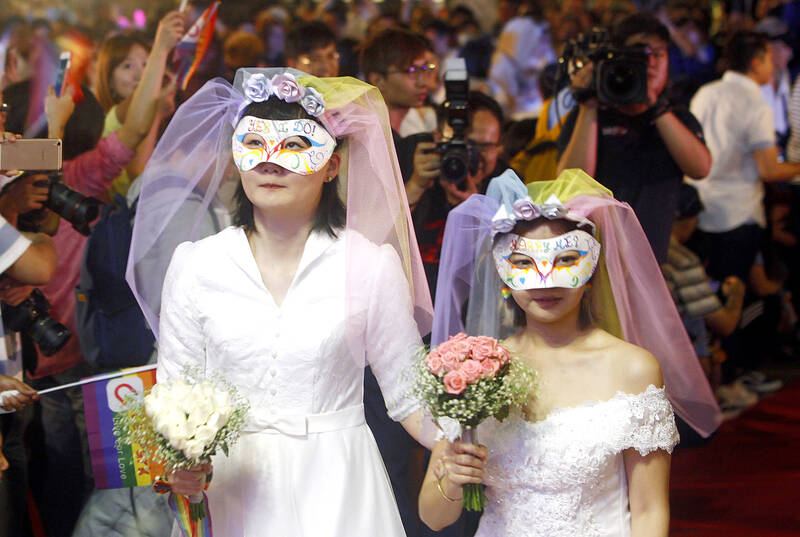
Photo: AP
As issues arose that might be considered left or right, each side would adopt them for their own electoral reasons. They grandstand to look more righteous and modern than their opponents.
Both parties have taken up causes normally considered left-wing, such as major social programs, labor laws, women’s rights, environmentalism and indigenous rights.
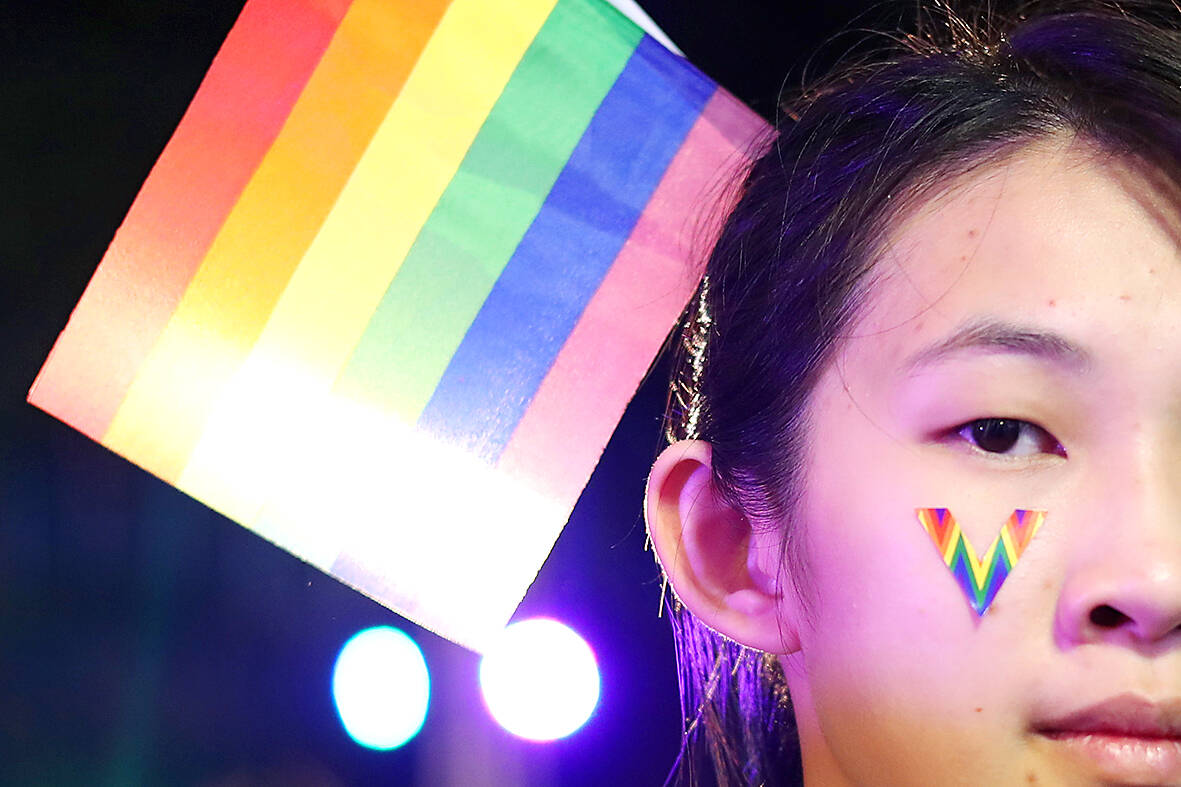
Photo: EPA-EFE
TAIWANESE VALUES
Historically, Taiwan has been in constant flux, with different colonial rulers with different norms and ideas. Taiwan industrialized and modernized faster than many countries, especially under the Japanese and the exiled Chinese KMT regime, with a heavy dose of American influence.
This means Taiwanese are very adaptable and less resistant to societal change, but do so informed by their own unique cultural and societal norms. Religiously, Taiwanese have traditionally been flexible, lacking the rule-bound rigidity of the Abrahamic religions. It is not a society or culture built on the same divisions that define the West.
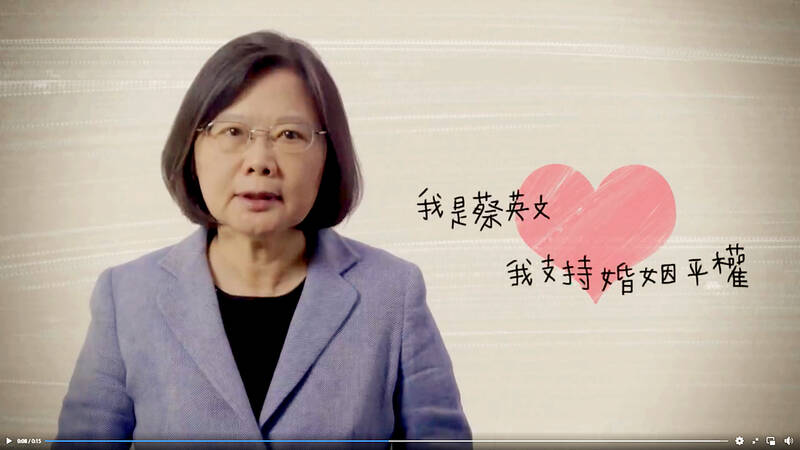
Photo: Screengrab
There has been comparatively little societal pushback against many changes. Both parties support big social programs, women’s empowerment and environmental protection — and both parties can claim big successes in pushing ideas like those forward. Overseas issues like abortion are politically and religiously charged, but not here.
Issues that appeal to traditional Taiwanese values of compassion, collective well-being and social harmony do well. Taiwanese are also practical and economically-minded. When challenges and new ideas are introduced, local responses appear a mishmash of left and right to foreign observers, but make perfect sense according to local sensibilities.
Selling lottery and scratch-off tickets is limited to families that include someone with a disability. This reduced the need for large taxpayer-funded social programs by legalizing gambling in such a way as to provide families with an economic pathway to raise funds to care for their disabled family members.
Is that a right or left-wing solution? It is a bit of both.
Some overseas causes have gained little traction here, such as abolishing the death penalty or legalizing marijuana, which both parties are firmly against. There are compassionate cases to be made for both, but the majority of Taiwanese believe that lifting either would damage social harmony by encouraging crime.
As a result, neither political party will risk supporting either (though individual politicians might), and will only change their minds if there is a popular movement backing them. There is no sign of that happening.
Some in Taiwan want the parties to conform to the right-left paradigm, and some insist that it is the case. Typically, these people portray the DPP as more left-wing and the KMT as right-wing, though a handful would reverse those designations.
Almost uniformly, those people are in Taipei. They are Taiwanese extensively educated abroad, Taiwanese-Americans/Canadians and their other foreign friends.
MARRIAGE EQUALITY
For a period in the late 2010s, it did appear that there was a growing left-right split on the issue of marriage equality.
In 2014, the Sunflower movement shifted the political mainstream towards a more pro-Taiwan stance, especially among younger voters. This was a huge opportunity for the DPP to pick up votes, which they did in landslides in 2014 and 2016.
They hoped they could lock down many of these voters for the long term — especially younger ones — thereby boosting their long-term prospects against an increasingly aged KMT.
However, this came with a catch. These young voters may have been more pro-Taiwan, but also brought support for another cause: Marriage equality.
That put the DPP into a quandary. Much of their existing support base was in southern, more rural counties and among Presbyterians.
In October 2015, with the January 2016 national election campaigns in full swing, then-DPP presidential candidate Tsai Ing-wen (蔡英文) released a video timed for the Taipei Pride Parade saying: “Before love all are equal. I am Tsai Ing-wen and I support marriage equality.”
Supporters were euphoric, but few picked up on her careful choice of words; she supported it personally, not as DPP party chairwoman or as part of the party’s campaign platform. The party also added rainbow motifs to campaign materials targeted at younger voters, but no campaign pledges were made.
Some appointed DPP legislative candidates on the party list came out in support, but almost none facing directly elected constituencies did.
Once in office, she dodged the issue, preferring to spend her political capital elsewhere. She washed her hands of it by punting the decision to the legislature, saying, “I believe that in the near future, all members of the Legislative Yuan will freely express their opinions on the amendments according to their own beliefs, values, judgments and the direction of public opinion.”
She also claimed there was no societal consensus on the issue, further distancing herself. Frustrated, some pro-marriage equality DPP and KMT lawmakers and the New Power Party caucus tried to advance the issue, but were stymied.
Then in 2017, the Council of Grand Justices (now Constitutional Court) ruled that barring same-sex marriages was unconstitutional, and ordered the government to resolve the issue within two years.
This could have been a get out of jail free card if the DPP had acted quickly, but they did nothing, dragging the issue into the 2018 local elections.
A coalition formed opposing marriage equality, spearheaded by conservative Christians and backed by other social conservatives. Professional overseas activists also got involved.
The KMT, like the DPP, was internally divided on this issue — but as the ruling party, it was the DPP’s problem.
REFERENDUM
Opponents to marriage equality wanted to crush the issue via two strategies. One was to put anti-marriage equality questions to referendum, which they won, but were unconstitutional.
The other was to send a message by defeating the DPP at the ballot box, and the best tool they had for that was the KMT. The KMT won the 2018 local elections in a landslide, though only some candidates openly agreed with these anti-marriage equality groups.
The DPP today proudly claims credit for passing marriage equality, but only did so with their back to the wall, one week before the court-imposed deadline. Some DPP lawmakers refused to vote for it, while some KMT lawmakers crossed party lines and supported the DPP’s version of the bill — including current Taipei Mayor Chiang Wan-an (蔣萬安).
It also was not full marriage equality, with restrictions placed on adoption rights and against marrying people from countries that had not legalized it.
Ahead of the 2020 national elections, many of the anti-marriage equality groups again supported the KMT. Though the KMT presidential candidate Han Kuo-yu (韓國瑜) did welcome these groups publicly in a general sense, he and his campaign were largely silent on the issue itself.
For a time during the 2020 election, it did feel that the demographically older KMT was becoming more conservative, and the DPP was more liberal.
It did not last. Younger voters today are more likely to favor the KMT or TPP than the DPP.
The two big parties went back to fighting over the same issues as before, not left-right ones.
* Taiwan in Time will return to this space next week.
Donovan’s Deep Dives is a regular column by Courtney Donovan Smith (石東文) who writes in-depth analysis on everything about Taiwan’s political scene and geopolitics. Donovan is also the central Taiwan correspondent at ICRT FM100 Radio News, co-publisher of Compass Magazine, co-founder Taiwan Report (report.tw) and former chair of the Taichung American Chamber of Commerce. Follow him on X: @donovan_smith.

Taiwan’s renewable shortfall is a problem of execution, not resources. Japan’s long-cycle, joined-up energy planning is the model worth studying — but what Taiwan can borrow is the institutional machinery, not the politics. When Nvidia CEO Jensen Huang (黃仁勳) used his visit to Taipei last month to warn that the country needs far more electricity, he was naming a constraint its own planners already know well: Taiwan Power Co (Taipower, 台電) expects demand from the semiconductor and artificial intelligence (AI) sector alone to exceed 5 gigawatts (GW) by 2030. The harder question is not whether to build more capacity but which

In a projection room, visitors at the Re: Battle City exhibition at Kaohsiung’s Neiwei Arts Center are invited to sit and watch a 20-minute animated movie. Artist Chang Li-ren (張立人) created the movie with dolls he made by molding paper into crude, painted figurines. The dolls interact in a detailed and realistic Taiwanese cityscape. Outside the projection room, visitors can wander around a massive model of the city. A sizeable crowd happily takes pictures of what looks like the best dollhouse in Taiwan: the same props that were used to tell the story of the country’s descent into techno-dictatorship in the movie. The

The last time Taiwan’s foreign correspondents were invited to a special briefing with a sitting president was in 2015. That was two presidents ago under Ma Ying-jeou (馬英九). But Thursday morning, President William Lai (賴清德) welcomed the nation’s international press corps warmly, speaking specifically to the theme of press freedom. Lai addressed Taiwan’s foreign press corps saying, “You live, work and report in Taiwan.” “Thank you for your professionalism and upholding the spirit of press freedom,” he continued. “As you engage in your work of journalism, you let the world see Taiwan.” The timing of this event, hosted by the Taiwan Foreign

Chinese Nationalist Party (KMT) Chairwoman Cheng Li-wun’s (鄭麗文) recent trip to the US highlighted her party’s anti-Taiwan defense policies. Disapproval of their policies was strong among those who met with her. Republican Senator Dan Sullivan, said that the KMT was “playing with fire.” Democratic Representative Tom Suozzi reportedly said that Cheng’s party was “weakening deterrence.” Foreign policy maven David Sacks observed in Asia Nikkei that “many Americans struggle to see the logic behind the KMT’s refusal to fund the portion of the special defense budget pertaining to indigenous defense production.” The logic of the KMT’s decision to purchase only US


 RSS
RSS