


Many people in Taiwan first learned about universal basic income (UBI) — the idea that the government should provide regular, no-strings-attached payments to each citizen — in 2019. While seeking the Democratic nomination for the 2020 US presidential election, Andrew Yang, a politician of Taiwanese descent, said that, if elected, he’d institute a UBI of US$1,000 per month to “get the economic boot off of people’s throats, allowing them to lift their heads up, breathe, and get excited for the future.”
His campaign petered out, but the concept of UBI hasn’t gone away. Throughout the industrialized world, there are fears that AI, robotics and other technologies will generate tremendous wealth while causing what Yang called “an unprecedented wave of job destruction.”
According to some forecasts, half of all white-collar jobs could be eliminated. Mass unemployment would cause a slump in consumer spending, forcing other businesses to lay off workers. Any government that tries to maintain a comprehensive social-welfare system will face a fiscal crisis, as spending on benefits and food assistance skyrockets. Economic upheaval is likely to be accompanied by worsening crime and unrest.

Photo Courtesy of UBI Taiwan
In his 2019 book Fully Automated Luxury Communism, Aaron Bastani calls this impending transformation “the third disruption,” because it’ll be as consequential for humanity as the shift from hunting-gathering to agriculture and the Industrial Revolution. Yet Bastani is an optimist who thinks a world in which everyone enjoys an abundance of energy, information and material goods will soon be possible.
Even if he’s wrong, AI should at least boost productivity. Without policy interventions, however, the benefits are likely to flow mainly to those who own the new technologies. Erik Brynjolfsson, a former director of the MIT Initiative on the Digital Economy, expresses optimism that AI could be used to make the world a better place, but warned that AI and machine learning could also “increasingly concentrate wealth and power, leaving many people behind… so the right question is not ‘What will happen?’ but ‘What will we choose to do?’” (Pew Research Center, Dec. 10, 2018).
Taiwan won’t be immune to these shocks, and some now say the country should consider supporting every citizen via universal basic income. UBI Taiwan (台灣無條件基本收入協會) — the group’s Chinese name uses the term “unconditional” rather than “universal” — argues that a regular no-questions-asked subsidy would not only protect the population from the downside of the AI revolution, but also reduce economic inequality and “alleviate the financial constraints that delay family formation,” hopefully ameliorating the dire birthrate.

Photo: Pixabay
NOT TRICKLING DOWN
Since 1980, the group says, Taiwan’s real GDP has grown 7.5 times. In real terms, however, mean wages are now just 2.4 times what they were in 1980. Between 2003 and last year, real GDP per capita doubled and the house-price index rose fourfold, yet real salaries flatlined.
UBI Taiwan propose that, in its initial stage, only those aged between 18 and 35 would benefit, and recipients who earn more than NT$500,000 in a year will have to repay part or all of their UBI income come Tax Day. It’s thus a type of guaranteed basic income (GBI), rather than a true UBI, although the group prefers the term YUBI (youth universal basic income).
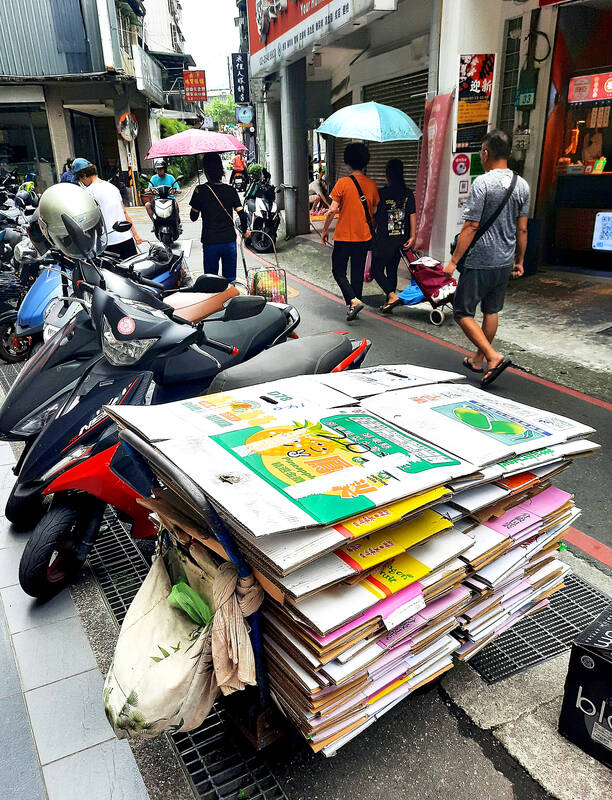
Photo: Steven Crook
In their e-mailed responses to questions from the Taipei Times, UBI Taiwan stresses that giving everyone in that cohort NT$15,515 per month would be “just a start, not the end.”
Acknowledging that an age-restricted scheme will face opposition from voters who stand to gain nothing, UBI Taiwan says they’re ready to argue their case from multiple angles.
“First of all, youth unemployment has long been around three times higher than the country’s average, and they’re the most vulnerable to structural displacement by AI. Secondly, young adults have low incomes and few assets to support themselves. Thirdly, economic anxiety is leading young people to delay marriage and lowering their desire to have children,” UBI Taiwan says.

Photo: Steven Crook
“Addressing youth challenges is not just about helping young people. It’s about fixing the structural issues that will shape Taiwan’s future. If the next generation can’t afford to live, work or raise families here, the whole country will face a social crisis that will doom it in 20 years or even less,” the group says.
Emphasizing that it’d be “an investment in future human capital,” UBI Taiwan believes that the monthly stipend would “alleviate survival anxiety, giving young people time to upskill, innovate and start businesses.”
And, hopefully, procreate.

GRAPHIC: TT
According to UBI Taiwan, implementing youth basic income in 2028 would cost the country NT$704 billion — equivalent to a quarter of the central government’s total expenditure in this fiscal year — and it could be funded without increasing income or corporation taxes.
Half of the money needed could be raised by adjusting the value-added tax (VAT) rate from 5 percent to 8 percent. The rest would come from lifting capital gains tax liability when selling stocks from 12 percent to 15 percent, doubling the tax rate on same-day stock trades to 0.3 percent, moving Taiwan’s foreign-currency reserves into a sovereign wealth fund, a carbon tax on polluting industries and a new tax of 0.1 percent on bond trades.
Unlike a proposal promoted by Millionaires for Humanity and UBI4ALL, UBI Taiwan’s blueprint doesn’t mention any kind of wealth tax. Saying the group has yet to reach a consensus on the question of wealth taxes, they contend that, within Taiwan “most people don’t support policy narratives aimed at bringing down the wealthy class. Therefore, we don’t want people to view UBI policy as taxing the rich to fund the general public.”
In both the UK and Japan, VAT hikes have triggered short-term but significant economic slowdowns, because they shrank consumers’ disposable income. That may not happen if a UBI scheme diverts money into the pockets of the less well off, who tend to spend almost every dollar they receive. Yet, as Part Two of this article will explore in tomorrow’s Taipei Times, some observers still hesitate to endorse UBI Taiwan’s proposals.
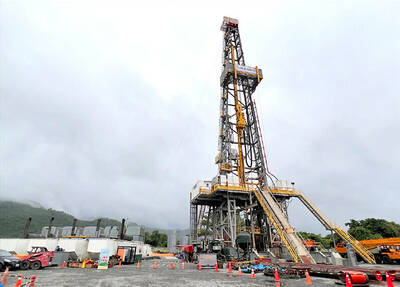
Taiwan’s renewable shortfall is a problem of execution, not resources. Japan’s long-cycle, joined-up energy planning is the model worth studying — but what Taiwan can borrow is the institutional machinery, not the politics. When Nvidia CEO Jensen Huang (黃仁勳) used his visit to Taipei last month to warn that the country needs far more electricity, he was naming a constraint its own planners already know well: Taiwan Power Co (Taipower, 台電) expects demand from the semiconductor and artificial intelligence (AI) sector alone to exceed 5 gigawatts (GW) by 2030. The harder question is not whether to build more capacity but which

In a projection room, visitors at the Re: Battle City exhibition at Kaohsiung’s Neiwei Arts Center are invited to sit and watch a 20-minute animated movie. Artist Chang Li-ren (張立人) created the movie with dolls he made by molding paper into crude, painted figurines. The dolls interact in a detailed and realistic Taiwanese cityscape. Outside the projection room, visitors can wander around a massive model of the city. A sizeable crowd happily takes pictures of what looks like the best dollhouse in Taiwan: the same props that were used to tell the story of the country’s descent into techno-dictatorship in the movie. The
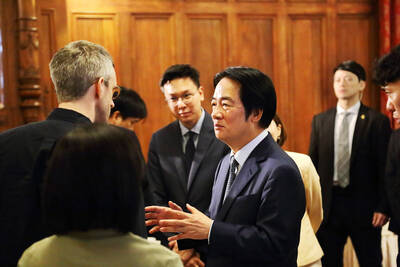
The last time Taiwan’s foreign correspondents were invited to a special briefing with a sitting president was in 2015. That was two presidents ago under Ma Ying-jeou (馬英九). But Thursday morning, President William Lai (賴清德) welcomed the nation’s international press corps warmly, speaking specifically to the theme of press freedom. Lai addressed Taiwan’s foreign press corps saying, “You live, work and report in Taiwan.” “Thank you for your professionalism and upholding the spirit of press freedom,” he continued. “As you engage in your work of journalism, you let the world see Taiwan.” The timing of this event, hosted by the Taiwan Foreign

Chinese Nationalist Party (KMT) Chairwoman Cheng Li-wun’s (鄭麗文) recent trip to the US highlighted her party’s anti-Taiwan defense policies. Disapproval of their policies was strong among those who met with her. Republican Senator Dan Sullivan, said that the KMT was “playing with fire.” Democratic Representative Tom Suozzi reportedly said that Cheng’s party was “weakening deterrence.” Foreign policy maven David Sacks observed in Asia Nikkei that “many Americans struggle to see the logic behind the KMT’s refusal to fund the portion of the special defense budget pertaining to indigenous defense production.” The logic of the KMT’s decision to purchase only US


 RSS
RSS