


There are always points in financial booms when market commentators ask if exuberance has got out of hand.
OpenAI’s multibillion-dollar deals with chip makers Nvidia and AMD are the latest reason for pause about the sustainability of vast investments in artificial intelligence.
Here we answer some questions about what these deals say about the AI stock market frenzy.

Photo: AFP
Why are the Nvidia and AMD deals concerning market watchers?
Some commentators are concerned by the circular nature of the deals. Under the terms of the Nvidia transaction, OpenAI will pay Nvidia in cash for chips, and Nvidia will invest in OpenAI for non-controlling shares.
Leading British tech investor James Anderson said he was concerned by parallels with vendor financing, where a company provides financial support to a customer buying its products – a precarious scenario if those customers have overly optimistic business projections. Vendor financing was one of the hallmarks of the turn-of-the-millennium dotcom bubble.

Photo: AFP
“It’s not quite like what many of the telecom suppliers were up to in 1999-2000, but it has certain rhymes to it. I don’t think it makes me feel entirely comfortable from that point of view,” said Anderson.
The AMD deal also enmeshes OpenAI with another chip maker alongside Nvidia. Under the deal, OpenAI will use hundreds of thousands of AMD chips in its datacentres — the central nervous systems of AI tools such as ChatGPT — and will have an opportunity to buy 10 percent of AMD. All of this is being driven by the thirst of OpenAI and its peers for as much computing power as possible to drive their models to ever greater performance breakthroughs — as well as to meet demand.
Neil Wilson, UK investor strategist at Saxo, an investment bank, said transactions such as Nvidia and OpenAI’s all pointed to a situation that “looks, smells and talks like a bubble.”
What are the other signs of a bubble?
Anderson flagged soaring valuations at leading AI companies as another source of concern. OpenAI is now worth US$500 billion, compared with US$157 billion last October, while Anthropic almost trebled its valuation recently, going from US$60 billion in March to US$170 billion last month. Anderson said the scale of the value increases “did bother me.” OpenAI reportedly posted revenue of US$4.3 billion in the first half of this year, with an operating loss of US$7.8 billion, according to tech news site The Information.
Recent share price swings have also jolted seasoned market watchers. For instance, AMD briefly gained US$80 billion in valuation during stock market trading on Monday after the OpenAI announcement, while Oracle — a beneficiary of demand for AI infrastructure such as datacentres — gained about US$250 billion in one day in September after announcing better than expected results.
There is also a huge capital expenditure boom, which refers to spending on non-staff costs such as buildings and equipment. The big four AI “hyperscalers” — Facebook parent Meta, Google owner Alphabet, Microsoft and Amazon — are expected to spend US$325 billion on capex this year, roughly the GDP of Portugal.
Is AI adoption justifying investor excitement?
Faith in the AI boom was rattled in August when the Massachusetts Institute of Technology published research showing that 95 percent of organisations are getting zero return from their investments in generative AI. The study said the issue was not the quality of the models but how they were used. It said this was a clear manifestation of the “genAI divide,” with startups led by 19 or 20-year-olds reporting a jump in revenues from deploying AI tools.
The report coincided with a heavy fall in AI infrastructure stocks such as Nvidia and Oracle. It came two months after McKinsey & Company, the consulting firm, said eight out of 10 companies report using genAI, but the same proportion report no significant impact on their bottom line. McKinsey said this is because AI tools are being used for broad purposes such as producing meeting minutes and not specific purposes such as highlighting risky suppliers or generating ideas.
All of this unnerves investors because a key promise from AI companies such as Google, OpenAI and Microsoft is that if you buy their tools, they will improve productivity — a measure of economic efficiency — by helping a single employee produce much more economically valuable work in an average working day.
However, there are other clear indications of a widespread embrace of AI. This week, OpenAI said ChatGPT is now used by 800 million people a week, up from the figure of 500 million cited by OpenAI in March. Sam Altman, OpenAI’s chief executive, firmly believes that demand for paid-for access to AI is going to continue to “steeply increase”.
What does the bigger picture show?
Adrian Cox, a thematic strategist at the Deutsche Bank Research Institute, says the current situation feels like “we are at a crossroads where the lights are flashing different colours.”
The red lights, he says, are enormous capital expenditure where “the current generation of chips could be outdated before the investment pays off” and the soaring valuations of private companies such as OpenAI.
The amber signals are a more than doubling of the share prices of the “magnificent seven” US tech stocks. This is offset by their price to earnings ratios — a measure of whether a stock is under or overvalued — which are below historical levels seen by other tech firms in the dotcom bubble of 2000. Cox also advises keeping an eye on the “complicated investment structures” seen in recent supplier/customer deals.
Cox adds that, on the green light side, a lot of the AI investment is from well-established, well-capitalised companies such as Alphabet, Meta, Amazon and Microsoft, mostly funding expenditure from their own free cashflow.
He adds: “We are only scratching the surface in terms of the technology’s capabilities and there is much more road ahead in terms of companies adopting AI.”
A recent report from the Environmental Management Administration of the Ministry of Environment highlights a perennial problem: illegal dumping of construction waste. In Taoyuan’s Yangmei District (楊梅) and Hsinchu’s Longtan District (龍潭) criminals leased 10,000 square meters of farmland, saying they were going to engage in horticulture. They then accepted between 40,000 and 50,000 cubic meters of construction waste from sites in northern Taiwan, charging less than the going rate for disposal, and dumped the waste concrete, tile, metal and glass onto the leased land. Taoyuan District prosecutors charged 33 individuals from seven companies with numerous violations of the law. This

As mega K-pop group BTS returns to the stage after a hiatus of more than three years, one major market is conspicuously missing from its 12-month world tour: China. The omission of one of the group’s biggest fan bases comes as no surprise. In fact, just the opposite would have been huge news. China has blocked most South Korean entertainment since 2016 under an unofficial ban that also restricts movies and the country’s popular TV dramas. For some Chinese, that means flying to Seoul to see their favorite groups perform — as many were expected to do for three shows opening

What is the importance within the Chinese Nationalist Party (KMT) of the meeting between Xi Jinping (習近平), the leader Chinese Communist Party (CCP), and Cheng Li-wun (鄭麗文), the leader of the KMT? Local media is an excellent guide to determine how important — or unimportant — a news event is to the public. Taiwan has a vast online media ecosystem, and if a news item is gaining traction among readers, editors shift resources in near real time to boost coverage to meet the demand and drive up traffic. Cheng’s China trip is among the top headlines, but by no means
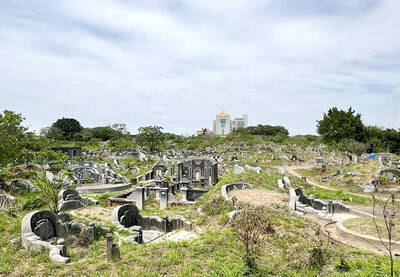
Apr. 13 to Apr. 19 From 17th-century royalty and Presbyterian missionaries to White Terror victims, cultural figures and industrialists, Nanshan Public Cemetery (南山公墓) sprawls across 95 hectares, guarding four centuries of Taiwan’s history. Current estimates show more than 60,000 graves, the earliest dating to 1642. Besides individual tombs, there are also hundreds of family plots, one of which is said to contain around 1,000 remains. As the cemetery occupies valuable land in the heart of Tainan, the government in 2018 began asking families to relocate the graves to make way for development. That


 RSS
RSS