


Allegations, accusations and intense speculation are engulfing Taiwan People’s Party (TPP) Chairman Huang Kuo-chang (黃國昌) and an alleged “political surveillance” “paparazzi” group he led, and it shows no signs of letting up. Separating truth from allegation is tricky, so some caveats. First, no one has been arrested, much less convicted of the alleged crimes.
Second, much of this has been coming from Mirror Media reporting, an outlet that excels in finding inside sources to break sensational exposes. Two problems to keep in mind: Sources may have their own agendas and, while Mirror Media reporting is often proven correct, “often” is not “always.”
An op-ed by Chu Meng-hsiang (朱孟庠), “Huang’s ‘paparazzi pack’ a threat”, in yesterday’s Taipei Times, appears to be jumping the gun in assuming much of the more excited speculation might be accurate, and questioning prosecutor’s decision to “rashly” close an earlier case (which the author did not specify). Prosecutors need ample evidence to justify opening an investigation, and guilt or innocence is determined by a court of law, not trial by Mirror Media.

Photo: Wang Yi-sung, Taipei Times
PUPPY SQUAD
It appears to have started innocently enough. Huang co-founded the Anti-Corruption and Whistleblower Protection Association (TAWPA). He was still affiliated with the party he co-founded, the New Power Party (NPP) at the time, and post-Sunflower movement for a time he re-branded himself as a whistleblower.
Early investigations by TAWPA included alleged corruption by the powerful Taichung Black Faction Yen (顏) clan, and even investigated TPP founder Ko Wen-je (柯文哲). There is some disagreement on how much the organization contributed to RW News reporting on the Yen clan, with Huang having to backtrack on seeming to have taken credit for all of the investigation, rather than just providing some information.
Huang is then alleged to have formed a group of journalists and photographers from his TAWPA contacts to conduct political surveillance on political targets affiliated with the Democratic Progressive Party (DPP), with funding and expenses run through Kai Ssu International Co (凱思國際), owned by Huang’s in-law, Lee Li-chuan (李麗娟). By this point, Huang was drifting away from the NPP and towards the TPP.
This group has been dubbed a “paparazzi team” by the local press. The Taiwanese term for “paparazzi” can be loosely translated as “puppy squad” (狗仔隊) in English, which is both cute and insulting, insinuating they are relentless dogs.
The list of DPP figures they are alleged to have targeted for digging up salacious dirt is long, high ranking and chosen to inflict maximum political damage.
There are also allegations that Kai Ssu is connected to a company of the same name in Hong Kong, and speculation that funding may have been routed through that company, possibly from China. That is far from being proven, though if true, it would be deeply alarming.
Huang remained silent for a couple of days before responding to the Mirror Media report, but then in a livestream admitted to working with various media outlets and with Central News Agency (CNA) reporter Hsieh Hsin-en (謝幸恩), whose non-CNA reporting was done under the pen name Hsiao Yi-yi (蕭依依).
CNA filed a criminal complaint against Hsieh for breach of trust and other offenses. CNA is state-funded and must uphold high standards while avoiding entanglement in politics, which it generally does well, having survived under leaders of both parties as a result.
DPP Legislator Wang Yi-chuan (王義川) also filed a lawsuit against seven people, including Huang, Hsieh, Lee and four photographers said to be part of the surveillance team. He claimed they received foreign funding in breach of national security and contravened personal privacy laws through the surveillance of politicians. Huang described it as a “frivolous lawsuit” orchestrated by the DPP.
This story traces back to June last year, when Chinese Nationalist Party (KMT) Legislator Hsu Chiao-hsin (徐巧芯) publicly released photographs of Wang’s car allegedly making an illegal left turn. Wang asked prosecutors to investigate who had been surveilling him and discovered that the team had rented a car under Kai Ssu and claimed to be media, but Kai Ssu owned no media. Prosecutors, however, did not follow up, saying the surveillance posed no threat to public safety.
Another casualty is RW News, which had its funding pulled by Taiwan Steel Group, its largest shareholder, and had to shut down. This is a shame, RW News did some excellent investigative reporting and some decent polling.
Mirror Media’s latest allegations are that Huang’s team not only worked to dig up dirt on the DPP, they actively peddled the materials found to KMT politicians for a profit. They cite sources saying each item of dirt was sold for NT$20,000 to NT$40,000, and that Huang was personally profiting from the arrangement.
INTERESTING HUSTLE
Which raises a question: Why haven’t we seen something like this before?
Already journalists dig up dirt professionally, including Mirror Media, to make money for their media outlets through sales and advertising.
Oppo (opposition) research conducted by political parties and their consultants at the start of a campaign is common, trying to find anything they can smear their opponent with.
Some politicians — most famously Hsu Chiao-hsin — conduct oppo research and appear to be crowdsourcing via the Internet to find salacious details about DPP figures. Hsu proudly collects dirt on her opponents so she “is not to be trifled with,” and once claimed to have 60,000 photographs on her phone collected to do battle with “pan-green jackals.”
What Huang is alleged to have done is use journalists to preemptively conduct oppo research, not based on an upcoming campaign when it is normally expected, suspicions or clear leads — but rather as a blanket tactic to see what they can turn up and then sell that for profit.
It is not hard to see how something like this could evolve from an innocent whistleblowing organization. With a political figure driven by personal ambition and hatred for the political opposition, and given these resources at hand, the temptation is obvious.
This not only provides potentially powerful ammunition to further their own political career and tear down enemies, it also provides ammunition to allies — at a price. Quite the side hustle.
However, such a business model comes with risks. It is ethically questionable, and depending on how they go about it, potentially illegal.
The team would also need to be very good at what they do. Many politicians are clean, and those who are not are understandably paranoid and cover their tracks.
A blanket approach targeting an entire party without solid leads is going to waste a lot of time. China’s United Front Work Department (UFWD) has the resources and patience for that; a private entity would need to marshal limited resources more effectively.
The remarkable thing about the allegations put forth in Mirror Media is how little their “paparazzi pack” found. Mostly trivial things, like traffic violations.
If accurate, part of the alleged reason for some sources coming forward is how inept this team was. Not only did it not come up with much of substance, these disgruntled sources complained much of what they did come up with turned out to be flawed or outright wrong.
It is far too early to know how much of this turns out to be true, so it is a story to follow carefully.
If enough of it is true to lead to criminal convictions, it would be quite the downfall for Huang — who would be a whistleblower gone bad chasing political ambitions, and sunk by an inept “puppy squad” that produced little of use in the end.
Donovan’s Deep Dives is a regular column by Courtney Donovan Smith (石東文) who writes in-depth analysis on everything about Taiwan’s political scene and geopolitics. Donovan is also the central Taiwan correspondent at ICRT FM100 Radio News, co-publisher of Compass Magazine, co-founder Taiwan Report (report.tw) and former chair of the Taichung American Chamber of Commerce. Follow him on X: @donovan_smith.
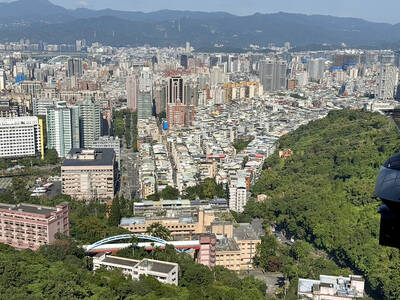
A recent report from the Environmental Management Administration of the Ministry of Environment highlights a perennial problem: illegal dumping of construction waste. In Taoyuan’s Yangmei District (楊梅) and Hsinchu’s Longtan District (龍潭) criminals leased 10,000 square meters of farmland, saying they were going to engage in horticulture. They then accepted between 40,000 and 50,000 cubic meters of construction waste from sites in northern Taiwan, charging less than the going rate for disposal, and dumped the waste concrete, tile, metal and glass onto the leased land. Taoyuan District prosecutors charged 33 individuals from seven companies with numerous violations of the law. This

As mega K-pop group BTS returns to the stage after a hiatus of more than three years, one major market is conspicuously missing from its 12-month world tour: China. The omission of one of the group’s biggest fan bases comes as no surprise. In fact, just the opposite would have been huge news. China has blocked most South Korean entertainment since 2016 under an unofficial ban that also restricts movies and the country’s popular TV dramas. For some Chinese, that means flying to Seoul to see their favorite groups perform — as many were expected to do for three shows opening
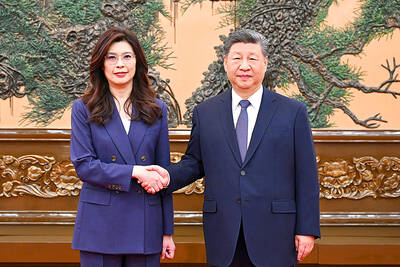
What is the importance within the Chinese Nationalist Party (KMT) of the meeting between Xi Jinping (習近平), the leader Chinese Communist Party (CCP), and Cheng Li-wun (鄭麗文), the leader of the KMT? Local media is an excellent guide to determine how important — or unimportant — a news event is to the public. Taiwan has a vast online media ecosystem, and if a news item is gaining traction among readers, editors shift resources in near real time to boost coverage to meet the demand and drive up traffic. Cheng’s China trip is among the top headlines, but by no means
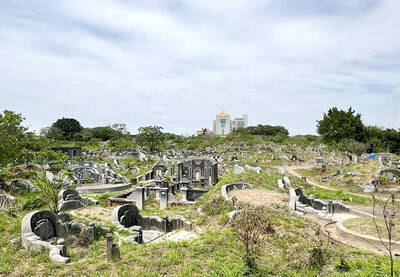
Apr. 13 to Apr. 19 From 17th-century royalty and Presbyterian missionaries to White Terror victims, cultural figures and industrialists, Nanshan Public Cemetery (南山公墓) sprawls across 95 hectares, guarding four centuries of Taiwan’s history. Current estimates show more than 60,000 graves, the earliest dating to 1642. Besides individual tombs, there are also hundreds of family plots, one of which is said to contain around 1,000 remains. As the cemetery occupies valuable land in the heart of Tainan, the government in 2018 began asking families to relocate the graves to make way for development. That


 RSS
RSS