


Way of the Dragon’s Enter the Dragon 13 card broke new ground Sunday at the Taipei Gymnasium, staging Asia’s first Dirty Boxing contest while also testing Beta MMA, Cage Striking, and professional MMA. The event drew a steadily growing crowd to the Red Gym, with subdued preliminaries giving way to a raucous main card.
The main event delivered a quick finish. Kevin Yu (尤凱文), nicknamed “Caesar” and fighting out of WAZA Combat Space, overcame a size and power disadvantage against Chiang Chieh-yu (蔣捷宇). Yu brought the fight to the mat almost immediately, advancing to mount and hammering away until the referee stopped the contest at 2 minutes 39 seconds of Round 1. Speaking to the Taipei Times before the fight, Yu downplayed personal stakes, saying what mattered most was that more Taiwanese could come to appreciate MMA.
The co-main event marked the professional debut of Peng Hao-yu (彭皓宇), the “Honey Badger Samurai.” Representing iFighting Gym, he faced Hong Kong veteran Lai Ting-Yi (黎霆義) and leaned on his wrestling, shooting clean double-legs and staying heavy on top. Peng’s steady control carried him to a unanimous decision and a promising start to his career.
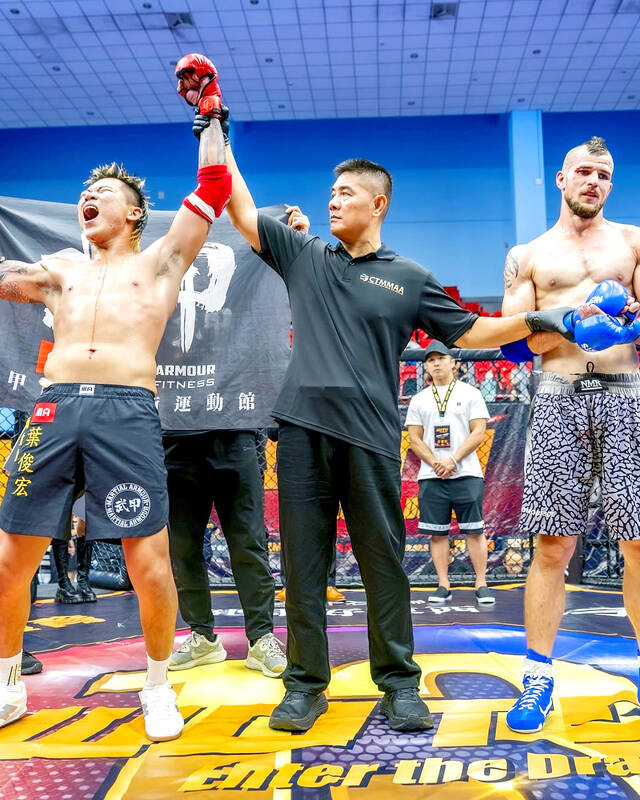
Photo Courtesy of Way of the Dragon
While not the headliner, the night’s lone Dirty Boxing contest was its most novel experiment. American Daniel O’Rourke (武丹龍) made an extravagant entrance in a blue satin robe, punctuated by a pantomimed home-run swing before the bell. Across from him, Yeh Chun-hung (葉俊宏), nicknamed the “Naughty Panther,” quickly opened a cut and frustrated O’Rourke with short punches and angles drawn from his background in Baguazhang. Both men mixed in spinning elbows and bursts of offense, but Yeh pulled away to earn a unanimous decision. Afterward, he drew laughs from fans by admitting he was too tired to think about boxing again anytime soon.
The card also showcased international talent and other experimental formats. Uzbekistan’s Narzullaev Bekzod, fighting out of Elemental Fighting Hall, stormed through Taiwan’s Tao Yi-ju (陶奕儒) with a three-punch combination that ended the fight inside a minute. Canadian fighter Jason Weeks outpointed Chiang Jui (江睿) by unanimous decision before announcing a break from competition as he prepares for fatherhood. Guo Shang-qian (郭尚謙) edged Chen Yun-ting (陳昀霆) by majority decision, while Chen Wei-cheng (陳暐承), the “Fighting Cop,” relied on his sanda kicks and takedown defense to defeat Hong Kong’s Ho Kwan-lit (何鈞烈). American David Nicholson closed the preliminaries with a rear-naked choke at the horn.
To lift the atmosphere after the preliminaries, ring announcer Alex Tsai rallied the crowd while ring girls tossed shirts and other giveaways into the stands. From that point the energy surged, with the thud of body kicks echoing through the venue and big finishes drawing louder reactions.
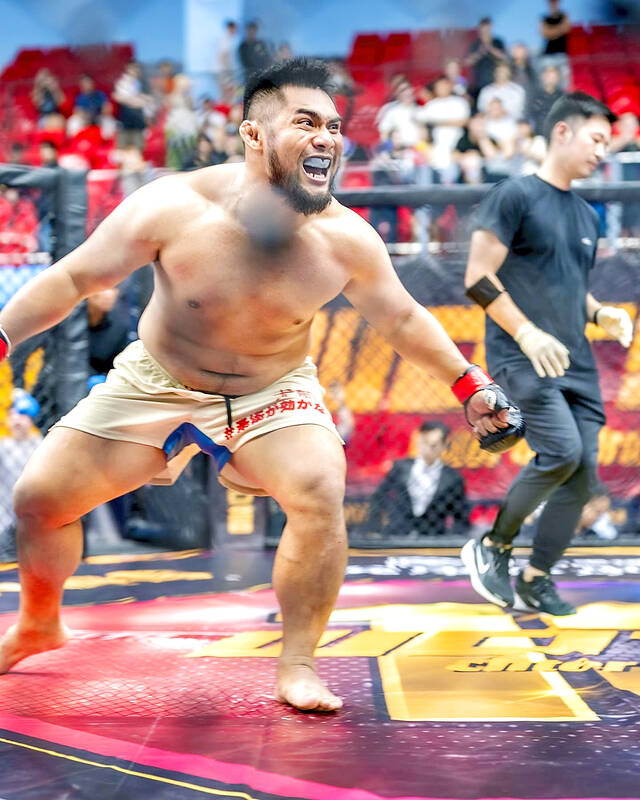
Photo Courtesy of Way of the Dragon
By the final bell, Enter the Dragon 13 had accomplished its aim: giving Taiwan’s fight fans both the familiarity of pro MMA and the novelty of multiple experimental formats. For WOTD, which began staging events in 2018 the night showed that Taiwan can serve as a testing ground for the sport’s next direction.
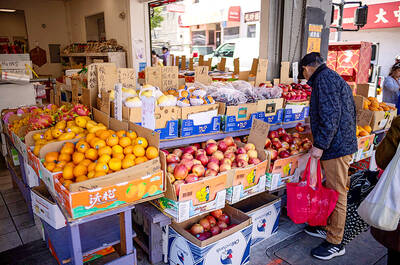
Ajay Verma, a consultant gastroenterologist at Kettering general hospital in Northamptonshire, says our gut is a “complex machine.” “It is constantly providing us with the nutrition we need, initially to grow and develop, and then for us to survive, thrive and repair from injury and illness.” How can we keep it functioning well? Put simply: “Make sure what you put into it is balanced, and that you clear out its waste products adequately,” Verma says. “In a general gastroenterology clinic, the most common conditions we see are irritable bowel syndrome (IBS), gastroesophageal reflux disease, inflammatory bowel disease and constipation,” says Nisha
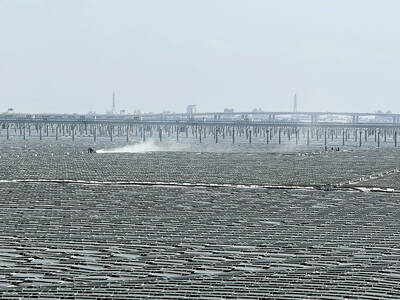
The arithmetic is straightforward and uncomfortable. By the end of 2025, Taiwan had committed itself to a 50-30-20 electricity mix — half natural gas, 30 per cent coal, 20 per cent renewables. The Ministry of Economic Affairs’s (MOEA) own monthly energy reports tell a different story. Natural gas reached 47.8 per cent of generation last year. Coal stood at 35.4 per cent, comfortably above its target ceiling. Renewables came in at 13.1 per cent, well short of the 20 per cent Taipei had pledged a decade earlier. Installed renewable capacity reached roughly half of the 12 gigawatts (GW) the government

Last week US President Donald Trump was asked by a reporter whether he would speak on the phone to the President of Taiwan. “l’ll speak to him. I speak to everybody. We have that situation very well in hand,” Trump said. This marked the second time in a couple of weeks he had said he would talk to the President of Taiwan. In 2016 he famously took a call from then-president Tsai Ing-wen (蔡英文), when he was president-elect. Despite warnings that the apocalypse was nigh because of a phone call, the world quickly forgot about the conversation between two democratically-elected presidents.
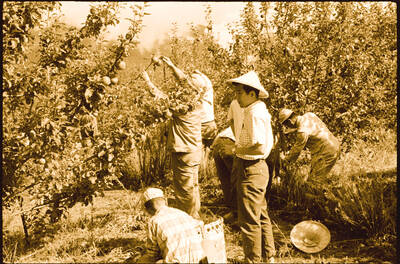
May 25 to May 31 Few believed that apples could be cultivated on a commercial scale in Taiwan’s high mountains. When horticulturalist Cheng Chao-hsiung (程兆熊) first proposed the idea in 1955, both American and Taiwanese colleagues dismissed it as implausible, arguing that temperate fruit could not be reliably grown on a subtropical island, especially on rugged terrain. However, it was this terrain in the Central Mountain Range where many Chinese Civil War veterans were resettled in the late 1950s. With limited job prospects and no family in Taiwan, they were placed on cooperative farms aimed toward self-sufficiency. Some say the conditions


 RSS
RSS