


If you’ve lately been feeling that the “Jurassic Park” franchise has jumped an even more ancient creature — the shark — hold off any thoughts of extinction. Judging from the latest entry, there’s still life in this old dino series.
Jurassic World Rebirth captures the awe and majesty of the overgrown lizards that’s been lacking for so many of the movies, which became just an endless cat-and-mouse in the dark between scared humans against T-Rexes or raptors. Jurassic World Rebirth lets in the daylight.
Credit goes to screenwriter David Koepp, who penned the original Jurassic Park, and director Gareth Edwards, who knows a thing or two about giant reptiles as director of 2014’s Godzilla. Together with director of photographer John Mathieson, they’ve returned the franchise to its winning roots.
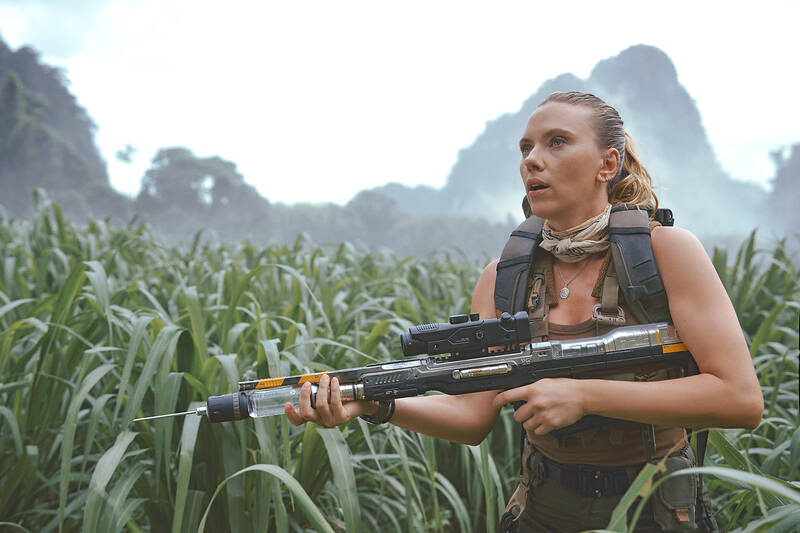
Photo: AP
Jurassic World Rebirth has nods to the past even as it cuts a new future with new characters. It’s a sort of heist movie with monsters that’s set on the original decaying island research facility for the original, abandoned Jurassic Park.
Scarlett Johansson and Mahershala Ali — both very unshowy and suggesting a sort of sibling chemistry — play security and extraction specialists — OK, mercenaries — hired to get what everyone wants from dinosaurs in these movies: DNA. In return, there’s US$10 million.
The movie is set five years after Jurassic World Dominion and some three decades after dinosaurs were reanimated. They’ve lost their public fascination — a subtle nod perhaps to the films in the franchise — and have struggled with the climate, gathering at the equator.
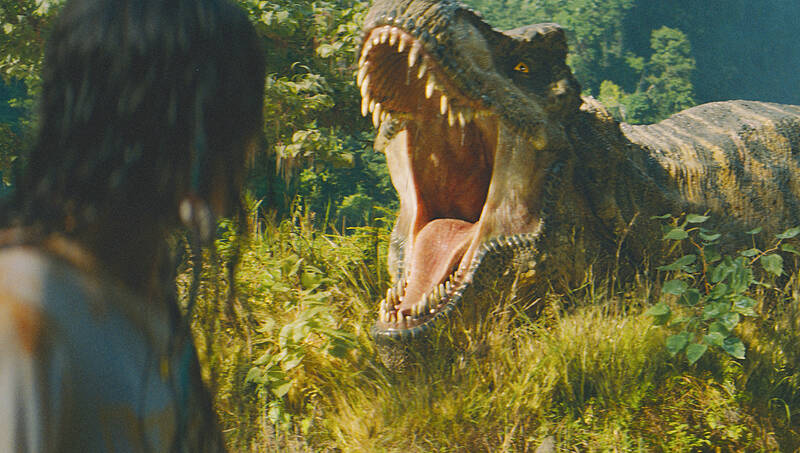
Photo: AP
The Big Pharma company ParkerGenix has come up with a blockbuster idea: Take DNA from three colossal Cretaceous-period creatures — the flying Quetzalcoatlus, the aquatic Mosasaurus and the land-based Titanosaurus — to cure cardiac disease. Wait, how does that work? Don’t ask us, something about hemoglobin.
The trick is this: The dinos have to be alive when the DNA is extracted. Why? Because then there’d be no movie, silly. It would be a 10-minute sequence of a guy in a white coat and a syringe. This way, we celebrate three kinds of dinosaurs in three separate chapters.
It may seem a little far-fetched, but may we remind you about the last movie, which involved a biogenetic granddaughter, a global pharma conspiracy, the cast members from both trilogies, a Giganotosaurus, giant locusts on fire and had the ludicrous decision to have Chris Pratt make a promise to bring home a baby dino — to its mother.
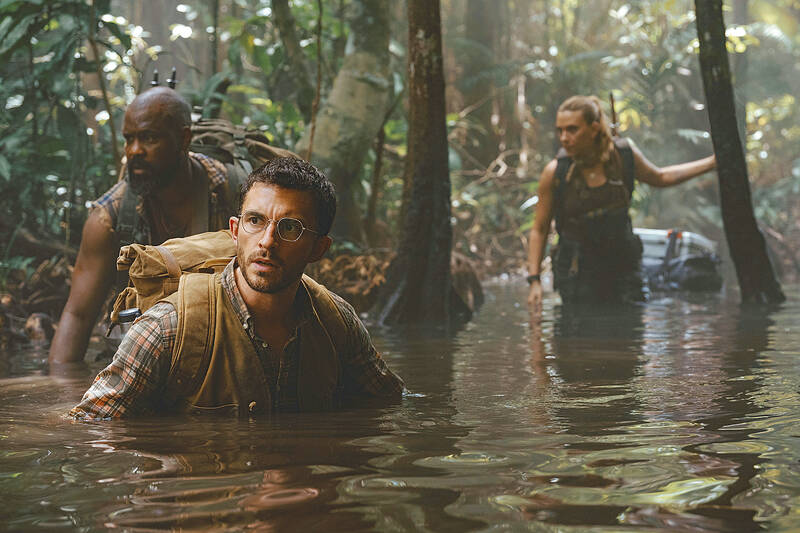
Photo: AP
The three-part quest at the heart of Jurassic World Rebirth is interrupted by a family — a dad, his two daughters and a sketchy boyfriend — in a 45-foot sailboat that is capsized and need rescuing. They bring a dose of not-always-working humor and humanity to the extraction team, which also includes a too-easily-telegraphing baddie played by Rupert Friend — “I’m too smart to die” — and a museum-based paleontologist played by Jonathan Bailey.
The filmmakers include clever nods to other blockbusters — Indiana Jones, Star Wars, Jaws and ET — and thrillingly create a dinos-hunting-in-a-convenience-store sequence like a tribute to the original film’s dinos-hunting-in-a-kitchen sequence. The shots overall are beautifully composed, from silhouettes on a boat in twilight to almost feeling the burn of the ropes as actors rappel down a 500-foot cliff face.
The creatures here are made glorious — from a dozing T-Rex along a river bed to the ones twisting in the sea, pure muscle and heft. A highlight is a pair of long-tailed Tyrannosauruses entwining their necks as John Williams’ familiar score plays, two lovers with thick, knotted skin utterly oblivious to the pesky humans who want some DNA.
For some reason, candy is a touchstone throughout the movie, from the opening sequence in which a stray Snickers wrapper causes incalculable harm, to licorice fed to a baby dino and one character’s fondness for crunching Altoids.
Edwards’ pacing is perfect, allowing dread to build with just the rustling of trees, and letting characters deepen between breathless, excellently filmed action sequences. The gorgeous landscape — Thailand’s waterfalls, grassy plains, shoreline caves and mangrove swamps — should be used for a tourist campaign, well, as long as they remove the rapacious dinos.
As if all this wasn’t enough, there’s a bonus bit at the end. The research facility that was abandoned years ago was cross-breeding dino species and making “genetically altered freaks” that still roam around. Some look like a turkey-bat-raptor hybrid — gross and scary — and one is a 20,000-pound T-Rex with a misshapen head and a horrible roar. It’s like getting a free monster movie.
In many ways, the folks behind Jurassic World Rebirth are trying to do the same thing as their mercenaries: Going back to the source code to recapture the magic of Steven Spielberg’s 1993 blockbuster original. They’ve thrillingly succeeded.

The small platform at Duoliang Train Station in Taitung County’s Taimali Township (太麻里) served villagers from 1992 to 2006, but was eventually shut down due to lack of use. Just 10 years later, the abandoned train station had become widely known as the most beautiful station in Taiwan, and visitors were so frequent that the village had to start restricting traffic. Nowadays, Duoliang Village (多良) is known as a bit of a tourist trap, with a mandatory, albeit modest, admission fee of NT$10 giving access to a crowded lane of vendors with a mediocre view of the ocean and the trains

For many people, Bilingual Nation 2030 begins and ends in the classroom. Since the policy was launched in 2018, the debate has centered on students, teachers and the pressure placed on schools. Yet the policy was never solely about English education. The government’s official plan also calls for bilingualization in Taiwan’s government services, laws and regulations, and living environment. The goal is to make Taiwan more inclusive and accessible to international enterprises and talent and better prepared for global economic and trade conditions. After eight years, that grand vision is due for a pulse check. RULES THAT CAN BE READ For Harper Chen (陳虹宇), an adviser

Traditionally, indigenous people in Taiwan’s mountains practice swidden cultivation, or “slash and burn” agriculture, a practice common in human history. According to a 2016 research article in the International Journal of Environmental Sustainability, among the Atayal people, this began with a search for suitable forested slopeland. The trees are burnt for fertilizer and the land cleared of stones. The stones and wood are then piled up to make fences, while both dead and standing trees are retained on the plot. The fences are used to grow climbing crops like squash and beans. The plot itself supports farming for three years.

President William Lai (賴清德) on Nov. 25 last year announced in a Washington Post op-ed that “my government will introduce a historic US$40 billion supplementary defense budget, an investment that underscores our commitment to defending Taiwan’s democracy.” Lai promised “significant new arms acquisitions from the United States” and to “invest in cutting-edge technologies and expand Taiwan’s defense industrial base,” to “bolster deterrence by inserting greater costs and uncertainties into Beijing’s decision-making on the use of force.” Announcing it in the Washington Post was a strategic gamble, both geopolitically and domestically, with Taiwan’s international credibility at stake. But Lai’s message was exactly


 RSS
RSS