


In the new horror movie, Heretic, Hugh Grant plays a diabolical religious skeptic who traps two scared missionaries in his house and tries to violently shake their faith.
What starts more as a religious studies lecture slowly morphs into a gory escape room for the two door-knocking members of The Church of Jesus Christ of Latter-day Saints, underscoring just how well-suited religion can be for terrifying and entertaining thrill-seeking moviegoers.
“I think it is a fascinating religion-related horror as it raises questions about the institution of religion, the patriarchy of religion,” said Stacey Abbott, a film professor at Northumbria University in Newcastle, England, whose research interests include horror, vampires and zombies.
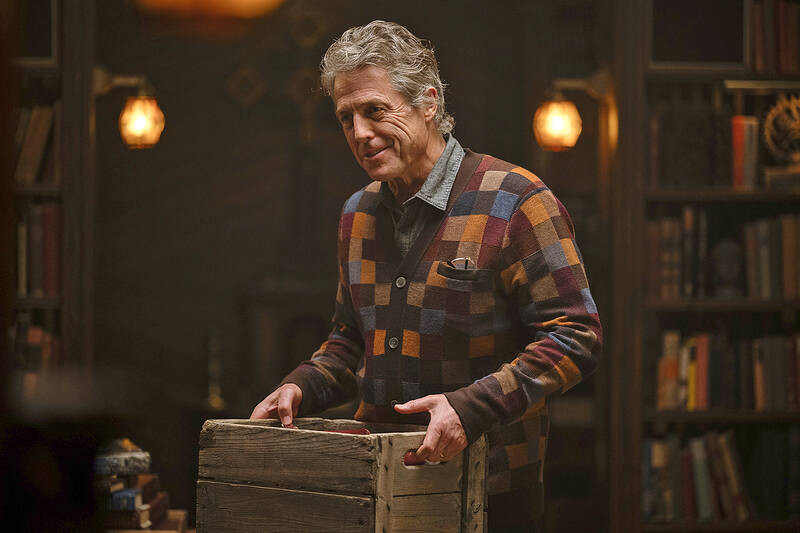
Photo: AP
“But it also questions the nature of faith and confronts the audience with a debate about choice, faith and free will.”
Horror has had a decades-long attraction to religion, Christianity especially in the US, with the 1970s The Exorcist and The Omen being prime examples. Beyond the jump scares, the supernatural elements of horror and its sublime nature pair easily with belief and spirituality — and religion’s exploration of big existential questions, Abbott said. Horror is subversive. Real-life taboo topics and cultural anxieties are fair game.
“It is a rich canvas for social critique and it can also be a space to reassert traditional values,” Abbott said in an e-mail.
DEATH AND DEMONS
Religions and horror tackle similar questions about what it means to be human — how people relate to one another and the world, said Brandon Grafius, a Biblical studies professor at Ecumenical Theological Seminary in Detroit and an expert on Christianity and horror.
“So much of religion is about how we grapple with the reality of death. … Helping us make meaning even in the face of that reality,” said Grafius. “Horror really serves that same process, as a way to reflect on death.”
Not only does Christianity translate well for US audiences, it has a lot of raw material for moviemakers to work with, he said.
“Christianity emerged as a strongly dualistic religion, where forces are either good or evil,” Grafius said. “Even though the US is moving away from being a nation dominated by Christianity, we still have that dualism deep in our bones.”
Among the more recent religion-themed horror films, The Conjuring franchise, including The Nun movies, show paranormal investigators battling demons, Abbott said, while The First Omen and Immaculate offer critiques of patriarchal attempts to control women’s bodies.
“These films seem to be a direct response to many of the debates that are happening in the US these days,” Abbott wrote in her e-mail. “These different approaches to religion in horror illustrate the way in which the genre is engaging with a very live debate around religion or more specifically how religion is being used to assert control (which is what Heretic is all about).”
Grant, who plays Mr. Reed in the new movie, said that he shared some of his “Heretic” character’s skepticism, although not necessarily from a religious perspective:
“There is a part of me — probably a not very attractive part of me — that likes to smash people’s idols. Anyone I feel is being a bit too smug or too pretentious, I don’t like to see that. I like to just take them apart a little bit.”
Horror can be challenging. It acts as a dark mirror that can reveal things people don’t want to admit and fears they don’t want to face, said the Reverand Ryan Duns, a Jesuit priest and theology chair at Marquette University in Milwaukee.
If done well, both religion and horror are unsettling, he said.
“Religion, when it unsettles, asks us am I living up to the person I have been called to be or am I complicit in systems of violence, oppression, injustice, going with the status quo,” said Duns, who wrote the “Theology of Horror” and teaches a course on it as well. “In the horror movie, the monster threatens normality — threatens to destroy our status quo.”
But they deviate from there. In horror, there is no way out, Duns said. He pointed out that defeating a movie’s monster doesn’t prevent sequels, hence Jaws 2, Terrifier 3, Return of the Killer Tomatoes and more.
In Christianity, it is Jesus and the Gospels threatening the status quo, but they offer hope and a way out, he said.
Ti West mixes religion into the narrative of his new movie, MaXXXine, a horror film about an adult film star trying to break into mainstream movies. West, who also wrote and directed The Sacrament, a horror movie inspired by the Jonestown Massacre in 1978, said he doesn’t actively set out to tell stories with prominent religion narratives, but religion can be ripe for mining.
“It kind of depends on the story,” West said, “Anything with morality wrapped up into it, they kind of go hand in hand at times. And it’s like religion is such a major part of every culture everywhere that … I feel like sometimes it’s such a major part of life that gets put aside in movies.”
WHEN RELIGION WORKS IN HORROR
Beyond poor storytelling, the mixing of horror and religion can go wrong if the movie is meant to offend the believers of a particular faith, said Lisa Morton, an award-winning horror author whose written books on Halloween and paranormal history.
But it can really go right. Morton’s all-time favorite movie is The Exorcist, a holy horror icon and a peak example of the genre. The Omen followed it.
“All of the contemporary bloodlines kind of trace back through those two,” said Morton. “It’s interesting how they keep getting rebooted over and over.”
Abbott agrees religion should be portrayed respectfully, just as she expects accuracy and respect for science in movies, though not every detail needs to be perfect.
“But some horror films, like exorcism movies, are built upon the fact that they are drawing upon real rituals and then taking them to a more extreme conclusion,” she said.
Osgood Perkins, who wrote and directed Longlegs, a horror movie about an occultist serial killer, invented the religious material in his film, piecing together whatever felt right from his imagination and real life.
“I just make it up,” said Perkins. “But then you catch hold of something like the Bible verse and you’re like, ‘Wow, this is really rich.’ Beasts coming out of the sea with heads and horns and crowns and things like that. I didn’t make that up.”
For Duns, an accurate portrayal of religious rituals and symbols — without over doing it — can add heft to a scene.
“The rituals of the churches have been stylized and lived out for centuries,” Duns said. “When movies are silly or are sloppy with it, the power of the gesture and the power of the symbols are lost.”

By global standards, the traffic congestion that afflicts Taiwan’s urban areas isn’t horrific. But nor is it something the country can be proud of. According to TomTom, a Dutch developer of location and navigation technologies, last year Taiwan was the sixth most congested country in Asia. Of the 492 towns and cities included in its rankings last year, Taipei was the 74th most congested. Taoyuan ranked 105th, while Hsinchu County (121st), Taichung (142nd), Tainan (173rd), New Taipei City (227th), Kaohsiung (241st) and Keelung (302nd) also featured on the list. Four Japanese cities have slower traffic than Taipei. (Seoul, which has some
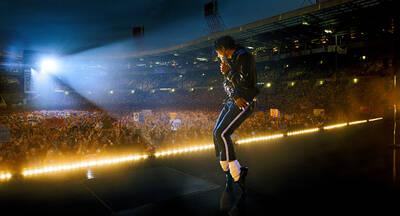
Michael slides a sequin glove over the pop star’s tarnished legacy, shrouding Michael Jackson’s complications with a conventional biopic that, if you cover your ears, sounds great. Antoine Fuqua’s movie is sanctioned by Jackson’s estate and its producers include the estate’s executors. So it is, by its nature, a narrow, authorized perspective on Jackson. The film ends before the flood of allegations of sexual abuse of children, or Jackson’s own acknowledgment of sleeping alongside kids. Jackson and his estate have long maintained his innocence. In his only criminal trial, in 2005, Jackson was acquitted. Michael doesn’t even subtly nod to these facts.

Writing of the finds at the ancient iron-working site of Shihsanhang (十 三行) in New Taipei City’s Bali District (八里), archaeologist Tsang Cheng-hwa (臧振華) of the Academia Sinica’s Institute of History and Philology observes: “One bronze bowl gilded with gold, together with copper coins and fragments of Tang and Song ceramics, were also found. These provide evidence for early contact between Taiwan aborigines and Chinese.” The Shihsanhang Web site from the Ministry of Culture says of the finds: “They were evidence that the residents of the area had a close trading relation with Chinese civilians, as the coins can be
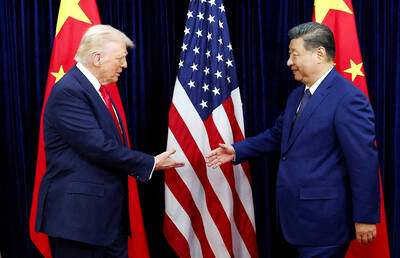
The March/April volume of Foreign Affairs, long a purveyor of pro-China pablum, offered up another irksome Beijing-speak on the issues and solutions for the problems vexing the People’s Republic of China (PRC) and the US: “America and China at the Edge of Ruin: A Last Chance to Step Back From the Brink” rang the provocative title, by David M. Lampton and Wang Jisi (王緝思). If one ever wants to describe what went wrong with US-PRC relations, the career of Wang Jisi is a good place to start. Wang has extensive experience in the US and the West. He was a visiting


 RSS
RSS