


In mid-1949 George Kennan, the famed geopolitical thinker and analyst, wrote a memorandum on US policy towards Taiwan and Penghu, then known as, respectively, Formosa and the Pescadores. In it he argued that Formosa and Pescadores would be lost to the Chine communists in a few years, or even months, because of the deteriorating situation on the islands, defeating the US goal of keeping them out of Communist Chinese hands. Kennan contended that “the only reasonably sure chance of denying Formosa and the Pescadores to the Communists” would be to remove the current Chinese administration, establish a neutral administration and hold a plebiscite for the islands.
“Formosan separatism is the only concept which has sufficient grass-roots appeal to resist communism,” he said.
In a June memorandum he made similar arguments. After saying that the chaos from China was spreading to Formosa, and noting that the Philippines recalled it had only recently been invaded from Taiwan, he urged the US to put together a multi-national force that would occupy the islands, take over administration and support a UN plebiscite on their status. The Philippines, he thought, could be led to “propose that the powers which are still legally at war with Japan should immediately concern themselves with the threatened turmoil in this part of the Japanese Empire which is still awaiting final disposition at a peace settlement.” Kennan felt that any of the Powers could make a statement requesting such an action, given “the shocking record of misrule during the past four years by the Chinese and of the many pleas from representative Formosans for autonomy.”
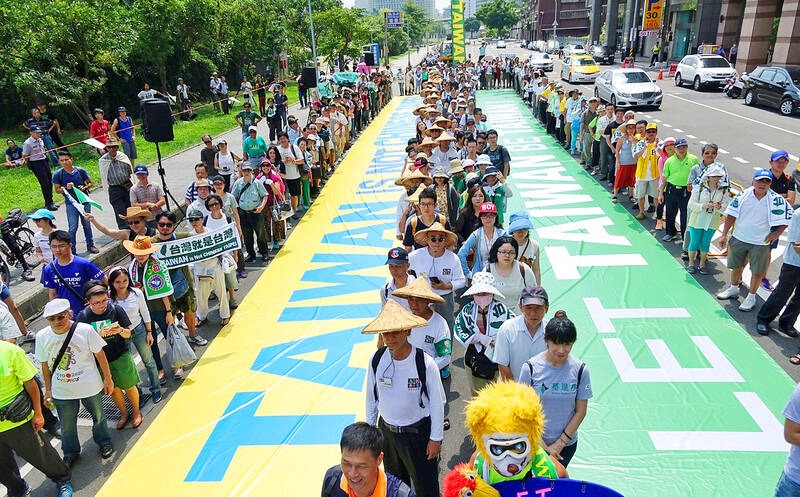
Photo: Liu Hsin-de, Taipei Times
Recall that in mid-1949 Formosa was still part of Japan and would remain a Japanese territory until April 28, 1952, when the peace settlement codified in the San Francisco Peace Treaty came into effect. Its status would not be resolved in the Treaty, and of course, remains unresolved today.
FORMOSANS FOR FORMOSA
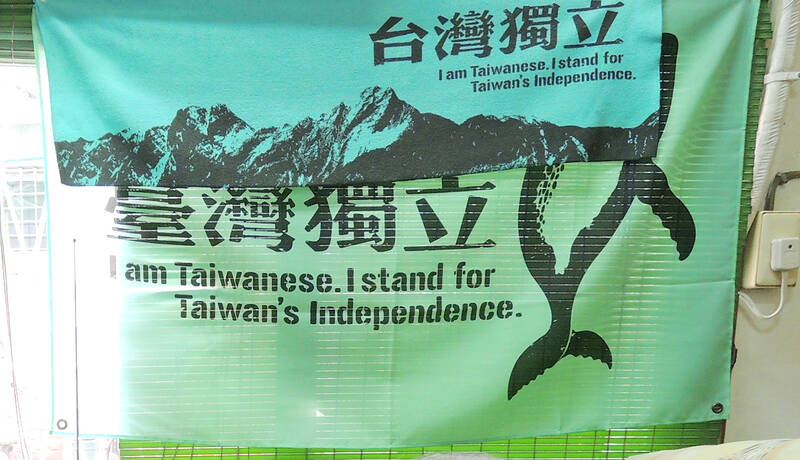
Photo: Liu Hsin-de, Taipei Times
Kennan’s suggestions were never followed, of course. But Americans who interacted with Taiwan in the 1950s and 1960s quickly came to understand that the Formosans wanted their own state. In April of 1957 John K. Fairbank, the great China scholar wrote in the Atlantic of the “ten million Chinese” on Taiwan that if they were given a choice, “there is little doubt today that they would seek freedom from the mainland.”
Similarly, in 1963 Albert Axelbank wrote in Harper’s Magazine: “if a poll were taken now to determine what status Formosans want for their island, I am sure that at least a two-thirds majority would favor independence.”
He added, in a highly detailed piece that was a scathing evaluation of Chinese Nationalist Party (KMT) colonialism: “But responsible Formosan leaders, both Kuomintang [KMT] and opposition members, have told me that more than 90 per cent of the people desire the establishment of an independent Formosan republic.”
Axelbank also averred that “I have often started to address a group of Formosans as, ‘You Chinese . . .’ only to be pointedly told: ‘We are Taiwanese, not Chinese.’”
In 1970 Douglas Mendel published an entire book, The Politics of Formosan Nationalism, on that topic. Mendel and Axelbank were on Taiwan at the same time in the early 1960s.
Of course, the Taiwanese themselves wrote copiously on their desire for an independent state in Taiwan, and debated it incessantly among themselves. Indeed, I first encountered Axelbank’s piece in linguist Ong Iok-tek’s (王育德) avowedly pro-Taiwan work Taiwan: A History of Agonies (台灣‧苦悶的歷史). My own introduction to Taiwan’s ardent desire for independence came from reading anthropological and social science works on Taiwan from the 1970s and 1980s.
In a 2012 piece, scholar of democratization Frank Muyard wrote on the shift in identity in the 1990s, which is often styled the “rising Taiwan identity” in the media. After martial law was lifted, in the 1990s, data from the Election Study Center at National Chengchi University (NCCU) showed that in 1992 25.5 percent of the population identified as solely Chinese. A decade later that figure stood at 9.2 percent. Meanwhile, in that same period, the “solely Taiwanese” population rose from 17.6 percent to 41.6 percent. The “dual identity” remained stable.
TAIWANESENESS
People don’t suddenly give up complex national social identities. As the comments of Kennan, Fairbanks and others show, Taiwaneseness did not spring into existence, manufactured by the Democratic Progressive Party (DPP) or the US in a nefarious plot to contain China. It had always existed, suppressed by the party-state, traceable back at least to the 1921 establishment of the Taiwanese Cultural Association (TCA) to advocate for Taiwan autonomy under Japanese rule.
Muyard argues that the key moment was November 1987 legalization of visits to China. From that point on, Taiwanese began to experience how different they were from Chinese, a process only accelerated by the arrival of millions of Chinese tourists, and the movement of hundreds of thousands of Taiwanese to China. Martial law was lifted that year and again in 1993, when the national security law that had replaced it was abolished. Once people felt safe, they rapidly revealed their real identities.
Note that this occurred even though a generation of Taiwanese males had spent two or more years on military bases (read: concentration camps) being harangued about their Chineseness by the largely KMT officer corps. Many of these males down to the present remain nostalgic for the 1980s and espouse the conservative social and economic positions they imbibed as young males, but hold a Taiwan-centered identity despite KMT indoctrination.
Curiously, that revelation of the Taiwan identity among locals coincided with the disappearance of the term “Formosa” in English usage. By 2000 it was largely gone, replaced by Taiwan/Taiwanese. One wonders what would have happened if NCCU had polled people on having a “Formosan” identity.
That public acknowledgment of old identities was followed, of course, by rising public support for independence, and the feeling, as recent DPP presidents have observed, that there are two countries on each side of the Strait.
“In July 2009,” Muyard reported of a Global Views poll, “82.8 percent of the respondents describe the cross-strait relations as being between two separately developed countries…”
Why does the media opt for describing “the rising Taiwan identity” rather than correctly locating it in the island’s long colonial history? Anthropologist Scott Simon pointed out to me that referring to the Taiwan identity as something “new” de-legitimates it politically, a pro-PRC move. People seem to prefer legitimating their social identities by locating them in the distant past. It also makes the repeated colonizations of Taiwan disappear, meaning they need not be discussed, enabling the writer to avoid confronting the colonial history that created that identity.
Fairbank presciently warned back in 1957: “Indeed we cannot overlook the possibility that, as the mainland builds up, its power of attraction by promise and threat may undermine Taiwan’s capacity for independence.”
Today the threat from the People’s Republic of China (PRC) far outweighs any promise it may have for Taiwanese.
As Kennan predicted, the basis for Taiwan’s rejection of PRC rule is Taiwan independence.
Notes from Central Taiwan is a column written by long-term resident Michael Turton, who provides incisive commentary informed by three decades of living in and writing about his adoptive country. The views expressed here are his own.
Ajay Verma, a consultant gastroenterologist at Kettering general hospital in Northamptonshire, says our gut is a “complex machine.” “It is constantly providing us with the nutrition we need, initially to grow and develop, and then for us to survive, thrive and repair from injury and illness.” How can we keep it functioning well? Put simply: “Make sure what you put into it is balanced, and that you clear out its waste products adequately,” Verma says. “In a general gastroenterology clinic, the most common conditions we see are irritable bowel syndrome (IBS), gastroesophageal reflux disease, inflammatory bowel disease and constipation,” says Nisha
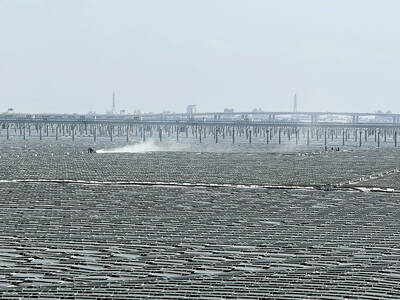
The arithmetic is straightforward and uncomfortable. By the end of 2025, Taiwan had committed itself to a 50-30-20 electricity mix — half natural gas, 30 per cent coal, 20 per cent renewables. The Ministry of Economic Affairs’s (MOEA) own monthly energy reports tell a different story. Natural gas reached 47.8 per cent of generation last year. Coal stood at 35.4 per cent, comfortably above its target ceiling. Renewables came in at 13.1 per cent, well short of the 20 per cent Taipei had pledged a decade earlier. Installed renewable capacity reached roughly half of the 12 gigawatts (GW) the government

Last week US President Donald Trump was asked by a reporter whether he would speak on the phone to the President of Taiwan. “l’ll speak to him. I speak to everybody. We have that situation very well in hand,” Trump said. This marked the second time in a couple of weeks he had said he would talk to the President of Taiwan. In 2016 he famously took a call from then-president Tsai Ing-wen (蔡英文), when he was president-elect. Despite warnings that the apocalypse was nigh because of a phone call, the world quickly forgot about the conversation between two democratically-elected presidents.
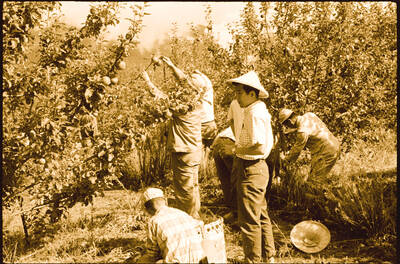
May 25 to May 31 Few believed that apples could be cultivated on a commercial scale in Taiwan’s high mountains. When horticulturalist Cheng Chao-hsiung (程兆熊) first proposed the idea in 1955, both American and Taiwanese colleagues dismissed it as implausible, arguing that temperate fruit could not be reliably grown on a subtropical island, especially on rugged terrain. However, it was this terrain in the Central Mountain Range where many Chinese Civil War veterans were resettled in the late 1950s. With limited job prospects and no family in Taiwan, they were placed on cooperative farms aimed toward self-sufficiency. Some say the conditions


 RSS
RSS