


Last month I got together with the longtime Australian scholar and Taiwan expert, Mark Harrison, who was in Taipei for the presidential inaugural. He remarked to me that if the People’s Republic of China (PRC) ever invades Taiwan, will mean that his nation’s most important trade partners go to war with each other. I went to have a look at that and at the debates about a PRC invasion in Australia, especially in light of the fighting over AUKUS, the trilateral security partnership between Australia, the UK and the US for the Indo-Pacific region, and Australia’s submarine program with the US.
According to Australian government figures, Australia’s top five export destinations are, in order, the PRC, Japan, South Korea, India and the US, which together comprise 62.8 percent of the nation’s exports. If the PRC (32 percent of Australia’s exports) invades Taiwan, its top export destination will be at war with its second and fifth most important export markets. South Korea, its number three destination, will likely become very expensive thanks to skyrocketing shipping costs, or completely inaccessible because the shipping lanes will be combat zones. It may even become involved in the war. Exports to India will also take a huge hit thanks to insurance costs. It may also become involved in the war, given PRC aggression in the Himal and likely, the Indian Ocean.
In overall trade figures (exports and imports) for Australia Taiwan is ninth, but it is the number six destination for exports. In fact, all of Australia’s top 15 export markets save the US and UK are Asian, including Hong Kong, which is counted separately from the PRC, but takes another 1.9 percent of Australia’s exports. A PRC-US war will be fought across Asia, and shipping insurance costs for even close destinations like Indonesia are going to rise, never mind the Philippines, which may well be in the war, and Vietnam, number 14 on the export list, which will require crossing the South China Sea, now a PRC lake.
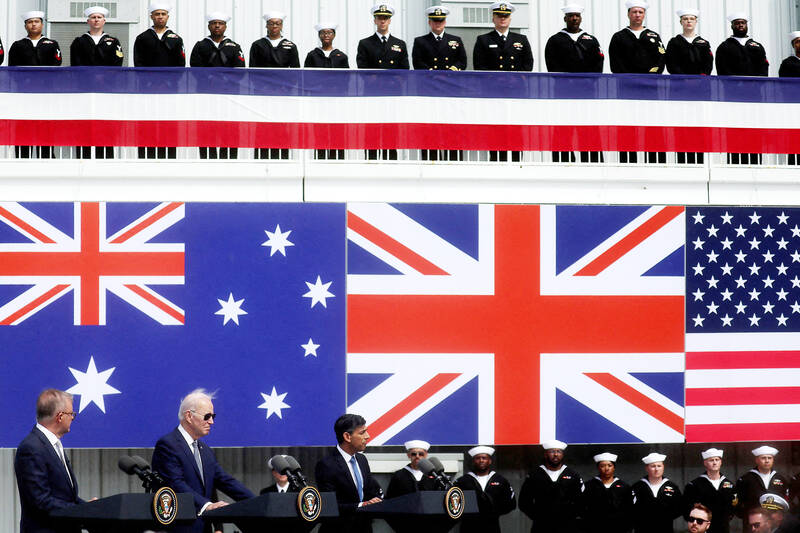
Photo: Reuters
Among importers to Australia, the top four are the PRC, the US, Japan and South Korea. Taiwan is 15th. Same problem: they will all be at war or inaccessible.
Australia’s GDP was about US$1.7 trillion last year. Its trade surplus with the PRC alone was almost US$82 billion, largely due to exports of minerals. That’s 4-5 percent of Australia’s GDP. By contrast, the submarine program that is generating so much angst in Australia is projected to cost US$268 to US$368 billion through the mid-2050s, with most of that occurring later in the program. Annually, that’s a fraction of Australia’s surplus with the PRC, never mind its overall trade with Beijing. It’s not even a blip on the radar of Australia’s overall exports.
CHINA NOT A THREAT?
Photo: Bloomberg
Australians often say in public and in private that the PRC is not a threat to Australia, because it is so far away. No invasion could ever be mounted by the PRC. Many Australians thus feel that a war with the PRC is a “northern hemisphere” event that has little to do with Australia. These arguments are often coupled to absurd claims, especially on the Australian left, that the US is dragging Australia into a war with the PRC and that Australia is “provoking” the PRC by arming itself, a classic example of how resistance to PRC expansionism is recast as provocation. For example, at a Greens gathering in April, Amanda Ruler from Medical Professionals for Prevention of War said that AUKUS risked sparking a regional arms race and that “Australia following the US into a catastrophic and potentially nuclear war against China, which is also our largest trading power.”
Another complaint is that the Australians will give up their sovereignty to the US if, as the current program calls for, they go with the US plan for submarines. Much of the complaining is driven by anti-US ideological commitments.
I don’t want to deal with this list of fictions. Rather, I want to ask what Australians who object to increased expenditures on deterring the PRC imagine will happen to their domestic politics when unemployment reaches 20 percent because a PRC invasion of Taiwan has destroyed Canberra’s foreign trade. As a mental exercise, they should add the effects of the flows of PRC money and disinformation to that domestic political scene.
The debates in Australia seem to entirely ignore the possibility that history doesn’t stop when Taiwan is occupied, that a PRC victory will lead to a new round of wars against Japan, the Philippines and elsewhere, increased expansionist gray-zoning, along with occupations of islands closer to Australia and the seaborne militia and Coast Guard of the PRC actively occupying Australian waters. Australians who believe that there will be some inconvenience, perhaps some unemployment, for a short period of time before things return to normal are living in cloud-cuckoo land. The warfare could go on for years, hot and cold. If the US is completely pushed out of the region, the new normal will be Canberra trading with Asia only if the PRC permits.
TAIWAN, THE PHILIPPINES AND JAPAN
It is instructive to compare Australia to Taiwan, the Philippines and Japan, three other nations with massive exports to the PRC and the US. All are increasingly arming against the PRC. Tokyo understands that not only does Taiwan sit astride its trade routes, but that its Senkaku Islands (known in Taiwan as the Diaoyutai Islands, 釣魚台) and Okinawa are the next targets of Beijing in follow-on wars, with likely PRC interest in the islands east of Taiwan Tokyo controls as well. Unlike Canberra, both Tokyo and Manila have clear views of what the PRC will do because they are already victims of it and because the PRC has announced what territories it wants.
Indeed, Australians who want to see their future should study PRC pressure on the Philippines, because that is how Australia with its insignificant navy and vast size will be treated. PRC naval militia and Coast Guard ships will routinely occupy and expand their presence in Australian waters — already there are worries about Beijing’s massive fishing fleet operating in Australian waters.
Those who wonder how all this power projection will take place can simply crack open a map and check out the new PRC-constructed infrastructure in Papua New Guinea and Beijing’s burgeoning relationship with the Solomons and its ongoing attempts to obtain a port and military bases in the region.
If the reader studies the west side of the map, they will soon see the small country of Timor-Leste, recently independent. It follows from obvious geostrategic logic that the PRC signed a comprehensive security agreement with Timor-Leste in 2022. Move east again and Vanuatu appears, another place Beijing has shown interest in for strategic reasons.
Now imagine this vast area without any US counterweight to the PRC. What kind of future will Australia have then?
Notes from Central Taiwan is a column written by long-term resident Michael Turton, who provides incisive commentary informed by three decades of living in and writing about his adoptive country. The views expressed here are his own.

The US war on Iran has illuminated the deep interdependence of Asia on flows of oil and related items as raw materials that become the basis of modern human civilization. Australians and New Zealanders had a wake up call. The crisis also emphasizes how the Philippines is a swatch of islands linked by jet fuel. These revelations have deep implications for an invasion of Taiwan. Much of the commentary on the Taiwan scenario has looked at the disruptions to world trade, which will be in the trillions. However, the Iran war offers additional specific lessons for a Taiwan scenario. An insightful

The problem with Marx’s famous remark that history repeats itself, first as tragedy, the second time as farce, is that the first time is usually farce as well. This week Chinese Nationalist Party (KMT) Chair Cheng Li-wun (鄭麗文) made a pilgrimage to the People’s Republic of China (PRC) “to confer, converse and otherwise hob-nob” with Chinese Communist Party (CCP) officials. The visit was an instant international media hit, with major media reporting almost entirely shorn of context. “Taiwan’s main opposition leader landed in China Tuesday for a rare visit aimed at cross-strait ‘peace’”, crowed Agence-France Presse (AFP) from Shanghai. Rare!

Polling data often confirms what we expect, but sometimes it throws up surprises. When examined over time, some patterns appear that speak to something bigger going on. In this column, whenever possible, Formosa’s polls are used. Despite the sometimes cringeworthy antics of Formosa’s Chairman, Wu Tzu-Chia (吳子嘉), the data produced includes detailed breakdowns crucial for analysis. It has also been conducted monthly 11-12 times a year for many years with many of the same questions, allowing for analysis over time. When big shifts do occur between one month and the next it is usually in response to some event in

April 6 to April 13 Few expected a Japanese manga adaptation featuring four tall, long-haired heartthrobs and a plucky heroine to transform Taiwan’s television industry. But Meteor Garden (流星花園) took the nation by storm after premiering on April 12, 2001, single-handedly creating the “idol drama” (偶像劇) craze that captivated young viewers across Asia. The show was so successful that Japan produced its own remake in 2005, followed by South Korea, China and Thailand. Other channels quickly followed suit, with more than 50 such shows appearing over the following two years. Departing from the melodramatic


 RSS
RSS