


Words of the Year are not just interesting, they are telling. They are language and attitude barometers that measure what a country sees as important. The trending vocabulary around AI last year reveals a stark divergence in what each society notices and responds to the technological shift.
For the Anglosphere it’s fatigue. For China it’s ambition. For Taiwan, it’s pragmatic vigilance.
In Taiwan’s annual “representative character” vote, “recall” (罷) took the top spot with over 15,000 votes, followed closely by “scam” (詐). While “recall” speaks to the island’s partisan deadlock — a year defined by legislative recall campaigns and a public exhausted by political warfare — the runner-up, “scam,” points directly to an attitude of technological wariness.
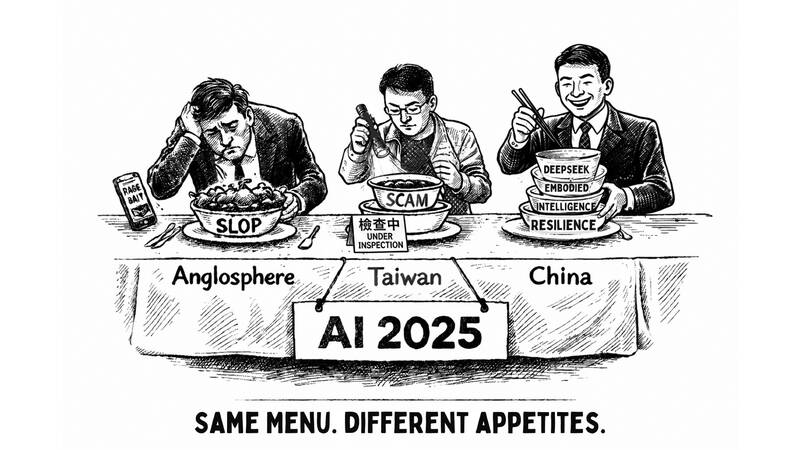
Illustration by Nigel P. Daly generated by ChatGPT and extensively edited with Canva
The Criminal Investigation Bureau warned about criminals using AI to impersonate authorities and reported an average of 530 fraud cases per day in July alone, with daily losses reaching NT$275 million.
AI TOOLS AND CAPABILITIES
In the English-speaking world, the popular AI terms were “vibe coding” and “agentic AI.”
Photo: Reuters
Vibe coding was chosen as Collins Dictionary’s word of the year to describe the practice of turning natural-language prompts into code using AI. Agentic AI was selected by the Association of National Advertisers (ANA) to mark the progress in AI capability from simply generating information to acting autonomously to complete complicated tasks.
Agentic AI is increasingly reflecting a tension between high hopes and harsh economic reality. A report by IT giant Capgemini notes that while nearly 70 percent of marketing leaders agree that agentic AI will be transformative, it is not clear yet how. This push to automate is driven by economic realities, with marketing budgets flatlining at just 7.7 percent of revenue, according to market researcher Gartner.
For China, homegrown AI was the source of its words of the year. In the state-sanctioned 2025 Chinese Language Review, “resilience” (韌) was selected as the national character and DeepSeek the defining phrase.
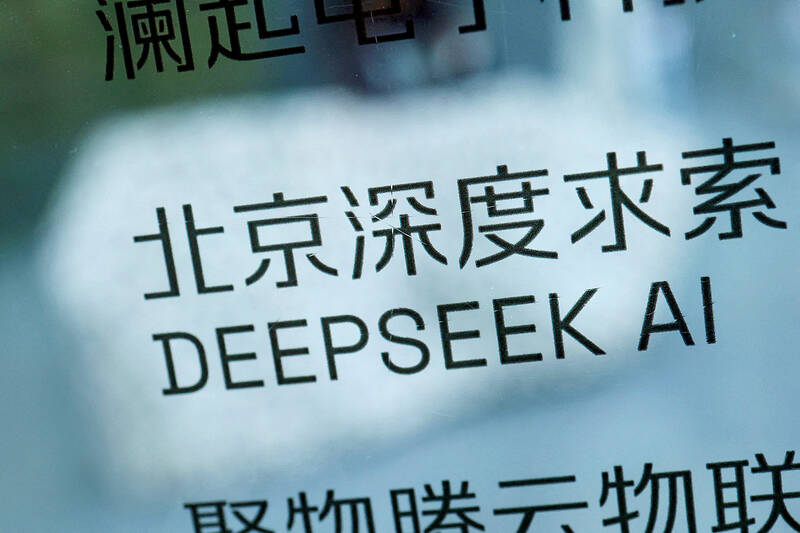
Photo: Reuters
DeepSeek’s R1 open source model slashed training costs and GPU dependence and marked China’s first real challenge to Silicon Valley’s dominance. Its release in January triggered a historic market reaction by erasing nearly US$600 billion from Nvidia’s valuation in a single day.
For Beijing, AI was seen as a means for global influence, sovereignty and national pride.
As for Taiwan, many discussions of AI moved away from ChatGPT and moved to Gemini, which became widely used in news reports, classrooms and offices as a tool for writing, translation, summarizing and productivity. According to Google search term results for Taiwan last year, Gemini ranked fifth overall, and for AI tools in particular, it ranked first, with DeepSeek second and ChatGPT fifth.
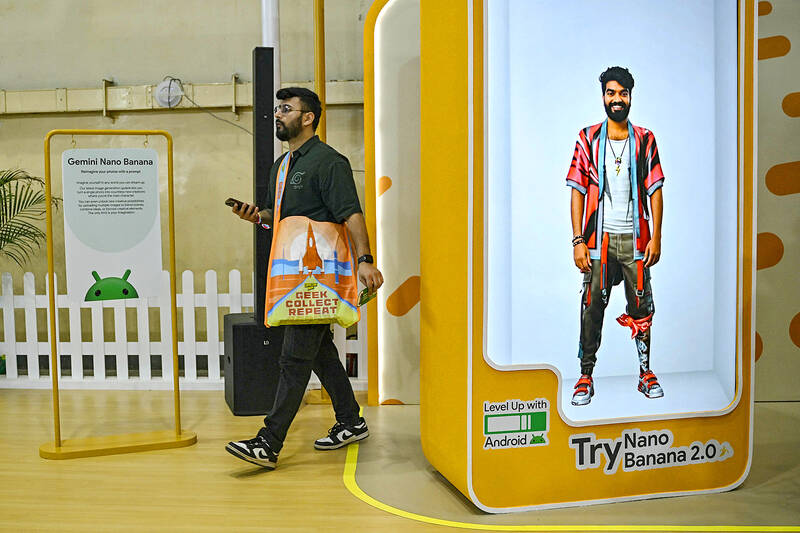
Photo: AFP
Taiwanese also widely discussed the term AI prompt wizard/whisperer, especially in the context of emerging careers, workforce commentary and generative-AI skill framing. Local media and job-market guides explained it as the new name for prompt engineering and related AI work.
In short, whereas the AI was seen in the anglosphere as workflow and agency and in China as national pride, in Taiwan AI was seen more as general utility.
But attention alone does not tell the full story. Across regions, the responses reveal a shared anxiety about authenticity, but expressed through very different cultural lenses.
HOW ARE COUNTRIES RESPONDING TO AI?
The Anglosphere response is one of online content pollution and attention warfare. “Slop” was Merriam-Webster’s word of the year, defined as low-quality digital content produced in quantity by AI. “Rage bait” was Oxford’s word of the year, describing content designed to provoke anger for engagement. And Cambridge Dictionary selected “Parasocial” as its word of the year, explicitly linking the term’s rise to one-sided relationships involving influencers — and AI chatbots.
These words fit squarely in a language of exhaustion. They treat AI as an accelerant poured onto platform incentives that already reward outrage and volume. They also reveal a desire for human connection and authenticity, which was ANA’s co-word of the year along with agentic AI.
China’s response vocabulary, as pointed out in various media commentary, focuses less on rejecting AI than on critiquing its emotional thinness and over-standardization. Terms such as “[no] living person feel” and “prefab” are used to describe content that feels overly engineered or soulless. They signal a preference for warmer, more human-like authentic output rather than a strong resistance to AI itself.
In Taiwan, however, the response was characterized more by threat and vigilance. Both “scam” and “deepfake” (深偽) dominated public (or at least media) anxiety about deception and the nefarious role AI can play in criminal fraud.
Taiwan also came up with a localized adaptation of “AI slop” as “digital garbage” (電子垃圾) or “AI crap” (AI大便). More Gen Z and millennials flocked to Threads, another trending term last year, as a more unfiltered platform with a more “living person feel” compared to the overly polished Instagram.
On platforms like these and PTT, younger generations started using quick slang verification phrases like “This checks out” (觸 chu; homophone of English “true”) and the sarcastic “Are you sure?” (要確欸 / 要確捏). These buzzwords reveal a technologically international and inter-lingual Taiwanese youth culture that is increasingly suspicious and ready to check.
THE TAKEAWAY?
The Anglosphere is becoming impatient with AI saturation and moral fatigue. The main terms of the year are about feed quality, manipulation and synthetic relationships. AI is treated as a force that worsens existing platform pathologies.
China, on the other hand, sees AI as a clear positive for national development and national capability. The key terms highlight breakthroughs and resilience, turning AI into infrastructure of a glorious nation-building project.
And Taiwan seems to be occupying another position: it is becoming more sophisticated in using generative AI tools like Gemini while being wary of online fraud and suspicious claims. Taiwan’s headline word of the year is “scam” and the AI-related fraud statistics back this up.
The “AI attitude” in Taiwan last year is less about moral outrage or pride and more about survival habits and being vigilant of threats. Taiwan is perhaps asking the most practical questions: Is this true? And is it trying to take my money?
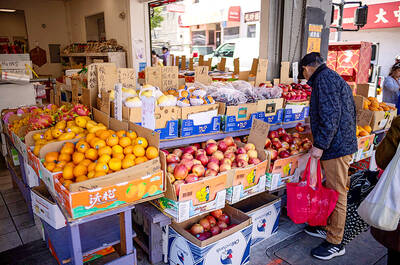
Ajay Verma, a consultant gastroenterologist at Kettering general hospital in Northamptonshire, says our gut is a “complex machine.” “It is constantly providing us with the nutrition we need, initially to grow and develop, and then for us to survive, thrive and repair from injury and illness.” How can we keep it functioning well? Put simply: “Make sure what you put into it is balanced, and that you clear out its waste products adequately,” Verma says. “In a general gastroenterology clinic, the most common conditions we see are irritable bowel syndrome (IBS), gastroesophageal reflux disease, inflammatory bowel disease and constipation,” says Nisha
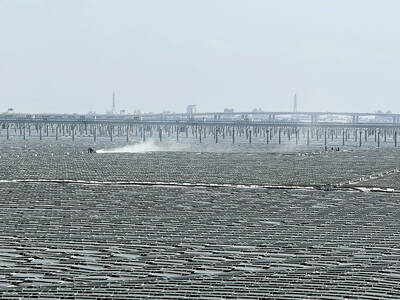
The arithmetic is straightforward and uncomfortable. By the end of 2025, Taiwan had committed itself to a 50-30-20 electricity mix — half natural gas, 30 per cent coal, 20 per cent renewables. The Ministry of Economic Affairs’s (MOEA) own monthly energy reports tell a different story. Natural gas reached 47.8 per cent of generation last year. Coal stood at 35.4 per cent, comfortably above its target ceiling. Renewables came in at 13.1 per cent, well short of the 20 per cent Taipei had pledged a decade earlier. Installed renewable capacity reached roughly half of the 12 gigawatts (GW) the government

Last week US President Donald Trump was asked by a reporter whether he would speak on the phone to the President of Taiwan. “l’ll speak to him. I speak to everybody. We have that situation very well in hand,” Trump said. This marked the second time in a couple of weeks he had said he would talk to the President of Taiwan. In 2016 he famously took a call from then-president Tsai Ing-wen (蔡英文), when he was president-elect. Despite warnings that the apocalypse was nigh because of a phone call, the world quickly forgot about the conversation between two democratically-elected presidents.

May 25 to May 31 Few believed that apples could be cultivated on a commercial scale in Taiwan’s high mountains. When horticulturalist Cheng Chao-hsiung (程兆熊) first proposed the idea in 1955, both American and Taiwanese colleagues dismissed it as implausible, arguing that temperate fruit could not be reliably grown on a subtropical island, especially on rugged terrain. However, it was this terrain in the Central Mountain Range where many Chinese Civil War veterans were resettled in the late 1950s. With limited job prospects and no family in Taiwan, they were placed on cooperative farms aimed toward self-sufficiency. Some say the conditions


 RSS
RSS