


In recent years, Slovakia has been seen as a highly democratic and Western-oriented Central European country. This image was reinforced by the election of the country’s first female president in 2019, efforts to provide extensive assistance to Ukraine and the strengthening of relations with Taiwan, all of which strengthened Slovakia’s position within the European Union.
However, the latest developments in the country suggest that the situation is changing rapidly. As such, the presidential elections to be held on March 23 will be an indicator of whether Slovakia remains in the Western sphere of influence or moves eastward, notably towards Russia and China.
The turnaround began after the Direction–Social Democracy Party (Smer-SD) claimed victory in the parliamentary elections last autumn with 22.9 percent of the vote. The party had previously lost support after the murder of investigative journalist Jan Kuciak, the first journalist assassinated in Slovakia in years. Previously, the government verbally attacked the media and the case was connected with corruption, the issue that still prevails in the country.
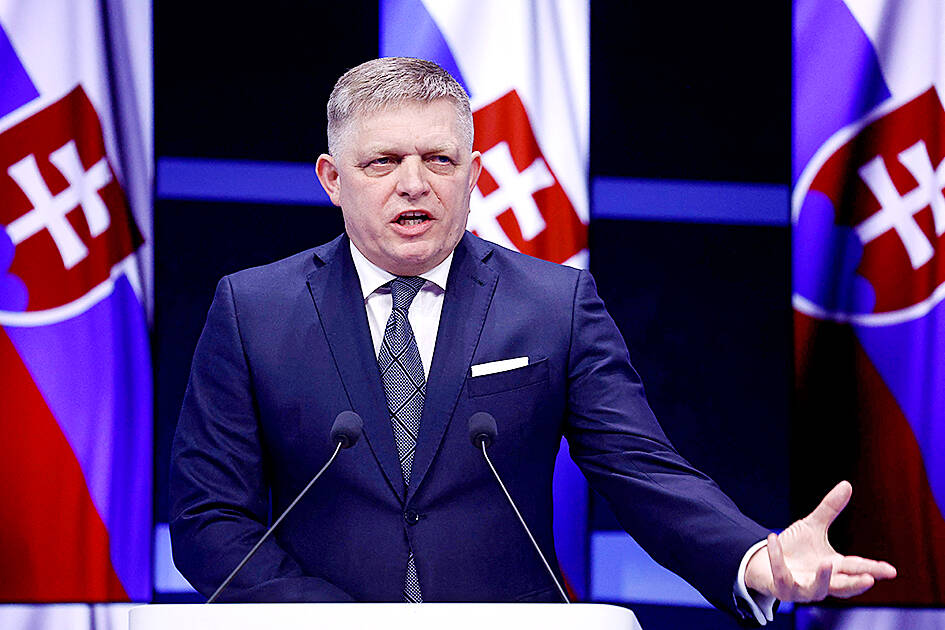
Photo: AFP
A left-wing, but conservative and nationalist party, Smer-SD is strongly pro-Russian and anti-Western, according to Jakub Filo, deputy editor-in-chief of the Slovak newspaper SME. The party’s chairman and the current prime minister, Robert Fico, says Filo, is “a combination of the prime minister of Hungary, Viktor Orban, [former US President] Donald Trump and Recep Erdogan, the Turkish president,” three leaders usually referred to as populists with links to authoritarian regimes.
Fico’s name has recently appeared on the banners of thousands of demonstrators who are taking to the streets to protest his government’s plan to change the structure of public service broadcasting, which could limit media freedom and free speech.
“Fico is a man who pursues an autocratic and non-liberal style of politics, whose aim is to control all aspects of the state and power, with the aim of creating an oligarchic system,” says Filo.
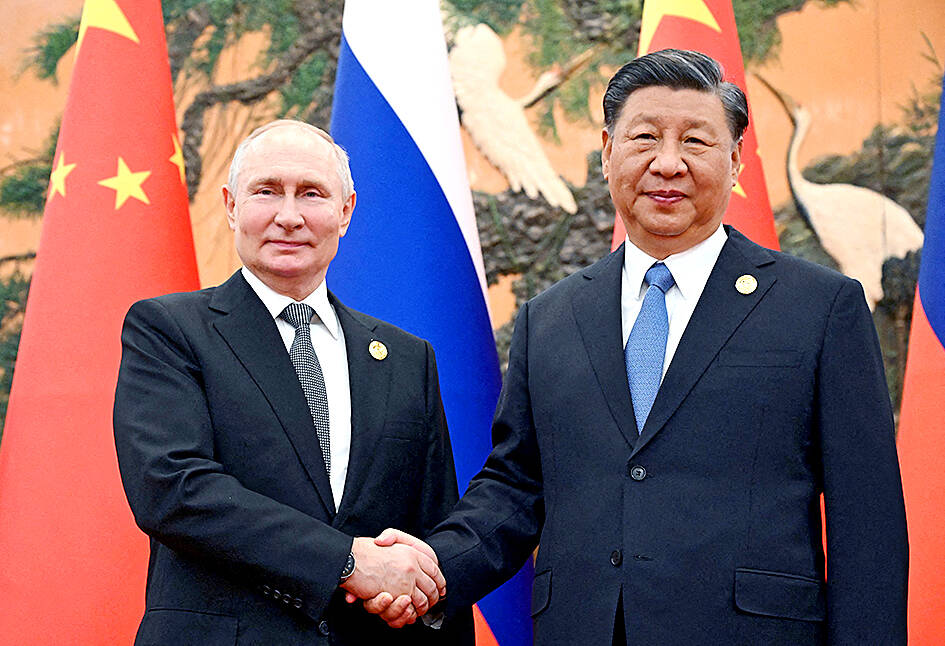
Photo: Reuters
OLD ALLIES
Some Slovaks worry that Fico’s dominance may increase even though he is not seeking the presidency, having failed in a previous bid in 2014, and though his party is not fielding any candidates in Saturday’s election.
However, with only three candidates from a field of 10 receiving more than 10 percent in recent public opinion polls, a Fico ally is one of two likely candidates to win the presidential vote. Once seen as Fico’s right hand, Peter Pellegrini gained his political experience in Smer-SD before departing in 2020 to found his own party, Hlas. With his political stance having remained fundamentally the same, Pellegrini last year joined Smer as part of the governing coalition. “He is once again an important ally of Fico,” a Slovakian journalist says.
Pellegrini’s main rival is Ivan Korcok, the independent candidate, who previously served as Slovakia’s foreign minister and has held diplomatic positions in Germany, Switzerland and the US. He is seen as a pro-Western candidate who will carry on the progressive legacy of the current president, Zuzana Caputova. After five years in the office, she cited personal reasons and the overall situation in politics as factors in her decision not to run again.
If none of the candidates receive more than 50 percent of the votes today, a second round with the two strongest candidates will follow on April 6. The inauguration of the new president of the country of 5.5 million will take place in June.
THE TAIWAN QUESTION
Aside from his inclination towards Russia, the Slovakian prime minister hasn’t hidden his admiration for Beijing over the years. Throughout his previous spells as prime minister and in government, since 2006, Fico has consistently rejected any criticism of China, downplaying the reports of human rights violations, sending his ministers on trips to China that were fully funded by Beijing and opposing a meeting by former president Andrej Kiska with the Dalai Lama in 2016.
“China deserves respect because it has achieved unprecedented economic results and is a stabilizing element in global security,” Fico wrote on his Facebook page in December. He has even announced plans to visit Beijing this spring to develop mutually beneficial economic relations.
This announcement came shortly after the government signed a deal with the Chinese company Gotion InoBat Batteries to build a gigafactory producing the batteries for electric vehicles in November. The first products should be leaving the factory, which will be built in the south of Slovakia, in 2026.
This raises the question of how Slovakia and Taiwan, two nations increasingly viewed as friends in recent years but without official diplomatic ties, will continue to build their relationship. “Slovak-Taiwanese relations have been quite intense until recently,” says Kristina Kironska, co-director at the Central Europe Institute of Asian Studies (CEIAS) and assistant professor at Palacky University Olomouc in the Czech Republic.
“Since the last parliamentary elections last September and the subsequent change of government in Slovakia, we haven’t noticed any new Slovakian-Taiwanese activities,” says Kironska, who is focusing on Taiwan, China and Myanmar in her research. “A cooling of relations with the arrival of a new government was to be expected. However, this does not mean that previous agreements or cooperation will be abrogated. These will remain, but no new ones are likely to emerge,” argues Kironska.
The results of today’s presidential elections may show if the pro-China direction under Fico will continue at the current pace or, in the case of a Korcok victory, whether the new president can balance the country’s position. Still, as the government wields greater power in Slovakia than the presidency, Korcok would face an uphill battle in building on the goodwill that has blossomed between Bratislava and Taipei. With the authoritarian tendencies that Fico has shown, the task could prove overwhelming.

As mega K-pop group BTS returns to the stage after a hiatus of more than three years, one major market is conspicuously missing from its 12-month world tour: China. The omission of one of the group’s biggest fan bases comes as no surprise. In fact, just the opposite would have been huge news. China has blocked most South Korean entertainment since 2016 under an unofficial ban that also restricts movies and the country’s popular TV dramas. For some Chinese, that means flying to Seoul to see their favorite groups perform — as many were expected to do for three shows opening
A recent report from the Environmental Management Administration of the Ministry of Environment highlights a perennial problem: illegal dumping of construction waste. In Taoyuan’s Yangmei District (楊梅) and Hsinchu’s Longtan District (龍潭) criminals leased 10,000 square meters of farmland, saying they were going to engage in horticulture. They then accepted between 40,000 and 50,000 cubic meters of construction waste from sites in northern Taiwan, charging less than the going rate for disposal, and dumped the waste concrete, tile, metal and glass onto the leased land. Taoyuan District prosecutors charged 33 individuals from seven companies with numerous violations of the law. This
Taiwan’s semiconductor industry consumes electricity at rates that would strain most national grids. Taiwan Semiconductor Manufacturing Co (TSMC) alone accounted for more than 9 percent, or 2,590 megawatts (MW), of the nation’s power demand last year. The factories that produce chips for the world’s phones and servers run around the clock. They cannot tolerate blackouts. Yet Taiwan imports 97 percent of its energy, with liquefied natural gas reserves measured in days. Underground, Taiwan has options. Studies from National Taiwan University estimate recoverable geothermal resources at more than 33,000 MW. Current installed capacity stands below 10 MW. OBSTACLES Despite Taiwan’s significant geothermal potential, the
Chinese Nationalist Party (KMT) Chair Cheng Li-wun (鄭麗文) returned from her trip to meet People’s Republic of China (PRC) dictator Xi Jinping (習近平) bearing “a gift” for the people of Taiwan: 10 measures the PRC proposed to “facilitate the peaceful development of cross-strait relations.” “China on Sunday unveiled 10 new incentive measures for Taiwan,” wrote Reuters, wrongly. The PRC’s longstanding habit with Taiwan relations is to repackage already extant or once-existing policies and declare that they are “new.” The list forwarded by Cheng reflects that practice. NEW MEASURES? Note the first item: establishing regular communication mechanisms between the Chinese Communist Party


 RSS
RSS