


“The bicycle,” writes Jody Rosen in Two Wheels Good: The History and Mystery of the Bicycle, “is a machine of improbable simplicity, elegance and ingenuity: two wheels of equal size, two tires, a diamond-shaped frame, a rear chain drive, a pair of pedals, handlebars, a seat…” This “classic form” emerged in the 1890s and led to the fin de siecle bicycle boom that preceded the automotive age.
Rosen is correct in observing the bicycle’s essential form has remained “unchanged” in over a century. A brief stroll around the halls and stalls of this year’s Taipei Cycle, however, suggests everything else about the humble two-wheeler is being transformed by high-technology and ecological imperatives.
“These bikes are from Germany,” says a sales representative, noticing me eyeing a chucky orange-colored bike — called igus — and made entirely of plastic, adding that they “are made from 90 percent recycled materials.”
Photos: Thomas Bird, Taipei Times
FUTURISTIC MACHINES
Indeed, what’s striking about the bicycles on display of the fourth floor of TaiNEX 2 (台北南港展覽館) — one of four areas hosting this year’s industry trade show — is just how futuristic these two-hundred year old machines now look: Electric-scooters; hybrid e-mountain bikes; fold-up e-bikes; e-trikes; thick-tire fat bikes and ultra-light urban scooters enhanced by inbuilt LED lights and cyclocomputers capable of mapping and measuring all aspects of a journey.
It would seem that the contemporary bicycle boom, expedited by a growing ecological consciousness and pandemic-induced lockdowns, is driving the kind of innovation that transformed diesel locomotives into bullet trains at the latter half of the last century.
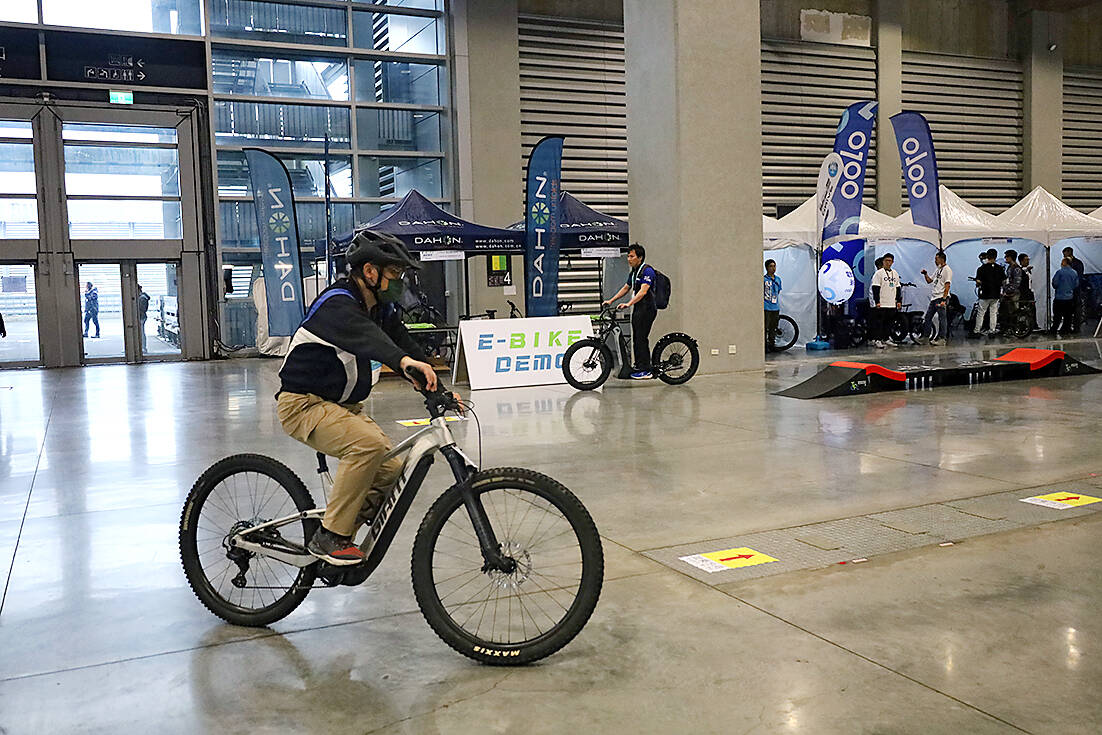
Photo: Thomas Bird, Taipei Times
Taiwan is well-positioned to benefit from a global market analysts predict will be worth US$80 billion by 2027. After all, two of its core industries, bicycle component manufacture and battery production, are now converging in contemporary bicycle designs.
New domestic brand OOLO, which produces three-wheel electric scooters (the three Os represent the wheels, the L for the rider) is exemplary of this trend.
“OOLO evolved from our experience designing and manufacturing lithium-ion batteries,” says Jones Ho (何宥甫), director of New Taipei City-based C-Tech United Corp. “Our overseas clients kept asking for batteries for scooters and e-bikes, even cars. There are a lot of polices and incentives in Europe and the US to develop electric transportation, so we thought we’d join the field.”
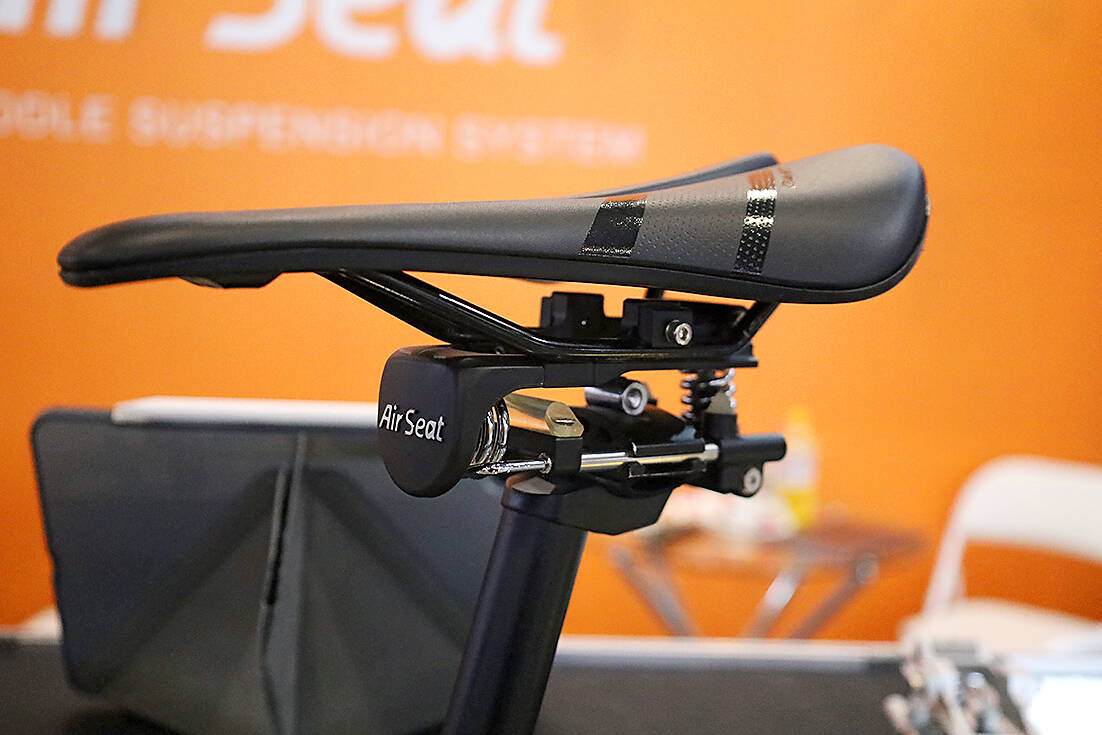
Photo: Thomas Bird, Taipei Times
I’m given a test run of one of OOLO’s scooters, zipping seamlessly and soundlessly across a track on three wheels.
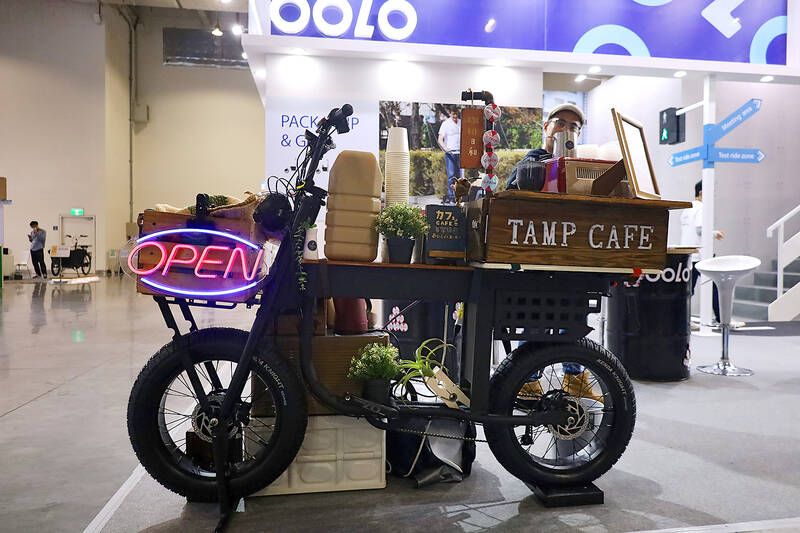
With its “TwinSync” suspension system and cargo space, the company is targeting small business owners like trades people, couriers and food stall operators. To illustrate this point, their OLOCRUISER model has been repurposed as a pop-up coffee shop.
“The 300W converter can power lighting, a payment terminal or music,” Ho explains of the e-bike’s potential to be the engine of a mobile enterprise.
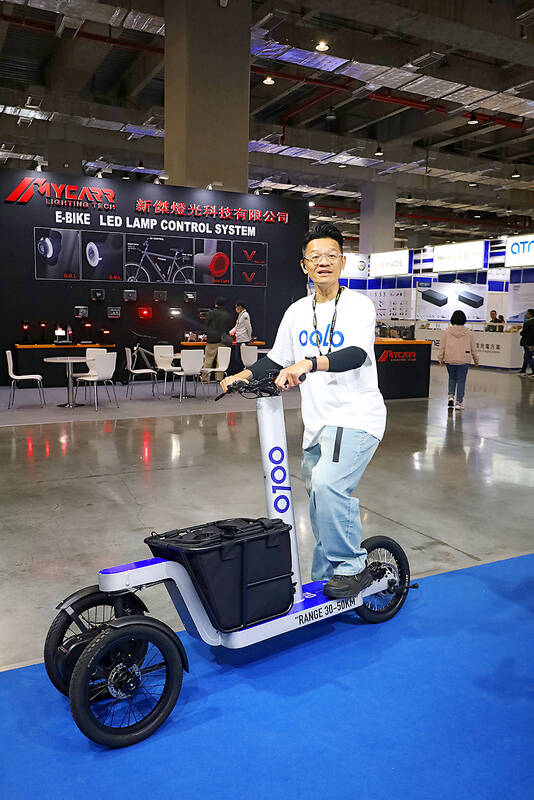
Photo: Thomas Bird, Taipei Times
Another domestic-brand taking something old and making it new is Tainan-based bicycle saddle manufacturer Li Yi Da.
“Do you cycle?” asks company CEO Peter Hsu (徐文紹).
“Yes.”
“And how do you feel after a long ride?” he asks.
“A little sore,” I admit.
“That’s because most saddles are hard, and at best, only have springs at the back.”
He then shows me his ingenious Air Seat, a bicycle saddle with both horizontal and vertically aligned springs that the company is calling “a full floating saddle suspension system.”
“It can be tailored to meet your expectations, configured to your weight and cycling preferences,” I’m told.
But feeling is believing so Hsu gives me a free run around on the e-bike demo track to test just how comfortably my backside melds with his super-comfortable seat.
Another company selling a simple but no-less-brilliant product is Korean helmet manufacturer Analogue Plus who are in town looking for a partner to help launch their “crnk” bicycle helmets in Taiwan. The product’s genius is, perhaps, only evident to anyone who has pinned an LED to their helmet only to find it fell off or stopped flashing somewhere down the road.
“The trick was to develop a helmet that was no heavier at the rear with a light inside it,” says branch manager Richard Pei, showing me how light the hard hat feels.
FASHION AND ACCESSORIES
While much of the trade shows focuses on bikes and components (from frames to gears and spokes) it’s not all about the hardware. Taipei-based KPLUS has a pavilion showcasing fashionable accessories ranging from helmets to socks, illustrating in no uncertain terms that cycling needn’t be the exclusive domain of the unstylish Sunday hobbyist.
More practical products are being showcased too, like Taichung-based TSAYARN, which produces bicycle baskets in all shapes and sizes, using materials as diverse as steel, willow and rattan.
Predictably, if somewhat regrettably, much of what is on display is meant exclusively for overseas buyers. The traffic, however, is not all one way. Taipei-based Thermaltake Technology began life in the computer game industry but ventured into the bicycle business in 2021. With two high-end stores in Neihu District (內湖), the company is less about sponsoring made-in-Taiwan velos than it is focused on bringing a taste of occidental cycling culture to Formosa, selling brands like Brooks England, a classic bike saddle manufacturer, and Wilier, an 110-year-old Italian bicycle maker. They’re even hosting a fashion show at Taipei Cycle, with catwalk models sporting European cycling apparel.
Thermaltake’s Genie Zhong (鐘苡菁) says that they sell classic Brompton fold-up bikes at their shop. “And we organize group rides for enthusiasts around town.”
ON THE ROAD
Meanwhile, Japan is currently experiencing a tourism boom with 25 million visitors touching down last year. This is not without accident as Tokyo has invested heavily in courting tourist dollars over recent decades.
Illustrative of Japan’s outreach at Taipei Cycle, representatives from various regional tourism divisions are on hand to distribute complimentary green tea bags, postcards and, significantly, bicycle maps to anyone planning a cycling holiday there.
Isao Hamamura of Fuji City guides me through a cycling wall map. “We have great bike routes in our region that are in view of Mount Fuji plus an amazing coastline where you’ll find some fantastic seafood like eels.”
Hopefully, other countries will follow Japan’s lead in promoting places as well as products, including Taiwan. Although little noise was made at Taipei Cycle, the Ministry of Transportation and Communications announced last month it will spend a whopping NT$5.77 billion (US$184 million) over three years to build bicycle paths nationwide. Despite such investment however, a made-for-export mindset remains pervasive in the domestic cycling industry. Only time will tell if this year’s official catchline “Envision a Better Cycling World” will be fully realized at home.

Taiwan’s English education system is being pulled apart by three opposing forces. Bilingual Nation 2030 pulls students toward English and global communication. Artificial Intelligence (AI) readiness pulls them toward digital judgment, verification and AI-mediated work. But Taiwan’s old exam culture pulls them back toward memorization, grammar drills, timed reading and correct answers. If the education system keeps using old exams to define success, it risks producing graduates who are neither genuinely bilingual nor genuinely AI-ready, but trained for tasks machines can already perform. The first force is Bilingual Nation 2030. Launched in 2018, the policy aimed to “help Taiwan’s workforce connect
It seems every few days one bumps into one of those “real man” comments in which Taiwan is urged to “face reality” or similar, and “make a deal,” with the speaker implying that soon it will be too late. “Deal” advocates always present themselves as having a superior grip on reality, and the manly ability to make the “hard choice.” Their testosterone-laden language often echoes that of Taiwan sellout advocates. Note that such commentary always specifies a process (“make a deal, work with, make progress”), never the end state of what occupation by a violent authoritarian colonialist state will entail. In

There are shadowy cabals plotting to sell out Taiwan to be annexed by China, by invasion if necessary. Fortunately, they are buffoons. In 2019, former Bamboo Union gangster and founder of the China Unification Promotion Party (CUPP), Chang An-le (張安樂, colorfully known as “White Wolf”), led a protest at the Legislative Yuan against comments made by then-premier Su Tseng-chang (蘇貞昌) that in the event of an attack by China, he would never surrender, but would protect the nation by fighting to the end, even if he only had a broom. Chang had party members bring a wooden casket that they
June 1 to June 7 "If all Taiwanese were as afraid of dying as you, then what would happen?” Physician Shih Chiang-nan (施江南) reportedly said this to his wife Chen Chiao-tung (陳焦桐) after she urged him to stop intervening on behalf of Taiwanese soldiers stranded overseas after serving in the Japanese Army during World War II. Shih had clashed with high-ranking officials over the issue, engaged in several heated arguments with Taiwan governor-general Chen Yi (陳儀) and allegedly shouted at general Ko Yuan-fen (柯遠芬), chief of staff of the Taiwan Garrison Command, over


 RSS
RSS