


It reads like a complex K-drama plot. South Korea’s first lady is secretly filmed as she’s presented with a lavish gift from a pastor who advocates for unification with North Korea. But this is no scripted narrative, rather a real political crisis that has plunged South Korea’s conservative government into disarray.
With elections for the country’s national assembly less than three months away, South Korean media is awash with accusations and recriminations — all of which stem from the alleged gift of a Dior handbag more than a year ago.
The turmoil began with a meeting between Korean-American pastor Choi Jae-young and Kim Keon Hee, the wife of president Yoon Suk Yeol.
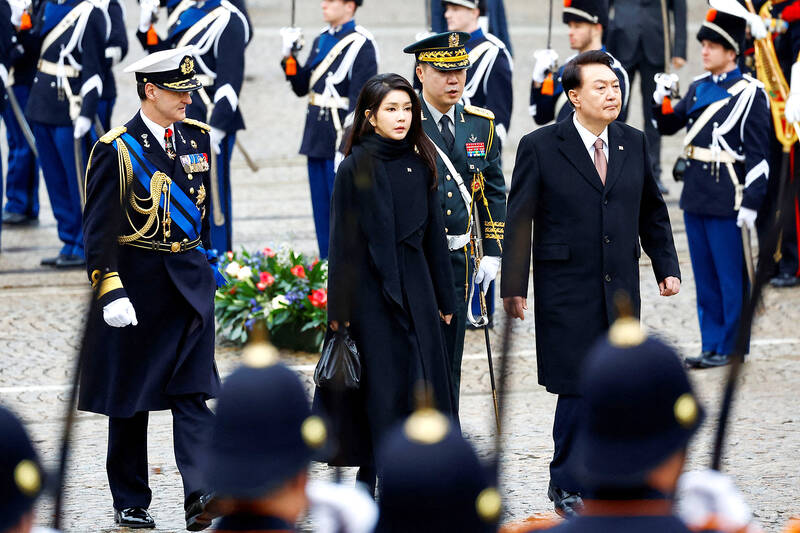
Photo: Reuters
Choi has a history of engagement with the North and has visited the communist country several times to conduct prayers at Pyongyang’s handful of state-operated churches.
He says he was motivated by a desire to “share advice” on matters related to unification with the current administration, and so approached first lady Kim, cultivating a relationship with her which culminated in a one-on-one meeting in 2022, just months after her husband became president.
ABUSE OF POWER?
During this meeting, Choi claims that he overheard Kim engaged in a phone conversation which touched upon sensitive state affairs. Alarmed by the nature of the alleged discussion, he decided to secretly record their next meeting, employing a spy camera concealed within a wristwatch.
Accusations of abuse of power are no laughing matter in South Korea: the former conservative president, Park Geun-hye, was impeached and imprisoned for corruption, before being pardoned by her successor.
It was during the course of Choi’s second meeting with Kim that he purportedly presented her with a Dior bag valued at 3 million won (US$2,240). Both the bag and the concealed camera were provided by the left-leaning news site Voice of Seoul, which is known for its staunch opposition to the Yoon government.
Voice of Seoul released the video at the end of November. In it, the first lady is seen in discussion with Choi who tells Kim that he’s brought a present, to which she replies “Why do you keep purchasing such items? Please don’t buy such expensive things.”
Although the transfer of the Dior bag to Kim is not apparent, it continues to be placed on the table in her presence.
Speaking to foreign media, Choi said he was purely driven by the public’s right to know about alleged corruption. He claims that he messaged Kim in advance, notifying her that he was bringing the bag and that there were no attempts to refuse it or return it later.
The potential legal repercussions are ambiguous: anti-graft laws prohibit a public official’s spouse from receiving gifts worth more than 1 million won (US$748) in one sitting, but this must be “in connection with the duties of the public official.”
At the same time, Choi himself is facing criticism from supporters of the president who say the ploy is an attempt to influence the election.
The Guardian could not independently verify the video or Choi’s claims, however the anti-corruption agency said it was investigating the case. To date, there has been no official statement from the presidential office.
CONTROVERSIAL FIRST LADY
Kim Keon Hee is no stranger to controversy, having weathered a series of allegations, including plagiarism concerning her academic writings, resume-padding and accusations of stock manipulation.
The controversies have proven a headache and a source of embarrassment for her husband. Earlier in January, Yoon vetoed a bill that would have authorized a special investigation into his wife’s alleged involvement in stock manipulation.
With South Korea’s general election scheduled for April 10, both major political parties are going all out to secure support. Neither party enjoys significant public favor, and both sides are grappling with their own internal power struggles. It’s within this context that the emerging handbag scandal could not have come at a worse time for the country’s deeply unpopular president.
In a poll released by a local news channel, 69 percent of respondents said Yoon needs to explain his position regarding the controversy around the first lady. Another poll in December showed 53 percent of respondents believe Kim acted inappropriately, while 27 percent said she was caught in a trap set up to embarrass her.
“It is a political bombshell,” said Rhee Jong-hoon, a political analyst. “The Kim Keon Hee risks are only going to get bigger.”
Loyalists of the president have dismissed the bag scandal as a smear campaign. But some members of his ruling People Power party have advocated for an apology and the party’s interim leader, Han Dong-hoon, has acknowledged that the controversy might be “a matter of public concern.”
Last week Han — who until recently served as justice minister and was widely regarded as Yoon’s closest aide — stated that while the Dior bag scandal was a “planned set-up using a spy camera … there were several misdeeds in handling the issues.”
Tension between Yoon’s office and his party threatened to boil over last week when a senior member likened the situation to the notoriety of Marie Antoinette, the French Queen known for her profligacy.
With apparent disagreement on how to handle the problem at the top of the ruling party, the internal disarray came to a head on Sunday, when senior members of Yoon’s office met with Han and suggested he resign. Han refused.
The unfolding drama is not going down well with major conservative media who are typically sympathetic to the president, with the upheaval being described as a potential “risk” for the ruling party in the run-up to the elections.
“As long as it is true that first lady Kim received a luxury bag, she cannot escape the criticism of the people. If President Yoon had apologized from the beginning … things would not have escalated to this extent,” the influential Chosun Ilbo said in an editorial on Tuesday.
“He didn’t, and the problem has now reached the worst possible situation.”

Taiwan’s English education system is being pulled apart by three opposing forces. Bilingual Nation 2030 pulls students toward English and global communication. Artificial Intelligence (AI) readiness pulls them toward digital judgment, verification and AI-mediated work. But Taiwan’s old exam culture pulls them back toward memorization, grammar drills, timed reading and correct answers. If the education system keeps using old exams to define success, it risks producing graduates who are neither genuinely bilingual nor genuinely AI-ready, but trained for tasks machines can already perform. The first force is Bilingual Nation 2030. Launched in 2018, the policy aimed to “help Taiwan’s workforce connect
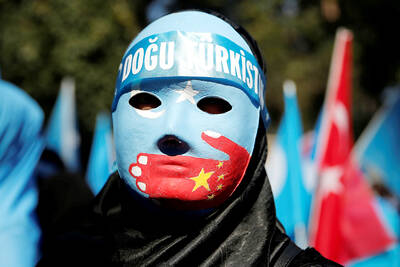
It seems every few days one bumps into one of those “real man” comments in which Taiwan is urged to “face reality” or similar, and “make a deal,” with the speaker implying that soon it will be too late. “Deal” advocates always present themselves as having a superior grip on reality, and the manly ability to make the “hard choice.” Their testosterone-laden language often echoes that of Taiwan sellout advocates. Note that such commentary always specifies a process (“make a deal, work with, make progress”), never the end state of what occupation by a violent authoritarian colonialist state will entail. In

“Taiwan’s Opposition Leader Comes to US With a Message Straight Out of Beijing” read a May 31 headline in the Wall Street Journal. Top US administration officials and members of Congress almost certainly read the WSJ, and if there was a bullet point takeaway that people in Washington should absorb ahead of Chinese Nationalist Party (KMT) Chair Cheng Li-wun’s (鄭麗文) arrival in DC on June 9, that headline is it. The last few columns have discussed this very topic, and the timing is not coincidental. While those top officials likely do not read the Taipei Times, judging by the number
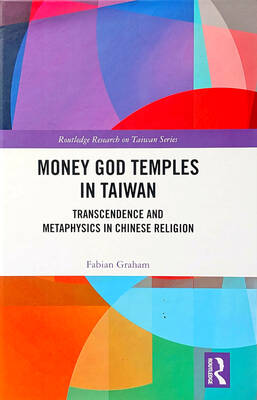
As someone who normally steers clear of books with “transcendence” or “metaphysics” in their subtitles, this reviewer — a casual observer of local belief systems since the 1990s — found Fabian Graham’s Money God Temples in Taiwan a challenging read. Those who’ve only dipped their toes into temple culture will likely need to parse several sections with special care if they’re to keep up with the author, a British ethnographic researcher whose previous books have investigated religious practices among ethnic Chinese in Southeast Asia. This scholarly volume examines a facet of Taiwan’s religious landscape that didn’t exist a century ago, and


 RSS
RSS