

Nanu, who in Han society goes by the name Lin Chen Mei-shan (林陳美珊), is a lively character. That much I could tell within a few minutes of meeting her halfway up a small mountain in Taitung County.
Of mixed Paiwan and Pinuyumayan indigenous descent, Nanu styles herself “the Wild Vegetable Queen” (野菜皇后, wildveggiequeen.com). Welcoming us in English that was strongly accented and unrestrained by the conventions of grammar, yet up to the task and endearingly confident, she offered us gumboots, which in the end weren’t needed.
Then she told us that, before we could go any further, a Paiwan elder would conduct a short rite to ensure our safety — and that sneezing while in the mountains is taboo.
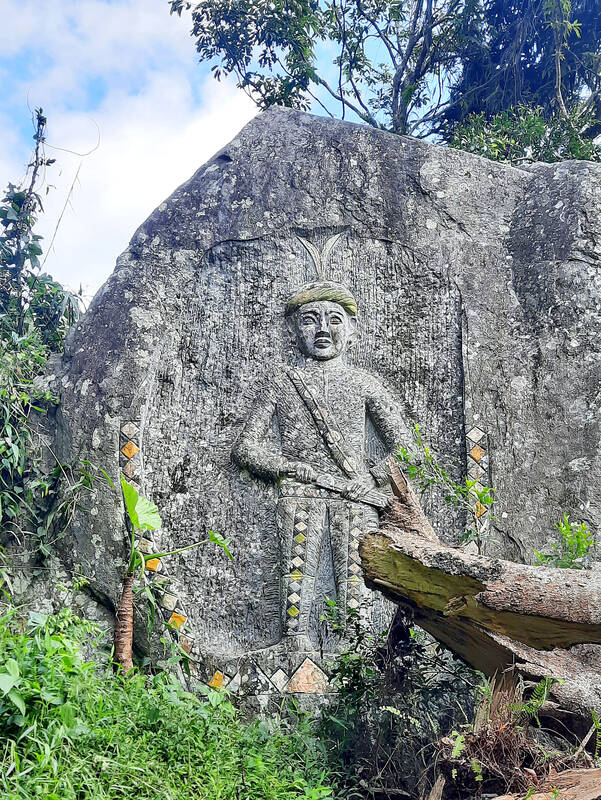
Photo: Steven Crook
First, he placed an offering of betel nuts, cigarettes and millet wine at the base of a boulder incised with the name of the place we’d be heading toward, but not actually reaching. Then the man quickly performed the necessary formalities, stating the size of our party and our purpose to any supernatural beings who might be listening.
Tribal shtick to entertain outsiders or a sincere attempt to communicate with the spirit world? It wouldn’t surprise me if, in the 21st century, Taiwan’s indigenous people are like many of their Han compatriots: Far from obsessive when it comes to religious customs or taboos, but inclined to err on the side of caution. Whether that’s the case or not, I’m all for including such traditions when it comes to designing experiences for tourists.
According to one bilingual signpost, the trail that ends at Balang Archaeological Site (巴蘭遺址, “Palan Site” on some signs) is 1,143 meters in length. Nanu, who was assisted on the day of our visit by the equally upbeat Jessica Hsieh (謝京潁), told us that we’d be going about halfway to the site.
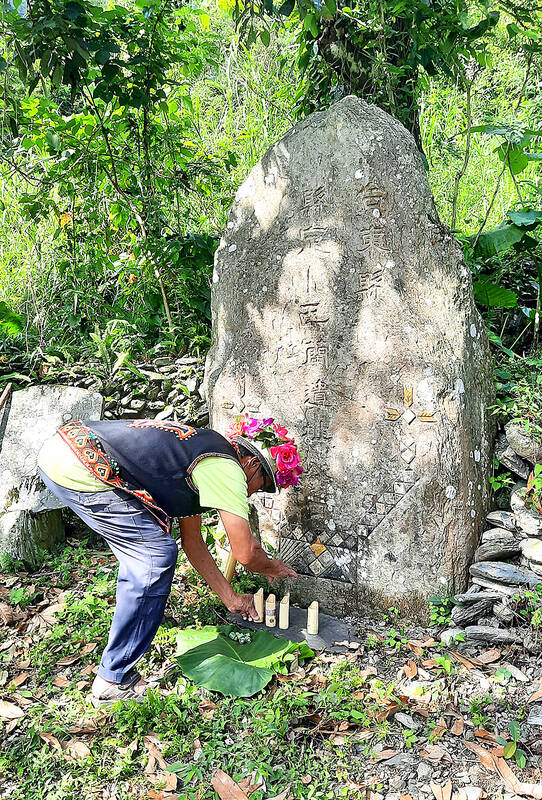
Photo: Steven Crook
Our session with the Wild Vegetable Queen came near the end of a three-day trip to Taitung. Each of the stops introduced us to a tourism business that has benefited from the Cross-Generational Bilingual Training Program, a government-sponsored project that aims to make the southeastern county more accessible to travelers who don’t speak Mandarin.
Soon enough, Nanu called us to a halt, and pointed out a plant that’s known to scientists as Dendrocnide meyeniana, and to English speakers as poisonous wood nettle. It gets its unforgettable Chinese name — yaorengou (咬人狗), literally “biting-people dog” — because of the seriousness of its sting. Hikers unlucky enough to brush its leaves often suffer days of soreness.
It looks quite different from (and less “nettly” than) the more-common Urtica thunbergiana (aka: yaorenmao, 咬人貓, “biting-people cat”), which some Westerners know as the Japanese nettle or hairy nettle.
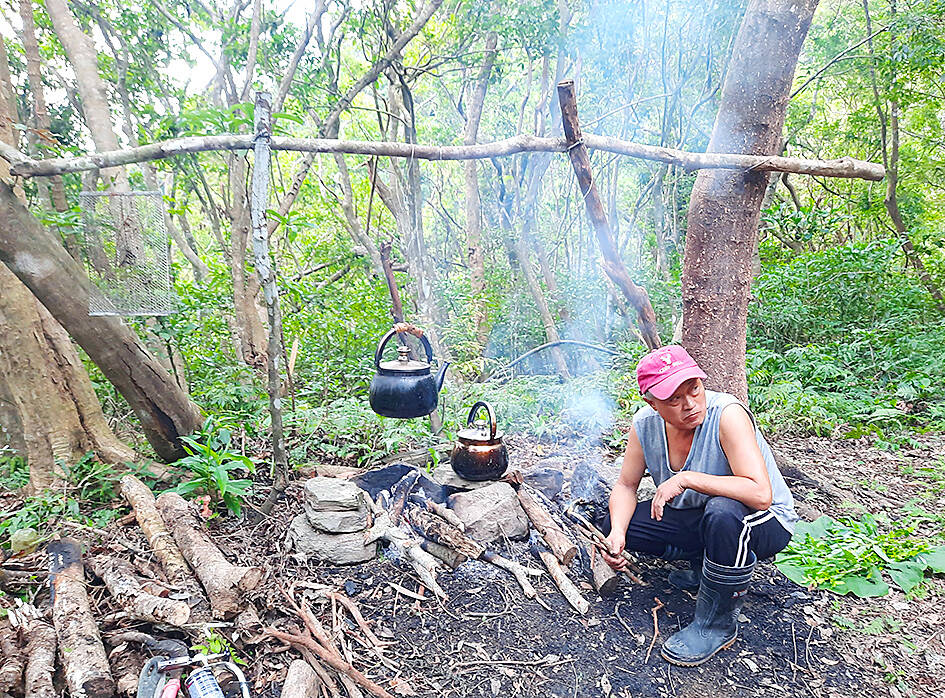
Photo: Steven Crook
Fortunately, the forest contains a natural treatment that can help Dendrocnide meyeniana victims. Snapping a Giant Elephant’s Ear (Alocasia odora) stem and rubbing the sap on the rash can bring some relief, Nanu informed us. I was keen to hear everything she had to say, but more than once I was distracted by the sight of a gorgeous butterfly. If you’re a Lepidoptera fan, you might want to come to this verdant corner of Taiwan just to see the butterflies.
The trail is fairly steep, and after a while we could see a tiny patch of the Pacific, about 14 kilometers southwest of us as the crow flies. Passing a relief image of a tribesman carved onto a man-sized boulder, Nanu explained that it’s a recent work, and that the two eagle’s feathers in the man’s headdress signify that he’s been recognized as an effective hunter.
Another plant with medicinal functions found hereabouts is Apple-of-Peru (Nicandra physalodes). Nanu said that boiling its leaves makes a liquid that can soothe a sore throat. According to online sources, the plant can also be used as a sedative and to reduce coughing. Its fruit can reduce inflammation and flatulence, while the seeds have a diuretic effect.
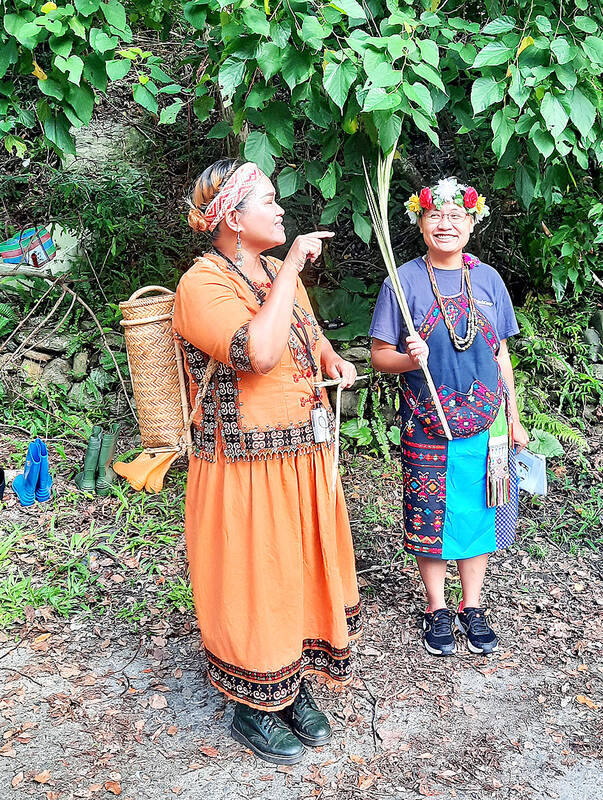
Photo: Steven Crook
The English-language leaflet we were given at the start of the walk mentions several other wild plants or trees for which indigenous people have discovered culinary, medicinal or other uses. Among them are myrtle, mulberry and rattan.
For generations, Taiwan’s indigenous people have been turning rattan vines into hats and baskets. The handmade balls which play a central role in the Paiwan tribe’s Five-Year Ceremony (see “A quinquennial spectacle: The Paiwan Malijeveq Festival” in the Nov. 3, 2023 issue of this newspaper) are also made of rattan. The Amis people eat tender rattan shoots.
In no time at all, we were at a clearing where a campfire smoldered and benches provided an opportunity to take the weight off our feet. After serving coffee and a wild-plant tea, Nanu and her friends demonstrated a herbal compress made from locally-gathered botanicals, and presented us with gifts of soap made from some of the same ingredients.
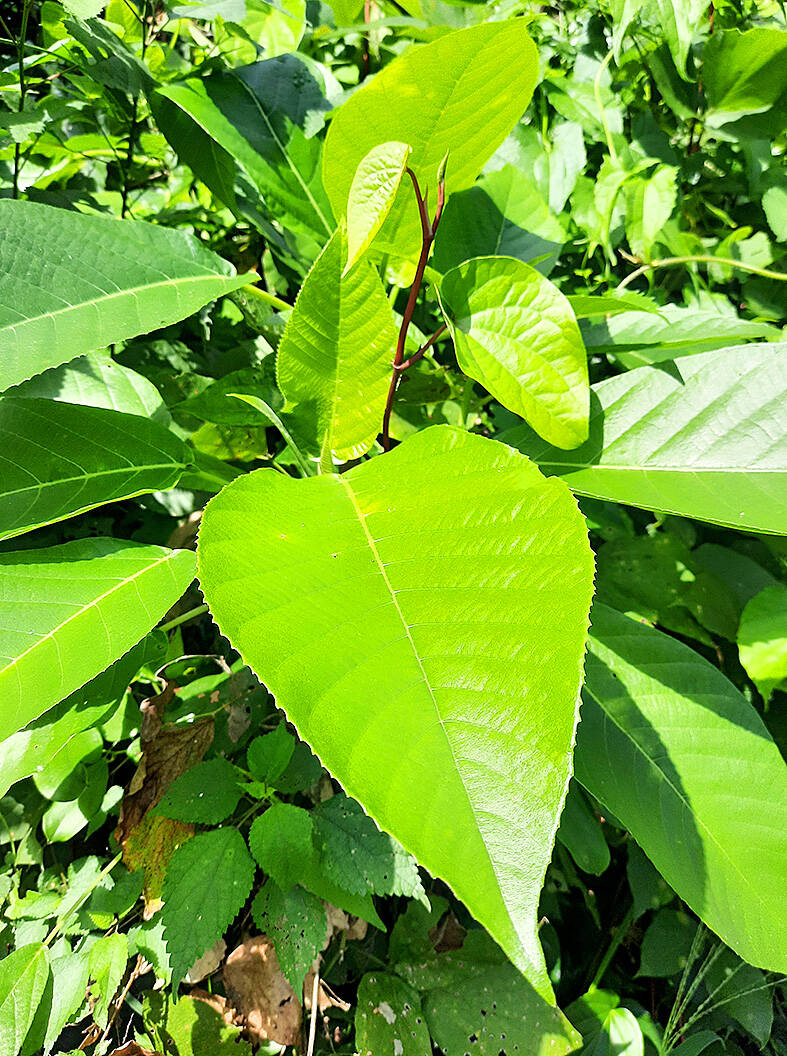
Photo: Steven Crook
It was a delightful spot to relax, and surprisingly free of mosquitoes. But as far as bloodsuckers go, in summertime it’s a very different story, Nanu assured me.
When I’m next in East Taiwan, hopefully I’ll be able to hike all the way to Balang Archaeological Site, 625m above sea level and just over three kilometers due west of Chulu Junior High School (初鹿國中) and Provincial Highway 9.
The site was rediscovered by archaeologists in 1996 after a Pinuyumayan church elder named Tseng Chien-tzu (曾建次) recognized artifacts being sold in a Taitung night market. He made enquiries, and eventually discovered they’d been pilfered from this location. Some years later, an official excavation identified parts of seven houses and more than a dozen tombs.
Judging by images recently posted online, some of these remnants are still clearly visible, and the view while walking up looks enticing. I reckon I could happily spend a morning getting to and looking around the site. But even if the idea of foraging for my lunch sounds like fun, I think I’ll just carry the usual convenience-store snacks.

A decade ago, Taiwanese television had an image problem. When representatives of Taiwan’s Public Television Service (PTS) traveled to Singapore to meet Netflix, they brought two dramas: A Touch of Green (一把青, 2015), a sweeping story of war, displacement and military families, and Wake Up (麻醉風暴, 2015), a tightly constructed medical thriller. They were not simply trying to sell programs. They were trying to change an idea of Taiwan. International perceptions of Taiwanese television, PTS executives recalled in interviews conducted for my joint research with Chairman Hu Yuan-hui (胡元輝), were still strongly associated with the idol dramas that had enjoyed enormous regional popularity

No matter where one sits on the political spectrum and who one blames for the ongoing struggles between the executive and legislative branches or the latest food scandal, there has been noticeable frustration with the way democratic institutions are functioning. Attempts to circumvent political opposition and institutional checks can begin a slide toward authoritarianism, even when presented as short-term solutions to gridlock. While that might solve problems in the short term, it inevitably evolves into a system that serves the rulers and the powerfully connected at the expense of the rights of regular folks. One interesting lens to examine the

Another doleful set of demographic announcements this month from the National Development Council (NDC), with the number of young people shriveling as the proportion of old people grows. “Taiwan’s 18-year-olds, the typical age for entering college, will fall below 200,000 for the first time in the 2027 academic year to 195,309, down from 200,406 in 2026,” this paper reported citing NDC sources. Meanwhile, the administration of President William Lai (賴清德) announced a goal of training at least 500,000 AI professionals by 2040. Although this could include foreign recruits and retraining those already in the workforce, the math is stark: Ministry of

The Chinese Nationalist Party (KMT)-controlled legislature in February 2006 established the National Communications Commission (NCC). One of the purposes of the NCC was to circumvent the control of the Government Information Office (GIO), long the KMT’s tool for overseeing the local media, by the administration of Democratic Progressive Party (DPP) president Chen Shui-bian (陳水扁). The NCC’s commissioners were originally apportioned according to the ratio of party control of the legislature. However, the Council of Grand Justices later ruled that agencies required greater coordination with the Executive Yuan, which then began sending a list of expert nominees for approval by the


 RSS
RSS