


The Taipei Biennial has served as Taiwan’s major portal to the global art world and most important exhibition of contemporary art since its first international edition in 1998. Through most of its first two decades, the exhibition has been helmed by star curators, mostly from Western Europe, who attempted to use the exhibition for their own grand philosophical statements about the newest and most crucial framings of the human predicament as reflected in contemporary art. Often, however, these globalist curators failed to understand what the world looked like from a Taiwanese perspective.
Now, for this edition of the Taipei Biennial, which opened at the Taipei Fine Arts Museum (TFAM) on Saturday and runs to March 24, the biennial feels both comfortable with its internationalism and also like it is finding its own voice. It is still plagued by the foibles of contemporary art –– an obsession with theory, artworks that rely on explanation rather than emotional or sensory experience, and general apathy towards notions of beauty –– but at least now it feels more like Taiwan’s own version of this elitist, intellectual enterprise.
NEW DIRECTION
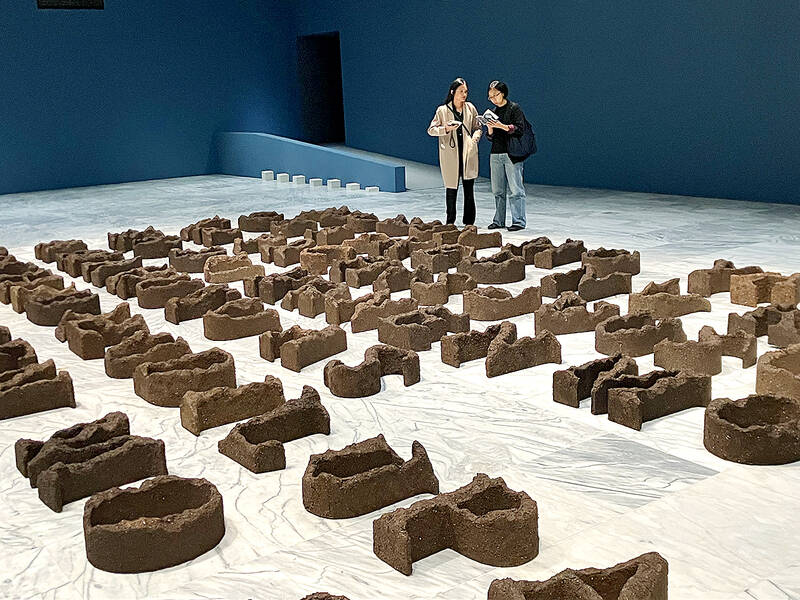
Photo: David Frazier
Last weekend’s opening attracted hundreds of culturati from Taiwan and around the world. Notably perhaps, for the first time ever the afterparty was held in the museum, with hundreds drinking and dancing in a B1 courtyard to the music of DJs Katrina and Sprinkles. (If you know anything about Taiwanese bureaucracy, a public institution staying open past 10pm is a major sea change, and TFAM director Wang Jun-jieh (王俊傑) is to be credited.)
The exhibition fills three floors of TFAM’s galleries with work by 58 artists, and also includes cinema and music programs that will provide event-based programs for the entirety of the four-month exhibition period. Artworks include 11 new commissions, dozens of recent works and also a selection of archival works from the 1950s to the 1980s the curators believe still have value today.
Music programs will feature sets by experimental turntablists (Dec. 10 to 16), musical collaborations with Indonesian migrant laborers (Jan. 7 to 27), and three-day residencies for local non-mainstream musicians focusing on improvisation (Feb. 21 to March 17).
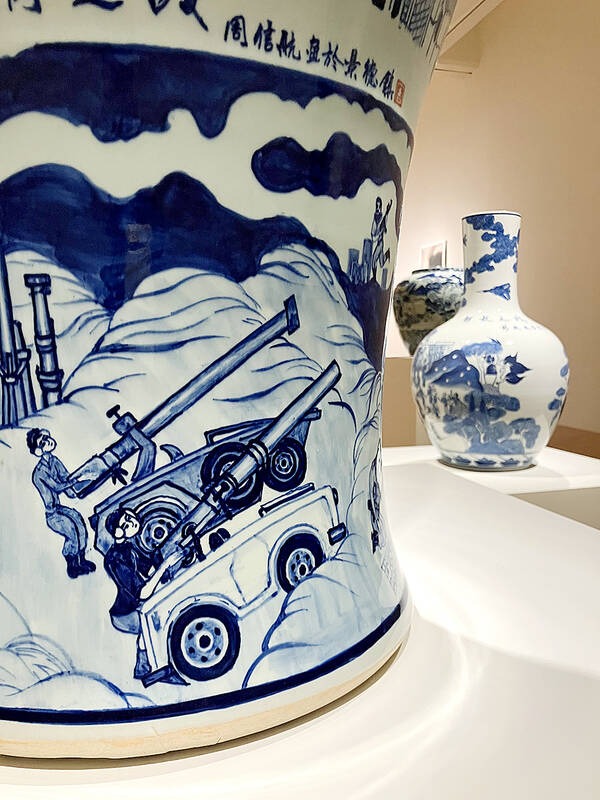
Photo: David Frazier
This Taipei Biennial is also the most Asia-focused to date, featuring at least 19 artists representing Taiwan, Hong Kong, China and overseas Chinese as well as major contingents from Southeast Asia and the Middle East.
At the same time, there are no real Western “art stars” –– and to be honest, it doesn’t feel like one is missing much by their absence.
The exhibition’s makeup is a result of the selection of curators, which steered away from Western European silverbacks and opted instead for a team of three relatively young curators: Taiwan’s Freya Chou (周安曼), who’s served as assistant curator at multiple Taipei Biennials since 2008, Brian Kuan Wood, US-based co-founder of the highly influential online journal of contemporary art, e-flux, and Reem Shadid, director of the Beirut Art Center.
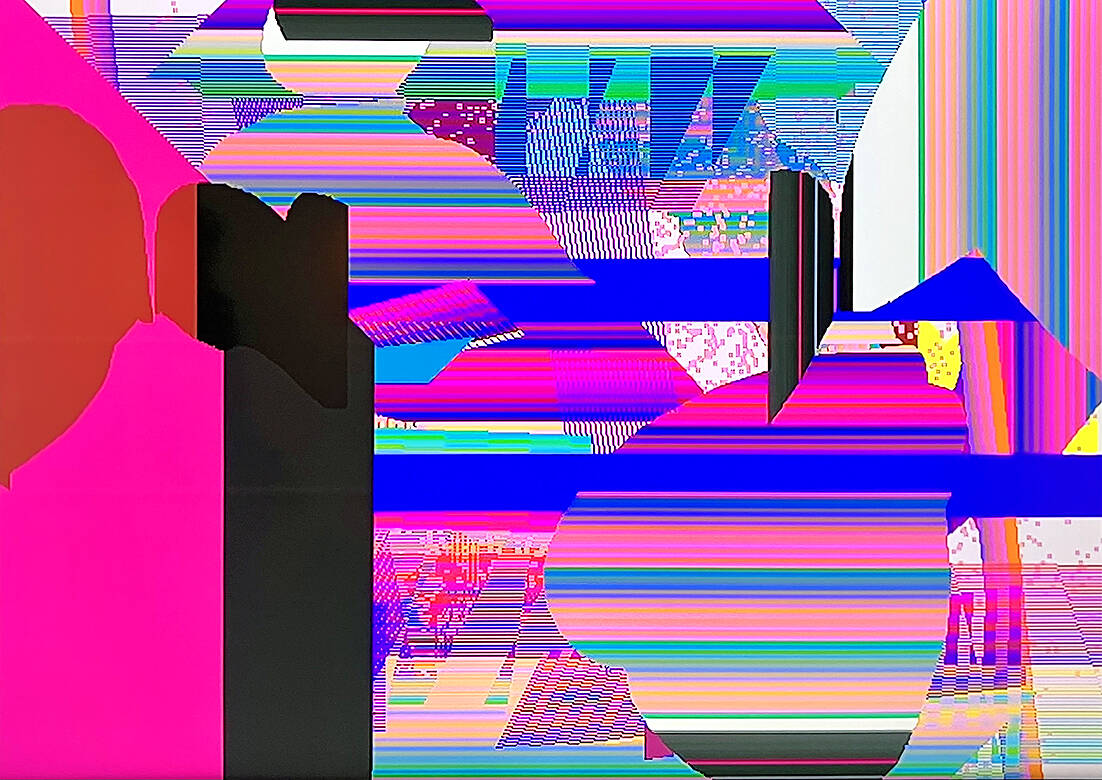
Photo: David Frazier
‘SMALL WORLD’
This exhibition theme chosen by this curatorial trio, “Small World,” is one for life in post-pandemic times and the age of social media.
“Small World,” the curators tell us in their exhibition statement, “suggests both a promise and a threat: a promise of greater control over one’s own life, and a threat of isolation from a larger community.”
Photo: David Frazier
It very much reacts to a world in which tech entrepreneurs promise us unlimited self-enablement, while at the same time human societies are encountering new epidemics of loneliness and mental health. Our “feelings of vulnerability and omnipotence,” the curator statement reads, have become “strangely interchangeable.”
The selection of artworks bundled under this guiding concept is often confoundingly eclectic. (At the opening, one long-time biennial observer commented, “It feels more like an art fair. The way the exhibition is designed, the works don’t really speak to each other.”) Often, the gallery design feels rather random.
Yet there are several threads that, even if they are woven loosely, nevertheless run through the exhibition. These include virtual realities and artificial intelligence, views of the world through the lenses of technology and science, dehumanization, neo-Marxist ideas of labor and exploitation and music as a source of social strategies.
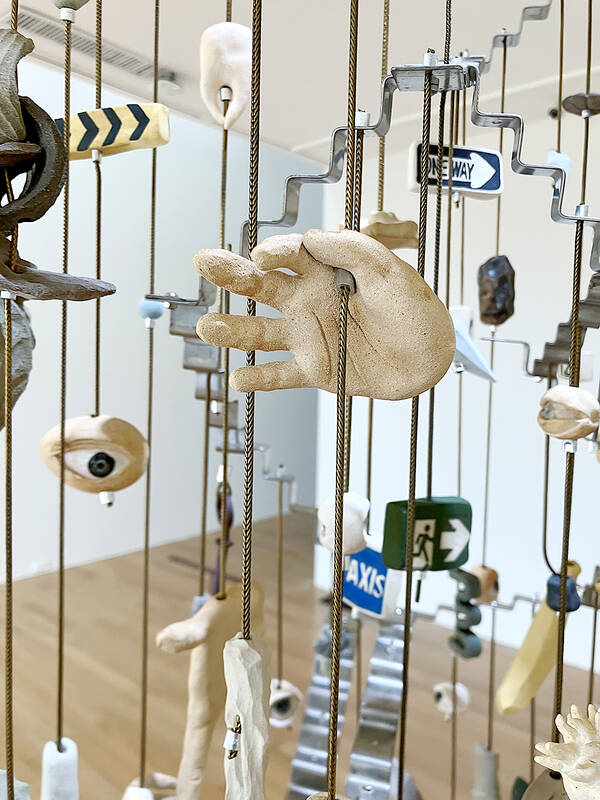
Photo: David Frazier
One of the exhibition’s most successful sections reflects Taiwan’s global preeminence as a manufacturer of computer chips by grouping several works. One is the short film Particular Waters by Taiwanese director Su Yu-hsin (蘇郁心), a humanistic portrait of one of the white-suited workers in Hsinchu’s semiconductor fabs. An adjacent gallery holds Naddim Abass’s Pilgrim in the Microworld, a large installation of a maze-like arrangement of stainless-steel-sided sandboxes and channels of fluorescent yellow liquid; when one mounts the stairs to view it from above, one discovers that it resembles a printed circuit board.
Also in the same gallery is Patricia L. Boyd’s Operator, a video from a camera rig programmed to automatically scan some unknown surface, which I at first mistook for the surface of an asteroid though it revealed itself to be the floor of some institutional space. Either way, the video work is about a type of mechanical seeing that has nothing human about it at all. It is merely a way of collecting data.
On another wall of the same gallery are a long row of photographs from Paul Virilio’s series Bunker Archeology from the 1950s and 1960s. Virilio, who died in 2018 and was known primarily as a philosopher of technology, in the post-war years took black and white photographs of abandoned Nazi bunkers along France’s Atlantic coast, later exhibiting them and publishing a book of essays also using the same title. Though the bunkers were once a part of the Nazi war machine and Fortress Europa, he only ever personally experienced them in their state of obsolescence and abandonment. For him, their archeology revealed a history of a certain technology –– mechanized warfare –– that pushed itself to its limit and ultimately burned itself out, leaving only these haunting, discarded reminders.
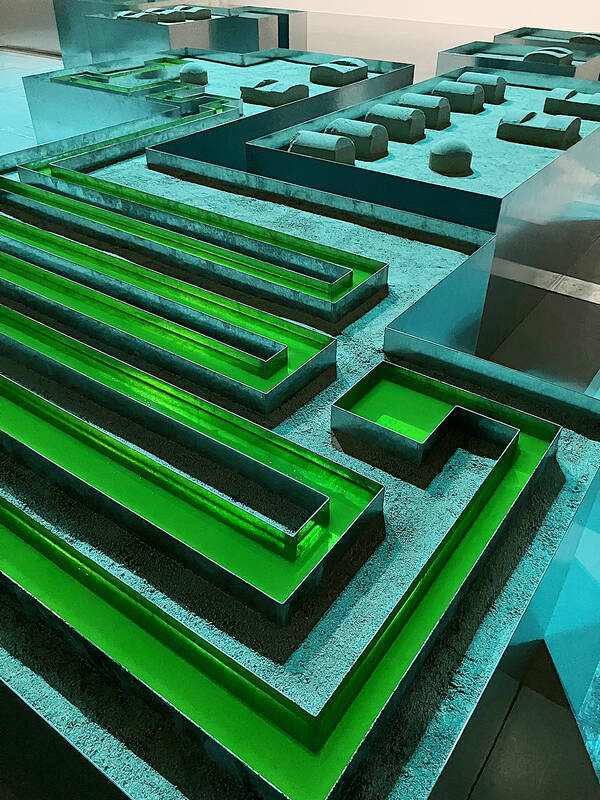
Photo: David Frazier
This sentiment of the promise and ultimate failure of technology serves as the Biennial’s most primary substrate.
‘RESISTANCE TO SCALE’
One solution of the curators of “Small World” offer is a “resistance to scale” –– and by this they clearly intend a critique of the idea of “scalability” so universally championed in Silicon Valley. Specifically, this is the idea that any innovation worth developing should hold the potential to be rolled out at unlimited scale so that it may influence (and be sold to) all humanity.
In opposition to such enforced homogenization, the curators look to find strength in close-knit groups, underground scenes and other communities rooted in particular circumstances and local realities.
Examples here include Filipino artist Pio Abad’s collection of poetry in Ivatan, a dying language of islands in the northern Philippines closely related to the indigenous tongue still spoken on Taiwan’s Orchid Island. One of these poems is exhibited in letters made of earth, filling one of the galleries.
Another is Hostbuster series of music happenings hosted by Indonesian musicians Julian Abraham “Togar” and Wok the Rock. Over a month, they will reach out to the hundreds of thousands of Indonesian migrant laborers in Taiwan –– who already have formed numerous bands and even their own music festival –– and invite them into the museum for jam sessions, karaoke parties, radio broadcasts, concerts and hangouts.
In very real terms, this represents the radical inclusion of a marginalized Taiwanese population into one of its more esteemed institutions. At present, Indonesian laborers in Taiwan are mainly visible in west coast factory towns and on Sundays in the hidden restaurant shacks near Taipei Main Station. I very much look forward to them coming to play grindcore in the Taipei Fine Arts Museum.
Taiwan’s overtaking of South Korea in GDP per capita is not a temporary anomaly, but the result of deeper structural problems in the South Korean economy says Chang Young-chul, the former CEO of Korea Asset Management Corp. Chang says that while it reflects Taiwan’s own gains, it also highlights weakening growth momentum in South Korea. As design and foundry capabilities become more important in the AI era, Seoul risks losing competitiveness if it relies too heavily on memory chips. IMF forecasts showing Taiwan widening its lead over South Korea have fueled debate in Seoul over memory chip dependence, industrial policy and

And so, in the wake of US President Donald Trump’s trip to the People’s Republic of China (PRC), all the experts on the Strait of Hormuz suddenly became experts on US-China-Taiwan relations. The Internet has certainly expanded human knowledge. Lots of these sudden experts made noise this week about Trump’s words after the meeting with PRC dictator Xi Jin-ping (習近平). Trump is going to sell out Taiwan! Longtime Taiwan commentator J. Michael Cole summed the situation up neatly in the Guardian: “We need to keep in mind that he has a tendency to say many things — sometimes contradicting himself within
There is considerable frustration and confusion among many, both in Taiwan and abroad — including in Washington — as to why the Chinese Nationalist Party (KMT) seems so dead set on using their legislative leverage to slash defense spending and disrupt the ability of the ruling Democratic Progressive Party (DPP) administration to function. Are they pawns of the Chinese Communist Party (CCP)? Are they traitors? In reality, there are multiple reasons. In the first column in this series on this subject, “Donovan’s Deep Dives: How and why the TPP and KMT help Beijing” (Sat May 16, page 12), we examined three

It took 12 years and months of standing in the same mountain location for director Liang Chieh-te (梁皆得) to capture a few seconds of footage: Taiwan’s largest resident raptor locking talons with its mate and spinning through the air in a courtship ritual. With only about 1,000 left in the wild and very short flight windows, the mountain hawk-eagle remains among Taiwan’s most elusive birds. The species generally produces only one offspring per year. Using forest cameras, the film crew and research teams document the arduous process the monogamous pairs go through for the chick to hatch and grow up, weathering


 RSS
RSS