


Episode two was as far as I got with Seqalu: Formosa 1867. The 12-part historical drama series — which scooped four gongs at last year’s Golden Bell awards — was, from the little I saw, visually appealing and featured decent performances from its Taiwanese leads. The acting from some of the Western cast, on the other hand, was dreadful.
While a stilted script and weak direction doubtless played their part, French-born model Fabio Grangeon’s portrayal of Charles LeGendre, US consul to Amoy (present day Xiamen), was stiffer than a frost-bitten corpse. To compound matters, misplaced syllable stress rendered his dialogue barely comprehensible at times.
Worse still was the treatment of historical figures. An introductory disclaimer at the beginning of each episode explains that these embellishments were intended to “enrich the story with stronger dramatic tension.”
But the depiction of William A. Pickering as a Bohemian wastrel complete with wide-boy banter was bizarre. He first appears reaching from beneath rumpled bedsheets for an empty liquor flask while, in the foreground, the previous night’s conquest — a local apothecary — pretties herself before a mirror. Moments later, he is demanding money from the protagonist Butterfly — his “cut” for securing her a position at an infirmary. “More money for wine!” he bellows.
For anyone familiar with Pickering through historical records, including Pioneering in Formosa, his own splendid account of his years as a customs agent in Taiwan, this is a shameful defamation. Pickering was many things — not least an unabashed imperialist who lobbied the British government to colonize Formosa — but drunken lothario? It is hard to imagine a worse misrepresentation.
TAKING NO LIBERTIES
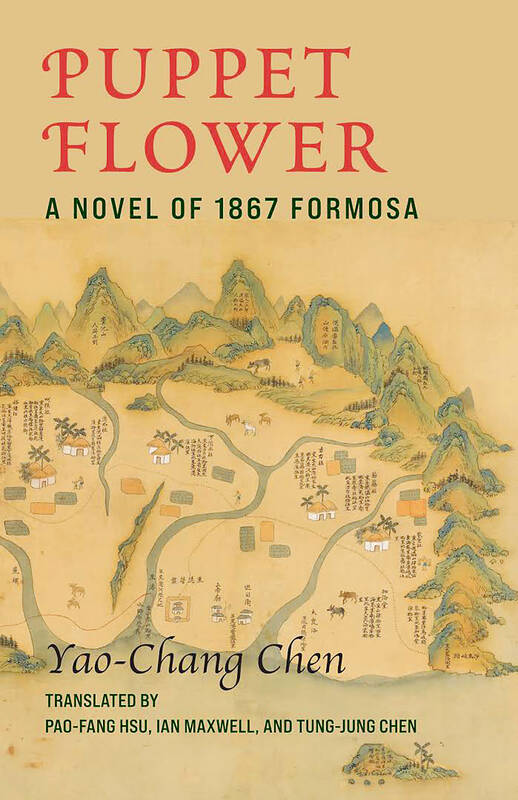
The novel on which the series is based takes no such liberties. The characters, cultures and competing interests in Puppet Flower: A Story of 1867 Formosa are conveyed with an even hand. The tale is based around the historical Rover Incident which saw tensions arise between indigenous Taiwanese, Qing Dynasty officials and American forces after the killing of the crew of shipwrecked merchant ship.
In telling the tale, author Chen Yao-chang (陳耀昌) rarely lapses into anything approaching moral judgment. His portrait of Pickering reveals a man, by turns, obstinate yet diplomatic, arrogant yet sensitive to the complexities of the local environment and, in particular, the ways of Taiwan’s indigenous peoples.
Pickering’s dim view of Chinese officialdom is evident throughout. “Qing governments are all the same,” he tells LeGendre. “If you don’t keep pressing them, they will never take action.”
This cynicism perplexes the British Consul Charles Carroll, who queries Pickering’s belief that “the Chinese are self-conceited liars and cheats, but the savages are kindhearted [sic] and straightforward.”
Chen’s depiction here is in keeping with Pickering’s memoir in which he frequently rails against Taiwan’s Qing representatives while expressing admiration for the indigenous people he encounters.
Interestingly, in his snapshots of Chinese officials — particularly the newly appointed “subprefect in charge of aboriginal affairs” Wang Wenqi (王文棨) — Chen suggests that Pickering’s outlook is justified. Wang, another historical figure, who later served as country magistrate for Chiayi (嘉義), is shown as ambitious, self-serving and given to dissembling. His superior, General Liu Ming-teng (劉明燈), who is given to talking out of both sides of his mouth, and claiming undue credit, is equally unsympathetic.
JUSTIFIED PORTRAYAL
Yet, legitimate as his misgivings may be, Pickering understands that compromise is crucial to avoid further antagonism between the various groups that jockey for land and influence in southern Taiwan’s Hengchun (恆春) or Liangkau (瑯嶠), as it was then known. He assists Wang in negotiating with Big Head Chief Tauketok, engaging a Hakka headman to serve as intermediary, and is prepared to concede where he believes it is for the general good.
In Tauketok, we have a somewhat tragic figure, who is forced to compromise for fear of precipitating the extermination of his people. Described by Pickering as “indomitable” and worthy of respect, Tauketok is accepted with some reluctance by the heads of Liangkau’s 18 tribes. However, while communicating his readiness for war to the “Red-Hairs” should they provoke it, he foresees disaster should he take a false step.
The character of LeGendre is perhaps the most nuanced of all, partly due to the added — fictionalized — layer of his relationship with Butterfly. Through his treatment of the book’s “half-breed” (tushengzi, 土生子) heroine, we decipher LeGendre’s insecurities — a failed romance and inadequacy over own identity as a French immigrant who, despite a stellar civil war record, remains desperate to prove his value to his adopted country.
As Michael Berry observes in his foreword, while “hybrid identity” is most obviously embodied through Butterfly and her brother Bunkiet who discovers and embraces his lineage, LeGendre also represents “the complexity and fluidity of identity” in this historical environment.
A series of internal monologues in which LeGendre congratulates himself for his cunning in playing the “savages” off against the Chinese officials reveal an aloof arrogance and ruthlessness. This ultimately proves to be Le Gendre’s undoing in, if not his political goals, at least his personal desires. Because of these shortcomings and the brutal act in which they culminate, there is little to like about Chen’s LeGendre.
Having decried the on-screen besmirchment of Pickering, I may fairly be accused of a double standard over LeGendre. Here, I can say only say that his key offense is convincingly rendered and feels justified within the overall context of the work. Strangely, Chen’s own explanation of this in the preface, which might be avoided if the hints here haven’t already made things plain, is rather unsatisfactory.
SELDOM GRIPPING
Some words of warning: While this novel will be engaging enough for readers with a grounding in this period of Taiwan’s history, it is seldom gripping. The prose is plain with few literary devices or stylistic flourishes. Too many of the characters lack depth, with several appearing fleetingly. In the case of the foreign historical figures, their inclusion was presumably to lend authenticity to the tale. The character of Bunkiet, in particular, is woefully underutilized, though his final proleptic scene poignantly indicates the fate of his and other indigenous people in Taiwan.
Likewise, while detached from the rest of the novel’s action, the final section of the epilogue is a deft touch that may surprise even those readers who are familiar with LeGendre’s life.
Perhaps, the most interesting scene of all, though, is Butterfly’s visit to Mr. Chen, the illegitimate son of Yao Ying (姚瑩), an ill-fated circuit attendant of Taiwan who fell from grace for his role in the Nerbudda Incident — the execution of 197 members of a British transport ship in 1842.
While the ageing gentleman’s recollections add little in terms of plot progression, they provide further texture to the author’s presentation of Taiwan as a complex, multicultural land where personal tribulations have played into international confrontations. By providing parallels with the current stand-off which has engulfed Butterfly, this aside reveals Taiwan’s precarious historical position as a pawn in international disputes and a battlefield on which domestic and external forces collide.
“In the future … Formosa will be a precious gem in Asia,” Caroll tells Dr. Patrick Manson as they gaze out over Taiwan’s green paddy from the harbor at Anping (安平). “How fortunate the Qing government is to have such a beautiful island.”


Taiwan’s English education system is being pulled apart by three opposing forces. Bilingual Nation 2030 pulls students toward English and global communication. Artificial Intelligence (AI) readiness pulls them toward digital judgment, verification and AI-mediated work. But Taiwan’s old exam culture pulls them back toward memorization, grammar drills, timed reading and correct answers. If the education system keeps using old exams to define success, it risks producing graduates who are neither genuinely bilingual nor genuinely AI-ready, but trained for tasks machines can already perform. The first force is Bilingual Nation 2030. Launched in 2018, the policy aimed to “help Taiwan’s workforce connect

“Taiwan’s Opposition Leader Comes to US With a Message Straight Out of Beijing” read a May 31 headline in the Wall Street Journal. Top US administration officials and members of Congress almost certainly read the WSJ, and if there was a bullet point takeaway that people in Washington should absorb ahead of Chinese Nationalist Party (KMT) Chair Cheng Li-wun’s (鄭麗文) arrival in DC on June 9, that headline is it. The last few columns have discussed this very topic, and the timing is not coincidental. While those top officials likely do not read the Taipei Times, judging by the number

With weighty, anxiety-inducing geopolitical topics dominating the headlines, checking in on the wild and weird state of local politics can take some of the edge off. This November’s elections will determine who will be in charge of fixing potholes in your neighborhood, not the potholes in Taiwan’s complicated geopolitical space. Recently, after an online interview with a Taipei-based journalist, I commented that Taipei journalists never go further than the MRT can take them. He laughed and agreed. Naturally, the Taipei mayoral race is eating up much of the press attention. TAIPEI CITY Democratic Progressive Party (DPP) candidate Puma Shen (沈伯洋) has
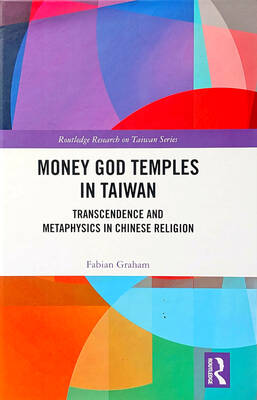
As someone who normally steers clear of books with “transcendence” or “metaphysics” in their subtitles, this reviewer — a casual observer of local belief systems since the 1990s — found Fabian Graham’s Money God Temples in Taiwan a challenging read. Those who’ve only dipped their toes into temple culture will likely need to parse several sections with special care if they’re to keep up with the author, a British ethnographic researcher whose previous books have investigated religious practices among ethnic Chinese in Southeast Asia. This scholarly volume examines a facet of Taiwan’s religious landscape that didn’t exist a century ago, and


 RSS
RSS