


CSBC Corp, Taiwan (台灣國際造船) yesterday released the first video documenting the submerged sea trials of Taiwan’s indigenous defense submarine prototype, the Hai Kun (海鯤), or Narwhal, showing underwater navigation and the launch of countermeasures.
The footage shows the vessel’s first dive, steering and control system tests, and the raising and lowering of the periscope and antenna masts.
It offered a rare look at the progress in the submarine’s sea acceptance tests.

Photo courtesy of CSBC Corp, Taiwan
The Hai Kun carried out its first shallow-water diving trial late last month and has since completed four submerged tests, CSBC said.
The newly released video compiles images recorded from Jan. 29 to Friday last week, the company said.
The video shows the submarine leaving port, diving in the test area, launching decoys, resurfacing and returning to harbor, demonstrating initial sea trial results.

Photo courtesy of CSBC Corp, Taiwan
CSBC Corp said it looks forward to continued public support for the domestic submarine program.
The shipbuilding team would next carry out system adjustments and inspections, and once safety conditions are confirmed and evaluated, subsequent sea trials would be scheduled, it said.
After completing the sea trials, the submarine would enter the evaluation phase, it said.
In the first stage, CSBC Corp would conduct technical assessments to verify that the platform and combat systems meet requirements, it said.
Once these tests are completed, the vessel would be handed over to the navy for tactical evaluation, it said, adding that the Hai Kun would then head to testing grounds, where combined technical and tactical assessments would verify whether it meets overall operational capabilities.

Right-wing political scientist Laura Fernandez on Sunday won Costa Rica’s presidential election by a landslide, after promising to crack down on rising violence linked to the cocaine trade. Fernandez’s nearest rival, economist Alvaro Ramos, conceded defeat as results showed the ruling party far exceeding the threshold of 40 percent needed to avoid a runoff. With 94 percent of polling stations counted, the political heir of outgoing Costa Rican President Rodrigo Chaves had captured 48.3 percent of the vote compared with Ramos’ 33.4 percent, the Supreme Electoral Tribunal said. As soon as the first results were announced, members of Fernandez’s Sovereign People’s Party

Taiwan Semiconductor Manufacturing Co (TSMC, 台積電) plans to make advanced 3-nanometer chips in Japan, stepping up its semiconductor manufacturing roadmap in the country in a triumph for Japanese Prime Minister Sanae Takaichi’s technology ambitions. TSMC is to adopt cutting-edge technology for its second wafer fab in Kumamoto, company chairman C.C. Wei (魏哲家) said yesterday. That is an upgrade from an original blueprint to produce 7-nanometer chips by late next year, people familiar with the matter said. TSMC began mass production at its first plant in Japan’s Kumamoto in late 2024. Its second fab, which is still under construction, was originally focused on
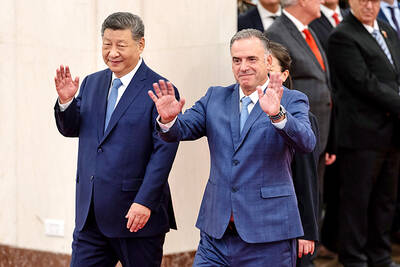
EMERGING FIELDS: The Chinese president said that the two countries would explore cooperation in green technology, the digital economy and artificial intelligence Chinese President Xi Jinping (習近平) yesterday called for an “equal and orderly multipolar world” in the face of “unilateral bullying,” in an apparent jab at the US. Xi was speaking during talks in Beijing with Uruguayan President Yamandu Orsi, the first South American leader to visit China since US special forces captured then-Venezuelan president Nicolas Maduro last month — an operation that Beijing condemned as a violation of sovereignty. Orsi follows a slew of leaders to have visited China seeking to boost ties with the world’s second-largest economy to hedge against US President Donald Trump’s increasingly unpredictable administration. “The international situation is fraught
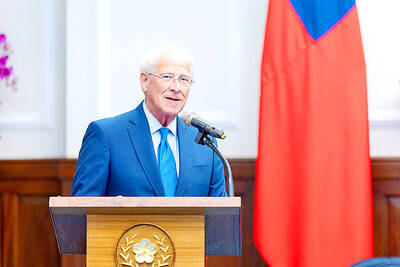
Opposition parties not passing defense funding harms Taiwan’s national security, two US senators said separately in rare public criticism. “I am disappointed to see Taiwan’s opposition parties in parliament [the legislature] slash President [William] Lai’s (賴清德) defense budget so dramatically,” Roger Wicker, a Republican who chairs the US Senate Armed Forces Committee, said on social media. “The original proposal funded urgently needed weapons systems. Taiwan’s parliament should reconsider — especially with rising Chinese threats,” he added. Wicker’s post linked to an article published by Bloomberg that said that the two opposition parties’ move was “potentially jeopardizing the purchases of billions of dollars of


 RSS
RSS