


Taiwan Semiconductor Manufacturing Co (TSMC, 台積電) plans to make advanced 3-nanometer chips in Japan, stepping up its semiconductor manufacturing roadmap in the country in a triumph for Japanese Prime Minister Sanae Takaichi’s technology ambitions.
TSMC is to adopt cutting-edge technology for its second wafer fab in Kumamoto, company chairman C.C. Wei (魏哲家) said yesterday.
That is an upgrade from an original blueprint to produce 7-nanometer chips by late next year, people familiar with the matter said.
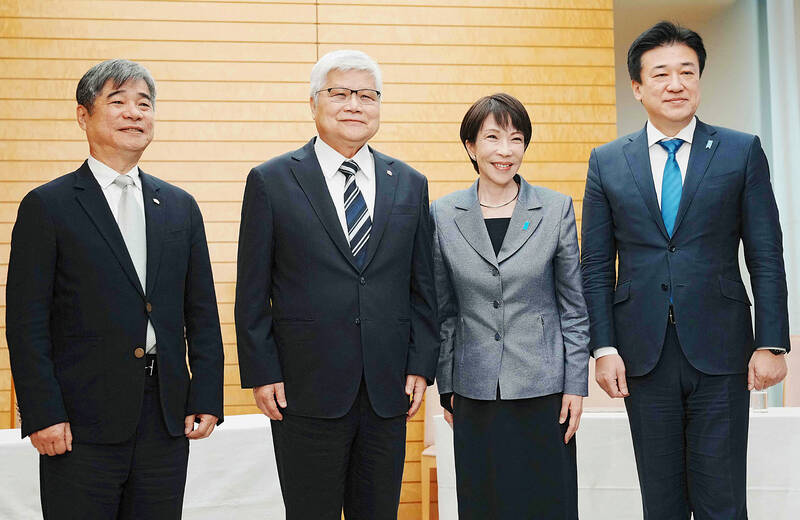
Photo: AFP
TSMC began mass production at its first plant in Japan’s Kumamoto in late 2024.
Its second fab, which is still under construction, was originally focused on manufacturing 6 to 12-nanometer chips, significantly less advanced than those announced yesterday.
The facility is scheduled to come online late next year.
To drive that expansion, TSMC plans to increase its overall investment in the Japanese plant to ¥2.6 trillion (US$17 billion), the Yomiuri Shimbun reported yesterday.
TSMC’s planned upgrade is likely to boost Takaichi’s goal to bolster domestic chipmaking.
Takaichi held up TSMC’s Kumamoto endeavor as a template for economic cooperation and said that a 3-nanometer fab shores up the global chip supply chain and Japan’s economic security.
“We want to strengthen our win-win partnership,” Takaichi said at the start of a meeting with Wei in Tokyo.
Wei in turn credited Tokyo for its endorsement and aid.
“Without your support this giga-fab project won’t be possible,” he told Takaichi, adding that he was a “firm supporter.”
He held up a copy of her book, Beautiful, Strong and Growing Nation: My Japan Economic Resilience Plan, and said: “You wrote a book five years ago, where you already talked about TSMC.”
The TSMC revelation coincides with a snap lower-house election this weekend that could reshape Japan’s political balance.
Takaichi — who has only been in the job for just more than three months — has set the election date for Sunday to capitalize on soaring public support to shore up her coalition government.
TSMC is accelerating a buildout around the world to meet a surge in demand for the high-end chips required to train and operate artificial intelligence (AI) services.
Taiwan also faces growing challenges when it comes to supplying resources, including land and electricity, while concerns persist about the concentration of advanced chip production in the nation.
Growing risk surrounding Taiwan likely contributed to the new plan, alongside faster-than-anticipated adoption of advanced technologies, Omdia analyst Akira Minamikawa said.
“This could lead to discussions about producing even more advanced nodes in Japan in the future,” he said.
Semiconductors made using 3-nanometer processes are used for AI robotics and data processing, Japanese Minister of Economy, Trade and Industry Ryosei Akazawa said, adding that Japan would work even closer with TSMC and deepen cooperation.
TSMC’s move to 3-nanometer chips is “fully aligned with the Takaichi administration’s strategy to advance the social implementation of AI in Japan,” he said.
While Taiwanese officials and TSMC have repeatedly pledged to keep its most-cutting-edge technology at home, the company intends to add capacity for more mature semiconductors overseas to alleviate resource constraints at home.
TSMC began mass production of 2-nanometer chips at its Kaohsiung factory last quarter.
“All TSMC’s decisions are based on customer needs, and their overseas expansion is not intended to replace Taiwan,” Executive Yuan spokeswoman Michelle Lee (李慧芝) said yesterday, citing Wei.
Additional reporting by CNA and AFP

Right-wing political scientist Laura Fernandez on Sunday won Costa Rica’s presidential election by a landslide, after promising to crack down on rising violence linked to the cocaine trade. Fernandez’s nearest rival, economist Alvaro Ramos, conceded defeat as results showed the ruling party far exceeding the threshold of 40 percent needed to avoid a runoff. With 94 percent of polling stations counted, the political heir of outgoing Costa Rican President Rodrigo Chaves had captured 48.3 percent of the vote compared with Ramos’ 33.4 percent, the Supreme Electoral Tribunal said. As soon as the first results were announced, members of Fernandez’s Sovereign People’s Party
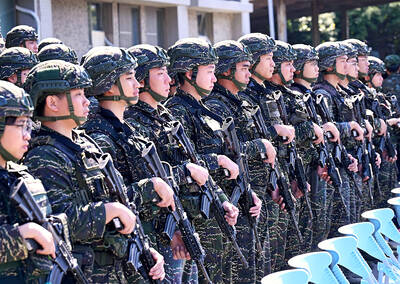
MORE RESPONSIBILITY: Draftees would be expected to fight alongside professional soldiers, likely requiring the transformation of some training brigades into combat units The armed forces are to start incorporating new conscripts into combined arms brigades this year to enhance combat readiness, the Executive Yuan’s latest policy report said. The new policy would affect Taiwanese men entering the military for their compulsory service, which was extended to one year under reforms by then-president Tsai Ing-wen (蔡英文) in 2022. The conscripts would be trained to operate machine guns, uncrewed aerial vehicles, anti-tank guided missile launchers and Stinger air defense systems, the report said, adding that the basic training would be lengthened to eight weeks. After basic training, conscripts would be sorted into infantry battalions that would take
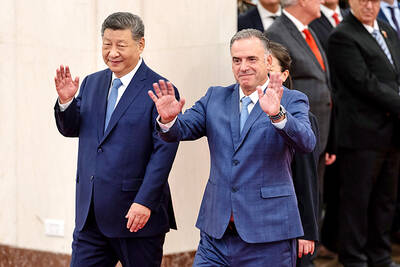
EMERGING FIELDS: The Chinese president said that the two countries would explore cooperation in green technology, the digital economy and artificial intelligence Chinese President Xi Jinping (習近平) yesterday called for an “equal and orderly multipolar world” in the face of “unilateral bullying,” in an apparent jab at the US. Xi was speaking during talks in Beijing with Uruguayan President Yamandu Orsi, the first South American leader to visit China since US special forces captured then-Venezuelan president Nicolas Maduro last month — an operation that Beijing condemned as a violation of sovereignty. Orsi follows a slew of leaders to have visited China seeking to boost ties with the world’s second-largest economy to hedge against US President Donald Trump’s increasingly unpredictable administration. “The international situation is fraught

GROWING AMBITIONS: The scale and tempo of the operations show that the Strait has become the core theater for China to expand its security interests, the report said Chinese military aircraft incursions around Taiwan have surged nearly 15-fold over the past five years, according to a report released yesterday by the Democratic Progressive Party’s (DPP) Department of China Affairs. Sorties in the Taiwan Strait were previously irregular, totaling 380 in 2020, but have since evolved into routine operations, the report showed. “This demonstrates that the Taiwan Strait has become both the starting point and testing ground for Beijing’s expansionist ambitions,” it said. Driven by military expansionism, China is systematically pursuing actions aimed at altering the regional “status quo,” the department said, adding that Taiwan represents the most critical link in China’s


 RSS
RSS