


US and Chinese fighter jets briefly faced off above waters near the Korean Peninsula this week, Yonhap News agency reported, marking a rare confrontation in that area between the two superpowers.
About 10 US fighter jets on Wednesday departed an airbase in Pyeongtaek, South Korea, for drills above international waters off South Korea’s western coast, the news outlet cited unidentified military sources as saying.
While the US planes did not enter China’s air defense identification zone, Beijing scrambled planes as they neared that region, the report said.
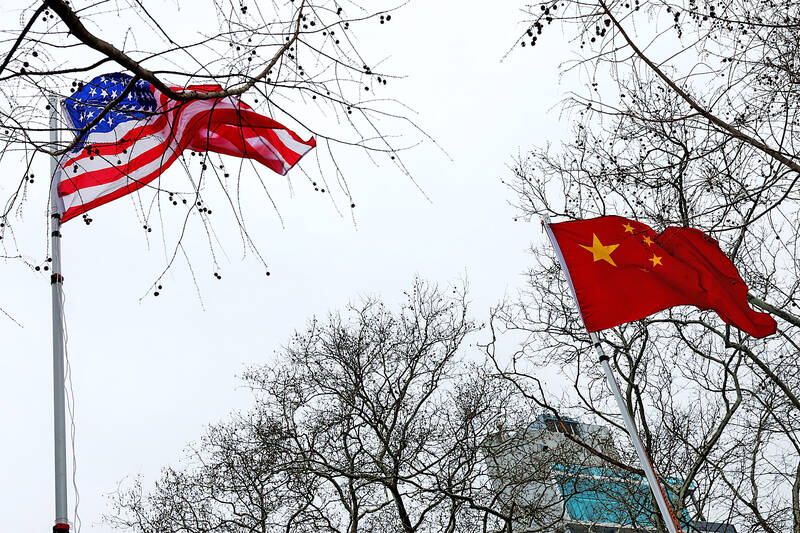
Photo: Reuters
“The Chinese People’s Liberation Army organized naval and air forces to monitor and effectively respond to the activities throughout the process, in accordance with laws and regulations,” the Chinese state-backed Global Times said yesterday, citing sources it did not name.
US Forces Korea, which oversees about 28,500 US troops stationed in South Korea, did not immediately provide a comment. The Chinese Ministry of Foreign Affairs did not reply to a request for comment made outside working hours, while the South Korean Ministry of National Defense said it could not confirm US military operations.
“US Forces Korea is maintaining a strong combined defense posture with our military,” the South Korean defense ministry said.
South Korea’s military was not involved in the latest training or aware of the flight details in advance, Yonhap reported.
It is unusual for US fighter jets stationed in South Korea to conduct training without Seoul so close to China’s air defense identification zone, the report added.
China has stepped up military aggression in the Indo-Pacific region, where Beijing has territorial disputes in the South China Sea and over Taiwan.
Tensions have flared in recent months between China and Japan, another key US ally in Asia, after Japanese Prime Minister Sanae Takaichi suggested Tokyo could be legally justified to deploy its military in the event of a Chinese invasion of Taiwan.

‘NO SECURITY RISK’: The Railway Bureau reassured the public that the technicians’ activities were limited to technical guidance and did not involve sensitive systems The Railway Bureau yesterday said it had invited eight Chinese technicians to assist with an airport MRT construction project. The bureau issued the confirmation after an Internet user said Chinese nationals had entered the construction zone of Taiwan Taoyuan International Airport’s Terminal 3 project. They asked why “individuals from an enemy state” were allowed access to such a major national infrastructure project, which raised serious concerns over Taiwan’s industrial safety, sensitive systems and information security. The bureau’s Northern Region Engineering Branch Office said subcontractor Taiwan Handle Industrial Co (台灣手把工業) of the Taoyuan airport MRT’s “Contract No. CU05 Project A14 Station Civil, MEP &

A US uncrewed surface vessel (USV) encountered multiple Chinese warships during an autonomous transit of the Taiwan Strait, US defense company Seasats said in a statement on Wednesday. Seasats announced that a Lightfish USV had completed the first autonomous transit of the Taiwan Strait. Over five days, the USV traversed the entire length of the Strait while constantly monitoring surface vessel traffic, the company said. The Lightfish encountered multiple Chinese warships, one of which was a Chinese People’s Liberation Army Navy (PLAN) Type 056 corvette, it said. The Chinese vessels were operating “well within Taiwan’s exclusive economic zone without transmitting their identity via the
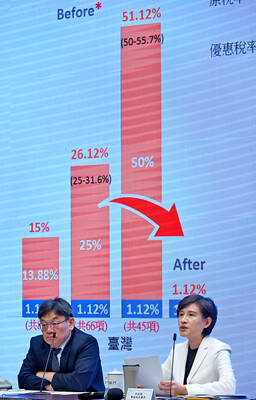
GREATER REACH? Auto parts and wood products would face tariffs of up to 15%, matching those targeting the EU, Japan and South Korea, Vice Premier said The US has announced that preferential tariff treatment for Taiwan’s non-semiconductor Section 232 goods would take effect retroactively from May 1, the Executive Yuan said yesterday. The US government yesterday posted a notice on the Federal Register’s public inspection Web site previewing tariff concessions for Taiwan under a memorandum of understanding (MOU) on Taiwan-US investment after two months of negotiations. The MOU signed on Jan. 15 stipulated three major preferential tariff arrangements: a 15 percent “reciprocal” tariff rate for Taiwan without stacking most-favored nation (MFN) rates; preferential Section 232 treatment for semiconductors and related products; and preferential Section 232 treatment for non-semiconductor

The National Chungshan Institute of Science and Technology yesterday showcased its locally developed variants of the Vision 60 robotic patrol dog, which it plans to deploy on the nation’s outlying territories in the South China Sea. The variants were produced under the Joint Lab project — created by the institute and domestic companies — and assembled with domestically produced motors, lenses and artificial intelligence (AI) systems alongside licensed tech from the US, Missile and Rocket Systems Research Division deputy director Jen Kuo-kang (任國光) told the media event at a military base in Taipei’s Dazhi (大直) area. Taiwan has built up its strengths


 RSS
RSS