


The Central Election Commission has amended election and recall regulations to require elected office candidates to provide proof that they have no Chinese citizenship, a Cabinet report said.
The commission on Oct. 29 last year revised the Measures for the Permission of Family-based Residence, Long-term Residence and Settlement of People from the Mainland Area in the Taiwan Area (大陸地區人民在台灣地區依親居留長期居留或定居許可辦法), the Executive Yuan said in a report it submitted to the legislature for review.
The revision requires Chinese citizens applying for permanent residency to submit notarial documents showing that they have lost their Chinese household record and have renounced — or have never possessed — their Chinese passport, thereby preventing dual citizenship, the report said.
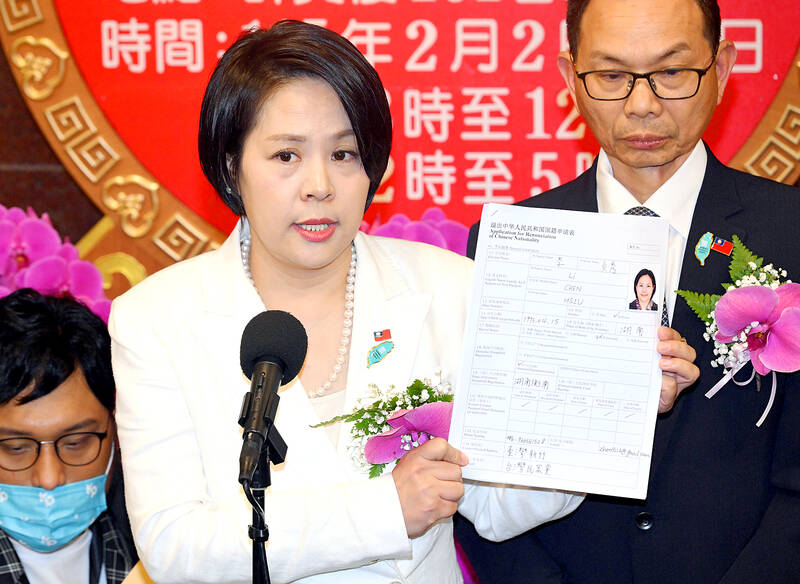
Photo: Liao Chen-huei, Taipei Times
The commission on Nov. 3 last year further amended the Act on Restoring Taiwanese Citizenship to Chinese Citizens in Taiwan (在台原有戶籍大陸地區人民申請回復台灣地區人民身分許可辦法) to include major contributions to Taiwan’s defense security, international image and public interest apart from humanitarian reasons as a requirement for the restoration of a Chinese citizen’s Taiwanese nationality, it said.
On Nov. 27 last year, the commission amended Article 15 of the Implementation Regulations of the Public Officials Election and Recall Law (公職人員選舉罷免法施行細則) to require elected candidates to provide affidavits proving that they have no household registration or Chinese passport and that they do not hold citizenship of other countries, the report said.
Candidates are also required to publish the affidavits in election bulletins for voters to review, it said.
To attract more international talent to Taiwan, the amendments to the Act for the Recruitment and Employment of Foreign Professionals (外國專業人才延攬及僱用法) passed by the legislature last year have come into force from Jan. 1 and focuses on recruiting talent from the US and New Southbound Policy countries, the report said.
As of the end of November last year, 58,873 foreign professionals and 20,787 foreign specialist professionals were approved, of whom 15,169 were granted a Taiwan Employment Gold Card, it said.
In related news, an official said supporting documents presented by Taiwan People’s Party Legislator Li Zhenxiu (李貞秀) to prove her renouncement of Chinese citizenship are suspicious.
An official familiar with cross-strait regulations yesterday said that Li obtained permanent residency in 1999 — six years after she got married and moved to Taiwan — when the requirement to renounce Chinese citizenships has yet to be included in the Act Governing Relations Between the People of the Taiwan Area and the Mainland Area (兩岸人民關係條例).
The official said that it is weird that Li said in her supporting documents that she had her Chinese citizenship revoked after marrying into a Taiwanese family on April 26, 1993.
This is not a usual approach to citizenship renouncement of Chinese spouses, and does not align with regulations and practices at the time, the official said, adding that it could constitute a contravention of the Criminal Code for alleged “public official making a false entry” if the content of her document is found to be falsified.


RESILIENCE: Taiwan plays a key role in semiconductors, energy, information infrastructure and advanced manufacturing, AIT Director Raymond Greene said Taiwan’s continued investment in deterrence and resilience remains vital, especially in uncrewed systems and other emerging technologies, American Institute in Taiwan (AIT) Director Raymond Greene said yesterday. Greene made the remarks at the annual National Strategic Summit on Supply Chain Resilience held by the Research Institute for Democracy, Society and Emerging Technology (DSET), a government-backed think tank. As Taiwan last year became the US’ fourth-largest trading partner and supply chain security is becoming more important, cooperation in emerging technologies continues to deepen between the two countries, he said. The US is committed to accelerating innovation, building key infrastructure, strengthening cooperation

The National Chungshan Institute of Science and Technology yesterday showcased its locally developed variants of the Vision 60 robotic patrol dog, which it plans to deploy on the nation’s outlying territories in the South China Sea. The variants were produced under the Joint Lab project — created by the institute and domestic companies — and assembled with domestically produced motors, lenses and artificial intelligence (AI) systems alongside licensed tech from the US, Missile and Rocket Systems Research Division deputy director Jen Kuo-kang (任國光) told the media event at a military base in Taipei’s Dazhi (大直) area. Taiwan has built up its strengths

RIGHT DIRECTION: Taiwan’s efforts to prevent forced labor include a proposal to ‘fully prohibit’ employers from withholding workers’ documents, an official said Taiwan is to establish a mechanism to restrict imports of goods linked to forced labor, the Executive Yuan said yesterday, after the US proposed imposing additional tariffs on Taiwanese goods over labor concerns. “The Ministry of Labor and the Ministry of Economic Affairs are to establish an interministerial review procedure,” Executive Yuan spokesperson Michelle Lee (李慧芝) said at a news briefing in Taipei. “The government is to use the Foreign Trade Act [貿易法] as the legal basis to restrict imports of goods produced with forced labor” and bring its supply chain governance more in line with international standards on human rights, resilience

NOT IMMEDIATE: Taiwan has a chance to appeal the proposed 10 percent tariff before it starts, while other countries face a 12.5 percent tariff from the trade office Taiwan is among 60 economies determined by the US to have failed to impose or enforce a ban on the importation of goods produced with forced labor, according to a notice released on Tuesday by the Office of the US Trade Representative (USTR), which proposed imposing an additional 10 percent or more tariff on them. The USTR in a statement said that following an investigation, it had determined under Section 301 of the Trade Act of 1974 that the failure of the 60 economies to impose and effectively enforce a prohibition on the importation of goods produced with forced labor is


 RSS
RSS