


Chinese President Xi Jinping (習近平) yesterday called for an “equal and orderly multipolar world” in the face of “unilateral bullying,” in an apparent jab at the US.
Xi was speaking during talks in Beijing with Uruguayan President Yamandu Orsi, the first South American leader to visit China since US special forces captured then-Venezuelan president Nicolas Maduro last month — an operation that Beijing condemned as a violation of sovereignty.
Orsi follows a slew of leaders to have visited China seeking to boost ties with the world’s second-largest economy to hedge against US President Donald Trump’s increasingly unpredictable administration.
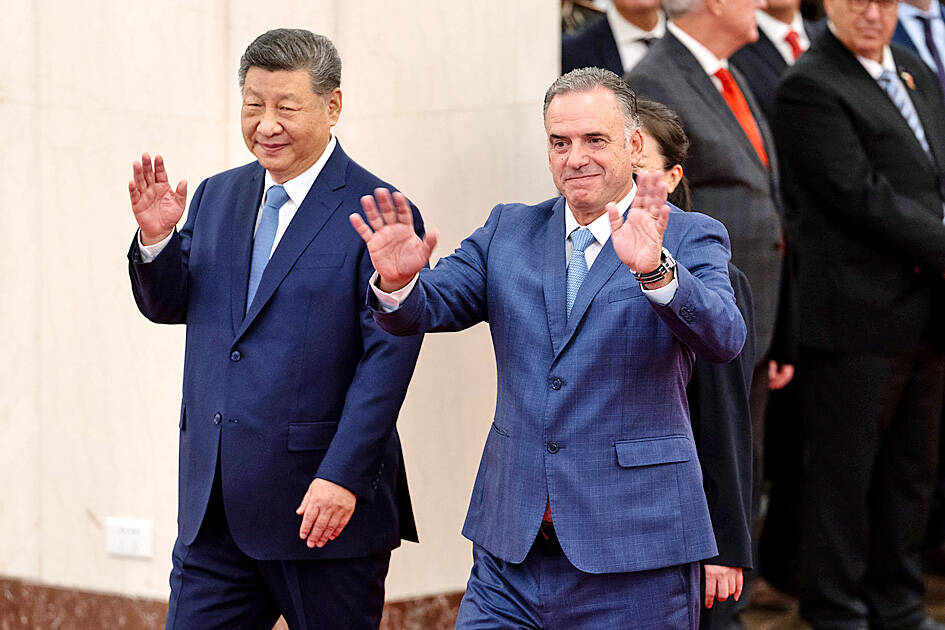
Photo: AP
“The international situation is fraught with intertwined turmoil, and unilateral bullying is intensifying,” Xi told Orsi, China Central Television reported.
China “is willing to strengthen solidarity and cooperation with Uruguay in the global south, jointly promote an equal and orderly multipolar world, and inclusive economic globalization,” he said.
Beijing “supports Latin American and Caribbean countries in safeguarding their sovereignty, security and development interests,” he added.
During the meeting, Orsi warned of risks from the “challenging international and regional scenario.”
China is Uruguay’s top trading partner, largest export destination and a key buyer of agricultural products such as soybeans and beef.
Chinese electric vehicle brands have also grown their market share in Uruguay, accounting for almost one-third of sales last year.
Beijing has invested billions of dollars in Latin America as part of its quest for natural resources and through its Belt and Road Initiative.
China and Uruguay would “seek to increase and diversify our bilateral trade,” Orsi said at the meeting, adding that they both supported a “standard-based international trade system.”
The two leaders signed agreements on science, technology, environmental cooperation and other areas.
Xi said the two sides would explore cooperation in emerging fields such as green technology, the digital economy and artificial intelligence.
Uruguay is part of South America’s Mercosur trade bloc, along with Brazil, Argentina and Paraguay, which limits its ability to strike unilateral trade deals with Beijing.
Montevideo has previously expressed interest in an independent commercial deal with China, which sparked opposition from fellow members.
Mercosur signed a trade deal — two decades in the making — with the EU last month, eliminating tariffs on more than 90 percent of bilateral trade.
Orsi was also due to hold talks with Chinese Premier Li Qiang (李強) and Chinese National People’s Congress Standing Committee Chairman Zhao Leji (趙樂際) yesterday before traveling to Shanghai.
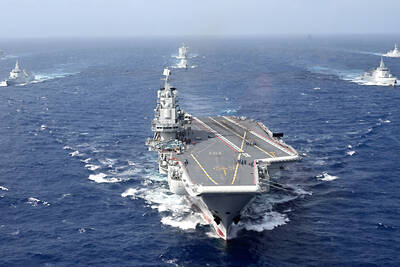
PROVOCATIVE: Chinese Deputy Ambassador to the UN Sun Lei accused Japan of sending military vessels to deliberately provoke tensions in the Taiwan Strait China denounced remarks by Japan and the EU about the South China Sea at a UN Security Council meeting on Monday, and accused Tokyo of provocative behavior in the Taiwan Strait and planning military expansion. Ayano Kunimitsu, a Japanese vice foreign minister, told the Council meeting on maritime security that Tokyo was seriously concerned about the situation in the East China and South China seas, and reiterated Japan’s opposition to any attempt to change the “status quo” by force, and obstruction of freedom of navigation and overflight. Stavros Lambrinidis, head of the EU delegation to the UN, also highlighted South China Sea
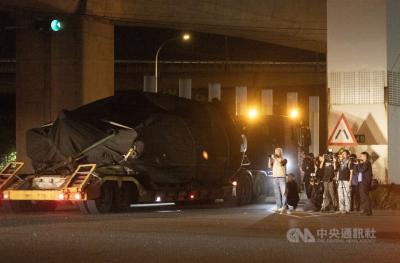
The final batch of 28 M1A2T Abrams tanks purchased from the US arrived at Taipei Port last night and were transported to the Armor Training Command in Hsinchu County’s Hukou Township (湖口), completing the military’s multi-year procurement of 108 of the tanks. Starting at 12:10am today, reporters observed more than a dozen civilian flatbed trailers departing from Taipei Port, each carrying an M1A2T tank covered with black waterproof tarps. Escorted by military vehicles, the convoy traveled via the West Coast Expressway to the Armor Training Command, with police implementing traffic control. The army operates about 1,000 tanks, including CM-11 Brave Tiger
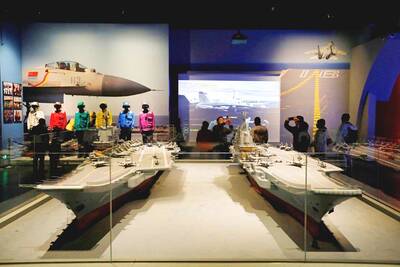
China on Wednesday teased in a video an aircraft carrier that could be its fourth, and the first using nuclear power, while making an allusion to Taiwan and vowing to further build up its islands, as it looks to boost maritime power, secure resources and bolster territorial claims. The video, issued on the eve of the 77th founding anniversary of the Chinese People’s Liberation Army Navy, featured fictional officers with names that are homophones of three commissioned aircraft carriers, the Liaoning (遼寧), Shandong (山東) and Fujian (福建). Titled Into the Deep, it showed a 19-year-old named “Hejian” (何劍) joining the group, sparking
Taiwan Semiconductor Manufacturing Co (TSMC, 台積電), the world’s largest contract chipmaker, said it expects its 2-nanometer (2nm) chip capacity to grow at a compound annual rate of 70 percent from this year to 2028. The projection comes as five fabs begin volume production of 2-nanometer chips this year — two in Hsinchu and three in Kaohsiung — TSMC senior vice president and deputy cochief operating officer Cliff Hou (侯永清) said at the company’s annual technology symposium in Silicon Valley, California, last week. Output in the first year of 2-nanometer production, which began in the fourth quarter of last year, is expected to


 RSS
RSS