


Opposition parties not passing defense funding harms Taiwan’s national security, two US senators said separately in rare public criticism.
“I am disappointed to see Taiwan’s opposition parties in parliament [the legislature] slash President [William] Lai’s (賴清德) defense budget so dramatically,” Roger Wicker, a Republican who chairs the US Senate Armed Forces Committee, said on social media.
“The original proposal funded urgently needed weapons systems. Taiwan’s parliament should reconsider — especially with rising Chinese threats,” he added.
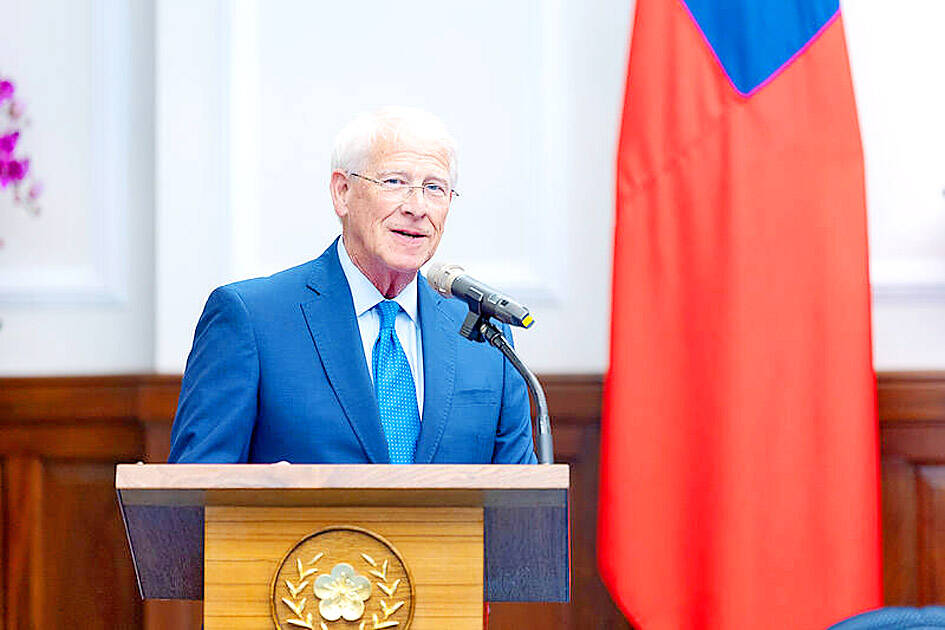
Photo: screen grab from the Presidential Office’s Flickr page
Wicker’s post linked to an article published by Bloomberg that said that the two opposition parties’ move was “potentially jeopardizing the purchases of billions of dollars of US weapons aimed at deterring the threat of invasion by China.”
Wicker in September last year said that Taiwan’s security is key to US interests, as the nation is home to critical semiconductor manufacturing and its fall could precipitate the collapse of US positions across the Indo-Pacific region.
Daniel Sullivan, a Republican, wrote on social media that “shortchanging Taiwan’s defense to kowtow to the Chinese Communist Party (CCP) is playing with fire.”
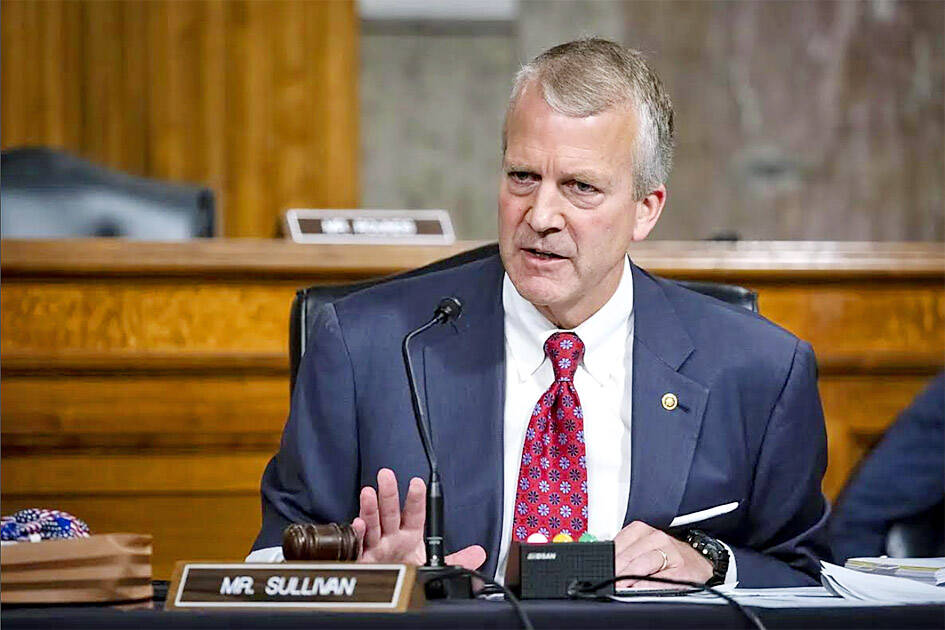
Photo: Bloomberg
“Taiwan’s legislature adjourned last week without passing the budget necessary for Taiwan to defend itself. Meantime, the leadership of the opposition party responsible for this, the KMT [Chinese Nationalist Party], is in Beijing meeting with the CCP and planning bigger engagements. It doesn’t take a genius to figure out what’s going on here,” Sullivan said.
In Taipei, Democratic Progressive Party Legislator Wang Ting-yu (王定宇) said the remarks from lawmakers of Taiwan’s most important ally highlighted the “extreme danger” the KMT and Taiwan People’s Party (TPP) had put the nation in.
Citing Wicker’s post, he said that the KMT’s refusal to pass the special defense budget amid China’s rising military threat to Taiwan sent the wrong signal to the world.
“The KMT is doing everything in its power to delay Taiwan’s defense budget and efforts to improve [the nation’s] defensive capabilities, while throwing itself into China’s arms,” Wang said. “By its complicity in spreading China’s narrative of delegitimizing ... Taiwan’s sovereignty, [the KMT] is facilitating the interiorization of Taiwan and the loss of its international support, as Hong Kong once did,” he said.
Separately yesterday, the KMT issued a response saying it “deeply regrets” that Wicker had “made comments on Taiwan without being sufficiently informed.”
The KMT has always supported national defense and its budget votes are aimed at de-escalating cross-strait tensions to pave the way for US President Donald Trump’s expected visit to China in April, it said.
The government’s military spending proposals neglected to furnish service members with adequate salaries, the party said, adding that it is not reasonable for Taiwanese generals to be paid less than non-commissioned officers in the US armed forces.
Additional reporting by Lin Hsin-Han

SILENCING CRITICS: In addition to blocking Taiwan, China aimed to prevent rights activists from speaking out against authoritarian states, a Cabinet department said The Ministry of Foreign Affairs (MOFA) yesterday condemned transnational repression by Beijing after RightsCon, a major digital human rights conference scheduled to be held in Zambia this week, was abruptly canceled due to Chinese pressure over Taiwanese participation. This year’s RightsCon, the world’s largest conference discussing issues “at the intersection of human rights and technology,” was scheduled to take place from tomorrow to Friday in Lusaka, and expected to draw 2,600 in-person attendees from 150 countries, along with 1,100 online participants. However, organizers were forced to cancel the event due to behind-the-scenes pressure from China, the ministry said, expressing its “strongest condemnation”
Taiwan’s economy grew far faster than expected in the first quarter, as booming demand for artificial intelligence (AI) applications drove a surge in exports, spilling over into investment and consumption, the Directorate-General of Budget, Accounting and Statistics (DGBAS) said yesterday. GDP growth was 13.69 percent year-on-year during the January-to-March period, beating the DGBAS’ February forecast by 2.23 percentage points and marking the most robust growth in nearly four decades, DGBAS senior official Chiang Hsin-yi (江心怡) told a news conference in Taipei. The result was powered by exports, which remain the backbone of Taiwan’s economy, Chiang said. Outbound shipments jumped 51.12 percent year-on-year to
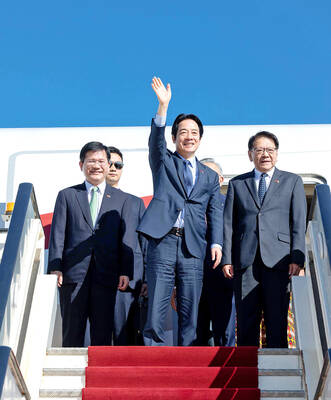
DELAYED BUT DETERMINED: The president’s visit highlights Taiwan’s right to international engagement amid regional pressure from China President Willaim Lai (賴清德) yesterday arrived in Eswatini, more than a week after his planned visit to Taiwan’s sole African ally was suspended because of revoked overflight permits. “The visit, originally scheduled for April 22, was postponed due to unforeseen external factors,” Lai wrote on social media. “After several days of careful arrangements by our diplomatic and national security teams, we successfully arrived today.” Lai said he looked forward to further deepening Taiwan-Eswatini relations through closer cooperation in the economy, agriculture, culture and education, as well as advancing the nation’s international partnerships. The president was initially scheduled to arrive in time to celebrate
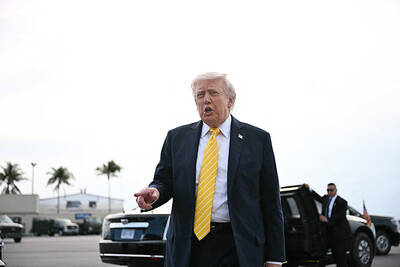
Iran’s Islamic Revolutionary Guard Corp (IRGC) yesterday said the US faced a choice between an “impossible” military operation or a “bad deal” with Tehran, after US President Donald Trump disparaged Iran’s latest peace proposal. Negotiations between the two countries have been deadlocked since a ceasefire came into effect on April 8, with only one round of direct peace talks held so far. Iran’s Tasnim and Fars news agencies reported that Tehran had submitted a 14-point proposal to mediator Pakistan, but Trump was quick to cast doubt on it. “I will soon be reviewing the plan that Iran has just sent to us, but


 RSS
RSS